
News Update - March 2022
FCC Announces Tentative Agenda For April 21st Open Meeting
March 31, 2022 – Federal Communications Commission Chairwoman Jessica Rosenworcel has announced the following tentative agenda for the FCC’s next open meeting, scheduled for Thursday, April 21, 2022:
Improving Receiver Performance – The Commission will consider a Notice of Inquiry to
promote more efficient use of spectrum through improved receiver interference immunity
performance, thereby facilitating the introduction of new and innovative services. (ET Docket
No. 22-137)
Wireless Emergency Alerts – The Commission will consider a Further Notice of Proposed
Rulemaking seeking comment on proposals to strengthen the effectiveness of Wireless
Emergency Alerts, including through public reporting on the reliability, speed, and accuracy of
these alerts. (PS Docket Nos. 15-91, 15-94)
Restricted Adjudicatory Matter – The Commission will consider a restricted adjudicatory
matter.
Restricted Adjudicatory Matter – The Commission will consider a restricted adjudicatory
matter.
Enforcement Bureau Action – The Commission will consider an enforcement action.
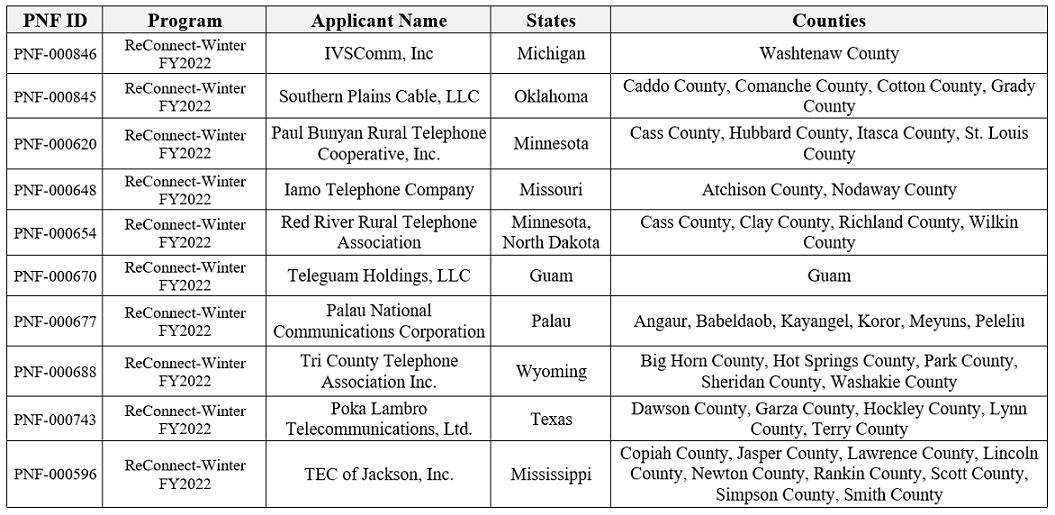
RUS Publishes 10 New ReConnect Program Funding Applications
March 30, 2022 – The U.S. Department of Agriculture’s Rural Utilities Service has published 10 new ReConnect Program applications requesting funding in Guam, Michigan, Minnesota, Mississippi, Missouri, North Dakota, Oklahoma, Palau, Texas, and Wyoming. The ReConnect Loan and Grant Program provides loans, grants, and loan-grant combinations to fund the costs of construction, improvement, or acquisition of facilities and equipment needed to provide broadband service in rural areas. Existing broadband providers can review the applications to determine whether they are already providing fixed, terrestrial broadband service to any of the geographic areas included in any of the applications’ proposed funded service areas. Existing broadband providers have 45 calendar days to respond to and challenge a ReConnect Program application. A public notice filings portal user guide containing instructions for responding to an application is available online from RUS.
Rural Digital Opportunity Fund: FCC Ready To Authorize $313 Million In RDOF Support For 557 Winning Bids

March 25, 2022 – The FCC’s Rural Broadband Auctions Task Force, Wireline Competition Bureau, and Office of Economics and Analytics have announced they are ready to authorize support for 557 Rural Digital Opportunity Fund (RDOF) Phase I auction winning bids.
This is the eighth set of RDOF winning bids that are ready to be authorized – $313 million in ten-year RDOF support “to fund new broadband deployments in 19 states bringing service to over 130,000 locations.” According to the FCC’s News Release, so far, the RDOF program “has provided over $5 billion in funding for new deployments in 47 states to bring broadband to over 2.8 million locations.” A list showing each winning bid ready to be authorized, the corresponding long-form applicant, each winning bid’s total amount of 10-year support, and other details is available as Attachment A to the Public Notice.
For this eighth set of ready-to-be-authorized RDOF winning bids, FCC staff reviewed the long-form applications associated with the winning bids, and determined they met all legal, financial, and technical requirements. To be authorized to receive the listed support amounts, however, each RDOF winning bidder must submit acceptable irrevocable stand-by letters of credit and Bankruptcy Code opinion letters for each state where they have winning bids that are ready to be authorized prior to 6:00 p.m. ET on April 8, 2022.
The FCC will continue to review RDOF long-form applications on a rolling basis, and will announce other approvals of long-forms in future public notices. Additional information on broadband providers set to receive RDOF Phase I auction support and RDOF funding amounts by state are available on the FCC’s RDOF auction website: https://www.fcc.gov/auction/904.
FCC Adds Three Companies To List Of Prohibited Communications Equipment & Services: AO Kaspersky Lab, China Mobile International USA Inc., & China Telecom (Americas) Corp.

March 25, 2022 – The FCC’s Public Safety and Homeland Security Bureau has announced the addition of the following three companies to its list of “covered” communications equipment and services:
AO Kaspersky Lab – Information security products, solutions, and services supplied, directly or indirectly, by AO Kaspersky Lab or any of its predecessors, successors, parents, subsidiaries, or affiliates.
China Mobile International USA Inc. – International telecommunications services provided by China Mobile International USA Inc. subject to section 214 of the Communications Act of 1934.
China Telecom (Americas) Corp. – Telecommunications services provided by China Telecom (Americas) Corp. subject to section 214 of the Communications Act of 1934.
“Covered” communications equipment or services are prohibited from U.S. communications networks because they have been “deemed to pose an unacceptable risk to the national security of the U.S. or the security and safety of U.S. persons.” The list should be read to include the named companies and their subsidiaries and affiliates. Under the Secure and Trusted Communications Networks Act, the FCC must publish and maintain a list of covered communications equipment and services. The initial list was released in March 2021, and this addition of three companies is the first update to the list. The up-to-date Covered List is available on the Public Safety and Homeland Security Bureau’s supply chain website.
FCC Denies RHMD, LLC’s ETC Waiver Petition – RHMD, LLC Will Lose $18.3 Million In Rural Digital Opportunity Fund Support In Georgia

March 25, 2022 – The FCC’s Wireline Competition Bureau has issued an Order denying a waiver request submitted by RHMD, LLC that sought a waiver of the FCC’s June 7, 2021 deadline requiring each Rural Digital Opportunity Fund (RDOF) Phase I auction long-form applicant to demonstrate that it has been designated as an eligible telecommunications carrier (ETC) in each of the geographic areas for which it seeks to be authorized for RDOF support. The Bureau denied the waiver petition after determining RHMD “failed to engage in good faith efforts to pursue and obtain the required ETC designation and deny its petition.”
RHMD won $18,303,843.20 in 10-year RDOF support to deploy broadband service to 6,943 locations in Georgia. As a result of the decision to deny the ETC waiver request, RHMD is in default on its winning bids in Georgia. The FCC will eventually release a public notice officially announcing the default and loss of $18.3 million in RDOF support.
FCC Extends Covid Waiver Of Lifeline Program Rules Through June 30th
March 25, 2022 – The FCC’s Wireline Competition Bureau has extended prior waivers of certain Lifeline program rules governing documentation requirements for subscribers residing in rural areas on Tribal lands, reverification, recertification, general de-enrollment, and income documentation through June 30, 2022. The prior waivers were set to expire on Marcch 31, 2021. Pursuant to the Bureau’s Order, the following Lifeline program rules are waived through June 30, 2022: 54.405(e)(1); 54.405(e)(4); 54.410(a); 54.410(b)(1)(i)(B); and 54.410(f).
FCC Cancels Pacific Networks Corp. & ComNet (USA) LLC Authority To Provide Communications Services In U.S.
March 23, 2022 – The Federal Communications Commission has revoked the domestic authority of Pacific Networks Corp. and its wholly-owned subsidiary, ComNet (USA) LLC, and revoked and terminated their international authority. In the Order on Revocation and Termination, the FCC explains that the companies “are U.S. subsidiaries of a Chinese state-owned entity, and therefore they are subject to exploitation, influence, and control by the Chinese government and are highly likely to be forced to comply with Chinese government requests without sufficient legal procedures subject to independent judicial oversight.” Among other things, the FCC found the companies’ “ownership and control by the Chinese government raise significant national security and law enforcement risks by providing opportunities for the Companies, their parent entities and affiliates, and the Chinese government to access, monitor, store, and in some cases disrupt and/or misroute U.S. communications, which in turn allow them to engage in espionage and other harmful activities against the United States.” Consequently, Pacific Networks Corp. and ComNet (USA) LLC must discontinue all services provided pursuant to section 214 authority no later than 60 days from the release date of the order.
FCC Extends Eligible Locations Adjustment Process Stakeholder Registration Deadline To May 13th
March 22, 2022 – The FCC’s Wireline Competition Bureau has extended the deadline for individuals, non-governmental entities, and governmental entities to initiate the registration process for participating in the Eligible Locations Adjustment Process (ELAP) as a stakeholder to Friday, May 13, 2022, 11:59 PM ET. Those entities registered as stakeholders will be able to file challenges to the accuracy and completeness of the location information submitted by ELAP participants. According to the Public Notice, the Wireline Competition Bureau has accepted the filings of 26 different carriers in 23 states as meeting the minimum prima facie evidentiary standards for proceeding with the ELAP. This amounts to 36 different combinations of ELAP participants and states. The ELAP participants “seek reductions of their defined deployment obligations ranging from a 1% to 60% reduction.” The Bureau believes ELAP stakeholder challenges “will help mitigate the risk that adjustments to [the 26 ELAP carriers’] deployment obligations will result in previously funded, qualifying locations remaining unserved.”
Mergers & Acquisitions: Mesa Telecoms Investments Acquiring Dobson Fiber And Wholly-Owned Subsidiaries

March 21, 2022 – The FCC’s Wireline Competition Bureau is seeking comment on a Section 214 Application filed by Dobson CC Limited Partnership (DLP – the Transferor) and Mesa Telecoms Investments, LLC (the Transferee). The application requests FCC consent for the indirect transfer of control of Dobson Technologies, Inc. d/b/a Dobson Fiber and its wholly-owned subsidiaries, from DLP to Mesa Telecoms. Comments on the Section 214 application are due on or before April 4, 2022. Reply comments are due April 11, 2022.
In February 2022, DLP and Mesa Telecoms entered into a stock purchase agreement and related agreements whereby Mesa Telecoms will acquire 100% of the direct ownership interests in Dobson Fiber. The applicants “fully anticipate that Dobson Fiber’s existing management team will largely remain in place, and coupled with the financial resources and management and operational expertise of Transferee, will bring substantial benefits to customers.”
Dobson Fiber, based in Oklahoma, is a privately-owned company that holds ownership of various companies operating as ILECs and CLECs in Oklahoma, Arkansas, and Texas. Dobson Fiber’s wholly owned subsidiaries include Dobson Telephone Company, Inc., Dobson Technologies – Transport and Telecom Solutions, LLC, Lavaca Telephone Company, Inc., Pinnacle Telecom L.L.C., and Vantage Telecom, LLC. Dobson Telephone Company receives Alternative Connect America Cost Model support, while Lavaca receives cost-based CAF-BLS support. Through its subsidiaries, Dobson Fiber owns and operates a 4,900-mile fiber optic network in Arkansas, Oklahoma and Texas, and provides connectivity services to businesses, carriers and other wholesale providers. DLP will continue to participate in the ownership of Dobson Fiber through an indirect minority interest in Mesa Telecoms.
Mesa Telecoms is a newly formed Delaware limited liability company created as a holding entity for the transaction, and is an indirect subsidiary of Mesa Telecoms Holdings, L.P., a Delaware limited partnership. Ultimately, Mesa Telecoms is an indirect subsidiary of iCON Infrastructure Partners V, L.P. and iCON Infrastructure Partners V-B, L.P, which make up the iCON V Fund, “an infrastructure investment fund established in March 2020, focused on acquiring and managing a diversified range of infrastructure assets in Europe and North America.”
FCC Releases Auction 108 Procedures – Bidding To Commence On July 29, 2022

March 21, 2022 – The FCC has released a Public Notice announcing the procedures to be used for Auction 108, which will make available approximately 8,000 new flexible-use, county-based overlay licenses in the 2.5 GHz band (2496–2690 MHz). The licenses cover areas with unassigned 2.5 GHz spectrum, which are mostly rural parts of the U.S. The Auction 108 Short-Form Application (FCC Form 175) filing window opens on April 27, 2022, at 12:00 p.m. ET and closes on May 10, 2022, at 6:00 p.m. ET. Upfront payments (via wire transfer) are due on June 23, 2022, at 6:00 p.m. ET. Other key details of Auction 108 include the following:
Start Date: Bidding in Auction 108 is scheduled to being on July 29, 2022.
Auction Type: Auction 108 will be conducted using an ascending clock auction with a supply of one in each category of frequency-specific channel blocks.
Auction 108 Bidding Tutorial: The Auction 108 bidding tutorial will be available online no later than July 13, 2022.
Mock Auction: The Auction 108 mock auction is scheduled for July 26-27, 2022.
Licenses: Auction 108 will offer geographic overlay licenses for unassigned spectrum in the 2.5 GHz (2496–2690 MHz) band.
Authorized Operations: The FCC has authorized both terrestrial fixed and mobile operations in the 2.5 GHz band.
Total Spectrum: 117.5 megahertz
Spectrum Blocks: Auction 108 will offer up to three blocks of spectrum – 49.5 megahertz, 50.5 megahertz, and 17.5 megahertz blocks, respectively – licensed on a county basis.
Channel Blocks: The first channel block will include channels A1–A3, B1–B3, C1–C3 (49.5 megahertz); the second channel block will include channels D1–D3, the J channels, and channels A4, B4, C4, D4, E4, F4 and G4 (50.5 megahertz); and the third channel block will include channels G1–G3 and the relevant K channels (16.5 megahertz of contiguous spectrum and 1 megahertz of the K channels associated with the G channel group, for a total of 17.5 megahertz).
License Term: New overlay licenses in the EBS portion of the 2.5 GHz band will be issued for 10-year, renewable license terms.
Small Business Bidding Credit: A bidder that qualifies as a “small business” – i.e., one with attributed average annual gross revenues that do not exceed $55 million for the preceding five years – to is eligible to receive a 15% discount on its overall payment. A bidder that qualifies as a “very small business” – i.e., one with attributed average annual gross revenues that do not exceed $20 million for the preceding five years – is eligible to receive a 25% discount on its overall payment.
Rural Service Provider Bidding Credit: An eligible applicant may request a 15% discount on its overall payment using a rural service provider bidding credit. To be eligible for a rural service provider bidding credit, an applicant must: (1) be a service provider that is in the business of providing commercial communications services and, together with its controlling interests, affiliates, and the affiliates of its controlling interests, has fewer than 250,000 combined wireless, wireline, broadband, and cable subscribers; and (2) serve predominantly rural areas. Rural areas are defined as counties with a population density of 100 or fewer persons per square mile.
Caps On Bidding Credits: There is a $25 million cap on the total bidding credit discount that may be awarded to an eligible small business, and a $10 million cap on the total bidding credit discount that may be awarded to an eligible rural service provider. Additionally, no winning designated entity bidder may receive more than $10 million in bidding credit discounts in total for licenses won in counties located within any partial economic area (PEA) with a population of 500,000 or less.
Tribal Lands Bidding Credit: A winning bidder that intends to use its licenses to deploy facilities and provide services to qualifying Tribal lands that have a wireline penetration rate equal to or below 85% is eligible to receive a Tribal lands bidding credit. A winning bidder must apply for a Tribal lands bidding credit after the auction when it files its FCC Form 601 post auction application. For additional information on the Tribal lands bidding credit, including how the amount of the credit is calculated, applicants should review the FCC’s rulemaking proceeding regarding Tribal lands bidding credits and related public notices.
Auction 108: FCC Releases Mapping Tool Showing High-Level View Of 2.5 GHz Spectrum Availability
March 21, 2022 – The FCC’s Wireless Telecommunications Bureau has released an Auction 108 mapping tool that can be used to help assess whether and to what extent there is unassigned 2.5 GHz spectrum available in any U.S. county. Auction 108 will make available approximately 8,000 new flexible-use, county-based overlay licenses in the 2.5 GHz band (2496–2690 MHz). The licenses cover areas with unassigned 2.5 GHz spectrum, which are mostly rural parts of the U.S. Bidding in Auction 108 is scheduled to being on July 29, 2022.
The Auction 108 mapping tool provides a high-level view of spectrum availability, and can be used to help assess whether and to what extent there is unassigned 2.5 GHz spectrum available in any U.S. county and county equivalents. However, the maps and data displayed in the tool are not an official representation of license or application status. Potential Auction 108 applicants are encouraged to consult the FCC’s Universal Licensing System (ULS) to confirm the status of any license or application for particular areas. The mapping tool, as well as instructions for its use, can be found under the Education tab on the Auction 108 website at www.fcc.gov/auction/108.
Rural Digital Opportunity Fund: FCC Authorizes RDOF Support For 5,223 Winning Bids (7th RDOF Authorization)
March 15, 2022 – The FCC’s Wireline Competition Bureau has announced it has authorized Rural Digital Opportunity Fund (RDOF) Phase I auction support for 5,223 winning bids. This is the seventh Public Notice authorizing RDOF support. A list of the authorized winning bids is available as Attachment A to the Bureau’s Public Notice. Many of the authorized winning bids belong to Bright House Networks, Charter, and Time Warner Cable. The authorizations were granted after the Bureau reviewed long-form application information for each authorized winning bidder, including letters of credit and Bankruptcy Code opinion letters, and concluded the submissions were acceptable. Consequently, the Bureau has directed and authorized the Universal Service Administrative Company to obligate and disburse Universal Service Fund support to each winning bidder. Support will be disbursed in 120 monthly payments, beginning at the end of March 2022. The first broadband deployment milestone that must be met by the RDOF support recipients authorized by the Public Notice is 40% of locations in a state by December 31, 2025.
Second Quarter 2022 USF Contribution Factor: 23.8 Percent
March 14, 2022 – The Federal Communications Commission’s Office of Managing Director has announced that the proposed universal service fund (USF) contribution factor for the second quarter of 2022 will be will be 23.8 percent. This is a slight decrease from the 1Q 2022 contribution factor of 25.2 percent. To provide more perspective, the USF contribution factors used for the four quarters of 2021 were all higher:
For the second quarter of 2022, the Universal Service Administrative Company (USAC) projects $8.751403 billion in total interstate and international end-user telecommunications revenues will be collected. (The 1Q 2022 total was $9.235846 billion.)
USAC estimates that $1.664020 billion is needed to cover the total demand and expenses for all Federal universal service support mechanisms (revenue requirement) in the second quarter of 2022. (The 1Q 2022 demand was $1.84091 billion.) Total second quarter 2022 demand includes projected program support, administrative expenses, and true-ups and adjustments, and breaks out as follows:
E-Rate Schools & Libraries: $563.22 million
Rural Health Care: ($7.62) million
High-Cost: $880.14 million
Lifeline: $220.47 million
Connected Care: $7.81 million
If the FCC takes no action on the proposed USF contribution factor within 14 days, it will be declared approved. Historical information on quarterly universal service fund contribution factors is available online from the FCC.
FCC Announces 2022 Funding Cap For E-Rate & Rural Health Care Programs
March 14, 2022 – The FCC’s Wireline Competition Bureau has announced the 2022 funding caps for the E-Rate and Rural Health Care programs. There is a 4.2% inflation-adjusted increase for each program.
E-Rate Program: The E-Rate funding cap for 2022 is $4,456,460,992.
Rural Health Care Program: The Rural Health Care funding cap for 2022 is $637,721,108. The internal cap for upfront payments and multi-year commitments in the Healthcare Connect Fund program is $161,022,761.
FCC Office Of Inspector General Issues Advisory On Improper And Abusive Enrollment Practices By Providers Of Lifeline, Emergency Broadband Benefit & Affordable Connectivity Program Services
March 11, 2022 – The FCC’s Office of Inspector General (OIG) has issued an advisory on improper and abusive enrollment practices by some providers of Lifeline, Emergency Broadband Benefit (EBB) and Affordable Connectivity Program (ACP) services. Specifically, the OIG has found that certain improper and abusive enrollment practices are part of some providers’ online enrollment processes:
These providers impermissibly tie enrollment in these programs by coercing and deceiving applicants for Lifeline service into enrolling in unwanted ACP/EBB service or into transferring their ACP/EBB service away from their preferred provider. Deceptive enrollment practices violate program rules including informed consent requirements and threaten program integrity by causing wasteful government outlays for undesired services. Such practices may also violate federal fraud statutes.
Providers of Lifeline, EBB, and ACP services are once again reminded that such deceptive practices violate the FCC’s rules. Any consumers that have experienced such improper and abusive enrollment practices should contact the FCC’s OIG using the OIG Hotline at (202) 418-0473 or Hotline@fcc.gov.
Rural Digital Opportunity Fund: FCC Ready To Authorize $640 Million In RDOF Support For 952 Winning Bids
March 10, 2022 – The FCC’s Rural Broadband Auctions Task Force, Wireline Competition Bureau, and Office of Economics and Analytics have announced they are ready to authorize support for 952 Rural Digital Opportunity Fund (RDOF) Phase I auction winning bids.
This is the seventh set of RDOF winning bids that are ready to be authorized – $640 million in ten-year RDOF support for “new broadband deployments in 26 states bringing service to nearly 250,000 locations.” According to the FCC’s News Release, so far, the RDOF program “has provided $4.7 billion in funding to nearly 300 carriers for new deployments in 47 states to bring broadband to almost 2.7 million locations.”
A list showing each winning bid ready to be authorized, the corresponding long-form applicant, each winning bid’s total amount of 10-year support, and other details is available as Attachment A to the Public Notice. Attachment B contains a list of default bids. These are bids that RDOF winners or their assignees have notified the FCC that they do not intend to pursue. RDOF support will not be authorized for those bids, and the winning bidders and assignees are in default and may be subject to forfeiture penalties.
For this seventh set of ready-to-be-authorized RDOF winning bids, FCC staff reviewed the long-form applications associated with the winning bids, and determined they met all legal, financial, and technical requirements. To be authorized to receive the listed support amounts, however, each RDOF winning bidder must submit acceptable irrevocable stand-by letters of credit and Bankruptcy Code opinion letters for each state where they have winning bids that are ready to be authorized prior to 6:00 p.m. ET on March 24, 2022. The FCC will continue to review RDOF long-form applications on a rolling basis, and will announce other approvals of long-forms in future public notices. Additional information on broadband service providers set to receive RDOF Phase I auction support and RDOF funding amounts by state are available from the FCC’s RDOF auction website: https://www.fcc.gov/auction/904.
FCC Sets Final Agenda For March 16th Open Meeting
March 9, 2022 – The Federal Communications Commission has released the final agenda for its open meeting on March 16, 2022. The meeting is set to begin at 10:30 a.m., and will be streaming live at www.fcc.gov/live and on the FCC’s YouTube channel.
Preventing Digital Discrimination – The Commission will consider a Notice of Inquiry that would commence a proceeding to prevent and eliminate digital discrimination and ensure that all people of the United States benefit from equal access to broadband internet access service, consistent with Congress’s direction in the Infrastructure Investment and Jobs Act. (GN Docket No. 22-69)
Resolving Pole Replacement Disputes – The Commission will consider a Second Further Notice of Proposed Rulemaking that would seek comment on questions concerning the allocation of pole replacement costs between utilities and attachers and ways to expedite the resolution of pole replacement disputes. (WC Docket No. 17-84)
Selecting Final Round of Applicants for Connected Care Pilot Program – The Commission will consider a Public Notice announcing the fourth and final round of selections for the Commission’s Connected Care Pilot Program to provide Universal Service Fund support for health care providers making connected care services available directly to patients. (WC Docket No. 18-213)
Restricted Adjudicatory Matter – The Commission will consider a restricted adjudicatory matter.
National Security Matter – The Commission will consider a national security matter.
FCC Releases Data Specification Guidance For The Upcoming Broadband Data Collection

March 4, 2022 – The FCC’s Broadband Data Task Force and Office of Economics and Analytics have published data specifications for the FCC’s new Broadband Data Collection (BDC). The information provides guidance for fixed and mobile broadband providers on how to prepare and format subscription, availability, and other broadband deployment data for submission into the FCC’s BDC system.
In February 2022, the FCC announced it will begin accepting broadband availability data filed pursuant to the new BDC rules and procedures on June 30, 2022. All facilities-based providers of fixed and mobile broadband Internet access service must submit broadband availability data as of June 30, 2022, to the BDC online filing system no later than September 1, 2022. The FCC’s new BDC program is an improved effort to collect geospatial broadband deployment data from broadband providers, as well as crowdsourced data to challenge the accuracy of the submitted data. Additional information on the BDC data specifications are available on the FCC’s BDC website.
USAC Files Second Quarter 2022 USF Contribution Base Data: $8.751 Billion

March 2, 2022 – The Universal Service Administrative Company (USAC) has filed projected universal service fund (USF) contribution base data which will be used to determine the USF contribution factor for the second quarter of calendar year 2022.
USAC has determined that the total projected collected interstate and international end-user telecommunications revenue base for the second quarter of 2022 is $8,751,403,396.
To provide a comparison, the total USF contribution base amounts for the past nine quarters were as follows:
First Quarter 2022: $9,235,845,776
Fourth Quarter 2021: $9,517,295,012
Third Quarter 2021: $9,665,944,070
Second Quarter 2021: $9,905,669,690
First Quarter 2021: $10,068,712,553
Fourth Quarter 2020: $10,428,377,862
Third Quarter 2020: $10,219,123,520
Second Quarter 2020: $10,865,131,593
First Quarter 2020: $11,129,976,956
USAC’s estimated revenue base for the second quarter of 2022 was derived from projected collected revenue for April to June 2022 reported by telecommunications service providers using FCC Form 499-Q submitted in February 2022 – 4,711 reporting providers, of which 3,012 are USF contributors and 1,699 are non-contributing de minimis service providers. As of February 18, 2022, USAC has yet to receive information from 176 non-de minimis telecommunications service providers that had previously submitted Form 499-Q revenue information to USAC.
After the Federal Communications Commission (FCC) approves the total USF contribution base, the quarterly funding requirements for USF support mechanisms, and projected USF administrative costs, the FCC will establish a USF contribution factor for the second quarter of 2022. The new contribution factor will be announced by an FCC Public Notice. USAC will then bill USF contributors on a monthly basis for their individual obligations based on the approved contribution factor.
GAO Denies LightBox Challenge Of FCC Broadband Mapping Fabric Contract Award

March 1, 2022 – The U.S. Government Accountability Office has denied a bid protest filed by LightBox Parent, LP challenging the FCC’s decision to award a $44.9 million contract to CostQuest Associates Inc. to create a Broadband Serviceable Location Fabric. After LightBox filed its challenge, the FCC was required to halt its work on the Fabric and give the GAO 100 days to issue a decision on the protest. Now that GAO has issued a denial, the FCC can restart its work with CostQuest on the further development and implementation of the Fabric.
The FCC released a Request for Proposals (RFP) to create the Broadband Serviceable Location Fabric on June 1, 2021, with responses due July 1, 2021. However, a pre-award protest was filed with Government Accountability Office following the RFP response deadline, which forced the FCC to issue a revised RFP on August 13, 2021. Revised proposals were due August 26, 2021. The $44.9 million contract to develop the Fabric was then ultimately awarded on November 9, 2021, to CostQuest. LightBox, who also submitted a proposal in response to the Fabric RFP, filed its bid protest challenging the FCC’s decision pursuant to the Federal Acquisition Regulation process on November 29, 2021.
The “Broadband Serviceable Location Fabric” will be a common dataset of all locations in the U.S. where fixed broadband internet access service can be installed, and is a key component of the FCC’s new Broadband Data Collection program. Broadband service providers will provide the FCC with granular and detailed coverage data which will be layered on top of the Fabric, thereby giving the FCC an accurate picture of broadband coverage in the U.S. and creating a more accurate national broadband map.
The FCC recently announced that it will begin accepting broadband availability data filed pursuant to the FCC’s new Broadband Data Collection (BDC) rules and procedures on June 30, 2022. All facilities-based providers of fixed and mobile broadband Internet access service must submit broadband availability data as of June 30, 2022, to the BDC online filing system no later than September 1, 2022.


