Kansas Broadband News


KCC Staff Issues Report & Recommendation On Adjustments To RLEC Intrastate Access Rates For 2027 & KUSF Support
October 8, 2026 – The Kansas Corporation Commission’s (KCC or Commission) telecommunications Staff has issued a Report & Recommendation (R&R) in Docket No. 26-GIMT-0461-GIT, which addresses the intrastate switched access rate, revenue, and Kansas Universal Service Fund (KUSF) support adjustments for Rural Local Exchange Carriers (RLECs) consistent with K.S.A. 66-2005(c).
To compile the R&R, Staff examined each RLEC’s interstate and intrastate originating Local Switching, Transport, and Information Surcharge rates as of July 1, 2026, and the corresponding minutes of use for each access service for the 12 months prior. Staff also reviewed the calculated difference between each RLEC’s July 1, 2026, interstate and intrastate access revenues and any corresponding adjustment to its annual KUSF support. Additionally, Staff reviewed tariffed rates for RLECs that participate in the NECA tariff and access pool, and rates for RLECs that have their own interstate tariffs and intrastate tariffs.
Staff concluded that in total, RLECs will experience a net intrastate originating access revenue decrease of $30,470, comprised of the following: a decrease of $26,466 in Local Switching revenue; a $3,757 decrease in Transport revenue; and a $248 decrease in Information Surcharge revenue. The $30,470 decrease in the originating intrastate access revenue includes $8,939 for five RLECs that do not currently receive KUSF support. Excluding those five, RLECs’ originating access revenue would decrease by $21,531. A total of 19 RLEC’s intrastate originating access revenue will decrease, which results in an equal increase their annual KUSF support subject to any pro-rata reduction under KS.A. 66-2008(e)(3). One will see a decrease to its KUSF support. Ultimately, the KCC telecom Staff recommends the following:
The Commission issue an Order adopting the July 1, 2026, interstate originating access rates shown on page 3 of Exhibit 1 to this R&R as the July 1, 2027, intrastate originating access rates for the RLECs;
The Commission adopt the calculated intrastate access revenue and the corresponding KUSF support adjustments identified in Exhibit 1 to this R&R for each RLEC, effective July 1, 2027;
The Commission adopt an aggregate increase of $21,531 to RLECs’ annual KUSF support, prior to any pro-rata reduction mandated by KS.A. 66-2008(e)(3), effective July 1, 2027; and
The Commission direct affected RLECs to file revised intrastate access tariffs reflecting the access rates adopted in this Docket by May 30, 2027.
Home Telephone Company Revises General Exchange Tariff To Remove Services No Longer Provided
October 7, 2026 – Home Telephone Company, Inc. d/b/a Home Communications, Inc. has filed revisions to its General Exchange Tariff with the Kansas Corporation Commission (KCC). Home Telephone’s revisions remove services from the tariff that the company no longer provides. Home Telephone states that the tariff revisions have no effect on revenue, and no customers are affected. The KCC Docket Number for the proceeding is 27-HOMT-0178-TAR.
Brightspeed Fiber Services, LLC Files Competitive Access Provider Services Tariff
October 1, 2026 – Brightspeed Fiber Services, LLC has filed a Competitive Access Provider Services Tariff with the Kansas Corporation Commission (KCC). Brightspeed Fiber Services has requested the tariff take effect on October 30, 2026. The KCC Docket Number for the proceeding is 27-BSFT-0170-TAR. Brightspeed Fiber Services was granted a Certificate of Convenience and Authority to provide facilities-based and resold local exchange and exchange access telecommunications (CLEC) services in the incumbent service territories of AT&T Kansas and Brightspeed in docket 26-BSFT-0182-COC on June 9, 2026.
Brightspeed Fiber Connection, LLC Files Competitive Access Provider Services Tariff
October 1, 2026 – Brightspeed Fiber Connection, LLC has filed a Competitive Access Provider Services Tariff with the Kansas Corporation Commission (KCC). Brightspeed Fiber Connection has requested the tariff take effect on October 30, 2026. The KCC Docket Number for the proceeding is 27-BFCT-0169-TAR. Brightspeed Fiber Connection was granted a Certificate of Convenience and Authority to provide facilities-based and resold local exchange and exchange access telecommunications (CLEC) services in the incumbent service territories of AT&T Kansas and Brightspeed in docket 27-BSFT-0091-COC on September 22, 2026.
Kansas Corporation Commission Telecom Dockets Opened In October 2026
27-BFCT-0169-TAR – Brightspeed Fiber Connection, LLC Filing Competitive Access Provider Services Tariff No. 1.
27-BSFT-0170-TAR – Brightspeed Fiber Services, LLC Filing Competitive Access Provider Services Tariff No. 1.
27-HOMT-0178-TAR – Home Telephone Company’s General Exchange Tariff.

September 2026
KOBD Agrees To Terminate 3JL Holdings, LLC’s Broadband Acceleration Grants
September 25, 2026 – The Kansas Office of Broadband Development (KOBD) has agreed to release 3JL Holdings, LLC from its obligations under the fifth round of the Kansas Broadband Acceleration Grant (BAG) program. In August, 3JL Holdings sent a formal letter to KOBD requesting a release from its BAG 5.0 grant agreement. As a result of KOBD’s decision, 3JL Holdings’ BAG 5 obligations and award funding have been rescinded and terminated.
3JL Holdings was awarded a total of $2,876,974 for two broadband projects under BAG 5 – $1,494,288 to provide broadband service to 161 homes and businesses in Anderson County, and $1,382,686 to provide broadband service to 124 homes and businesses in Woodson County. The awards were announced by KOBD on December 31, 2025. No BAG 5 funding was requested by or disbursed to 3JL Holdings.
3JL Holdings purportedly requested a rescission of its BAG 5 awards so it could focus its resources toward successfully completing its Broadband Equity, Access and Deployment (BEAD) program projects. The company was awarded a total of $58,556,500 in BEAD funding to serve 3,146 locations in Kansas (cost per location of $18,613). It’s worth noting however, that private entities that applied for BAG 5 funding were required to certify that they have been operating in the state of Kansas for three years or more. 3JL Holdings was formed as a Kansas limited liability company on October 30, 2025 – one day before the BAG 5 application window closed on October 31, 2025 at 5:00 pm.
Brightspeed Companies Of Kansas Revise Tariff Terms Applicable To ISDN-PRI Term Discount Plans For Business Customers
September 23, 2026 – The Brightspeed Companies of Kansas have filed revisions to their General Exchange Service Tariff with the Kansas Corporation Commission (KCC). The Brightspeed Companies of Kansas’ tariff filing “revises the terms and conditions applicable to ISDN-PRI Term Discount Plans for business customers,” with a requested effective date of October 23, 2026. Brightspeed notes that it “is a price-cap regulated carrier and makes this tariff filing in accordance with K.S.A. 2005(q)(1)(F) which declared the services contained herein as price deregulated.” The KCC Docket Number for the proceeding is 27-UTDT-0164-TAR.
KCC Opens Kansas Universal Service Fund Year 31 Docket
September 22, 2026 – The Kansas Corporation Commission (KCC) has issued an order opening a docket to determine the assessment rate for the Thirty-First Year of the Kansas Universal Service Fund (KUSF) (March 2027 – February 2028). The docket also will be used to determine the residential and single line business affordable rates for local exchange services provided by rural telephone companies subject to traditional rate-of-return regulation pursuant to K.S.A. 66-2005(e). The KCC Docket Number for the proceeding is 27-GIMT-0155-GIT. All carriers contributing to, and all carriers receiving distributions from the KUSF parties to the docket. Carriers must file their information in the docket utilizing the forms that are available for download from the KCC’s website. The KCC has adopted the following procedural schedule for this proceeding:
October 19, 2026 – Companies File Data
December 18, 2026 – Staff Files Direct Testimony
December 30, 2026 – Intervenors File Testimony
January 11, 2027 – Staff Files Reply Testimony, If Needed
January 22, 2027 At 9 A.M. Via Zoom – Evidentiary Hearing, If Needed
By January 31, 2027 – Order Adopting Year 31 Rates
Another New Record! Federal USF Contribution Factor For Fourth Quarter Of 2026 – 42%
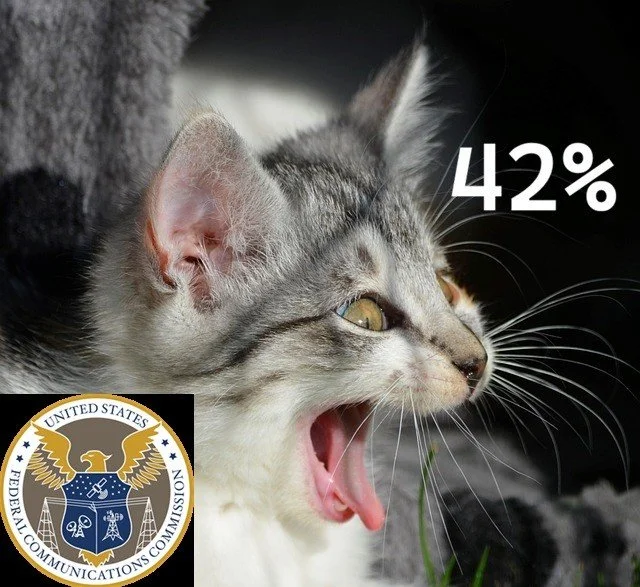
September 14, 2026 – The FCC’s Office of Managing Director (OMD) has announced that the proposed universal service fund (USF) contribution factor for the fourth quarter of 2026 will be 42 percent. If the FCC takes no action on the proposed USF contribution factor within 14 days, it will be declared approved.
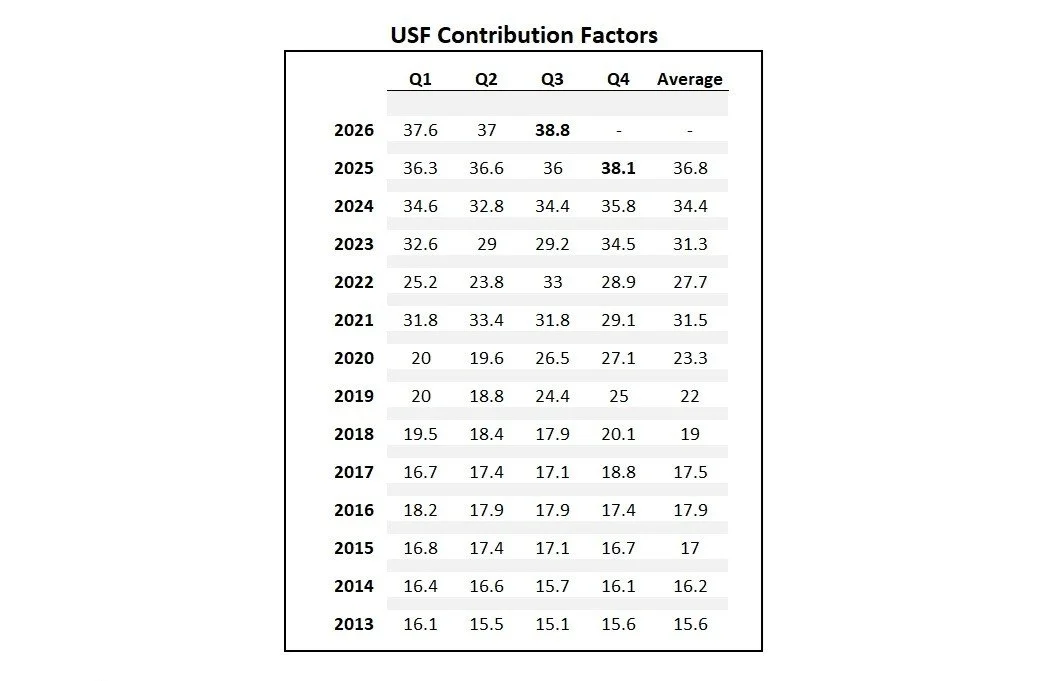
The 42% contribution factor for 4Q 2026 is a new all-time high. The previous record for the highest USF contribution factor was 38.8% which was used last quarter. Also, for the first time ever, the USF contribution factor has broken through 40%. Historical information on quarterly universal service fund contribution factors is available online from the FCC.
For the fourth quarter of 2026, the Universal Service Administrative Company (USAC) projects $6.909925 billion in total interstate and international end-user telecommunications revenues will be collected (3Q was $7.221914; 2Q was $7.553337, and 1Q was $7.604471).
USAC estimates that $2.026190 billion is needed to cover the total demand and expenses for all Federal universal service support mechanisms (revenue requirement) in the fourth quarter of 2026 (3Q was $2.003130, 2Q was $2.022700, and 1Q was $2.060770). Total fourth quarter 2026 demand includes projected program support, administrative expenses, and true-ups and adjustments, which breaks out among the USF support mechanisms as follows:
E-Rate Schools & Libraries: $627.85 million (3Q was $550.73 million, 2Q was $641.92 million, and 1Q was $648.93 million)
Rural Health Care: $132.78 million (3Q was $183.04 million, 2Q was $178.84 million, and 1Q was $181.11 million)
High-Cost: $1.07877 billion (3Q was $1.07906 billion, 2Q was $1.01156 billion, and 1Q was $1.00545 billion)
Lifeline: $186.79 million (3Q was $190.30 million, 2Q was $190.38 million, and 1Q was $225.28 million)
NTIA Announces Supplemental “True Up” Round Of BEAD Program Funding
September 3, 2026 – The National Telecommunications and Information Administration (NTIA) has announced a new round of funding under the Broadband Equity, Access, and Deployment (BEAD) program will be made available. The new round will allow states “to access additional BEAD funding to address locations that may remain unserved due to defaults in other federal and/or state programs, misreporting by providers, and other changes to the Federal Communication Commission’s (FCC) broadband DATA maps since the completion of Final Proposals.” NTIA has released a BEAD Supplemental Deployment Policy Notice which outlines the requirements and processes for the new funding round.
First, NTIA will provide each state with a list of unserved locations not addressed by the state’s Final Proposal (the Supplemental BEAD Eligible Location List). States will have 30 days to review the list and potentially remove locations subject to state or local enforceable funding commitments or other reasons. States must then publish the list of locations and hold a 30-day abbreviated challenge process which will only be used to remove locations from the Supplemental BEAD Eligible Location List. There will be no rebuttal round. States will submit a final location list to NTIA. Thereafter, NTIA will determine the amount of additional funding that should be released to each state to cover broadband deployment to their final Supplemental BEAD Eligible Location Lists. Once NTIA approves a state’s final location list and sets the total funding amount, the state has 90 days to conduct a second benefit of the bargain round. States must then send NTIA a Supplemental Deployment Plan and proposed budget modification. NTIA then has 90 days to approve a state’s Supplemental Deployment Plan.
AT&T Kansas To Discontinue Certain Legacy TDM-Based Voice Services In Portions Of Certain Kansas Wire Centers
September 1, 2026 – AT&T Services, Inc., on behalf of its affiliates, including Southwestern Bell Telephone Company, LLC, d/b/a AT&T Kansas, has filed a Section 63.71 application with the Federal Communications Commission (FCC) for approval to discontinue services. Specifically, AT&T is seeking to discontinue, on or after September 1, 2027, AT&T Residential Local Service and AT&T Business Local Exchange Access Line Service – legacy POTS voice services – provided to approximately 35,000 customers in portions of certain wire centers located in AT&T’s ILEC footprint in 19 states.
Customers affected by the discontinuance will have access to AT&T’s AT&T Phone – Advanced and AT&T Phone for Business – Advanced. AT&T has requested that the FCC conclude that those are adequate replacements for residential and business POTS under the Adequate Replacement Test outlined in the FCC’s 2016 Tech Transitions Order. AT&T notes that the FCC has reached that conclusions in past AT&T discontinuance applications. Additionally, affected customers have other options for voice service, including voice service from cable, fiber, fixed wireless, and satellite technologies. In Kansas, AT&T is seeking discontinuance in certain areas currently served by the following wire centers:
ABILENE (ABLNKSCD), ANTHONY (ANTHKSWS), ARKANSAS CITY (ARCYKSSO), ATCHISON (ATSNKSSF), BUCKLIN (BCKLKSSM), CANEY (CANYKS05), CEDARVALE (CDVAKSPL), CHANUTE (CHNTKSSS), CHAPMAN (CPMNKS04), CHERRYVALE (CHVAKSEM), CHETOPA (CHTPKSBE), DESOTO (DESTKSLU), DOUGLASS (DGLSKSPI), ELDORADO (ELDOKSST), ENTERPRISE (ENTRKSCT), ERIE (ERIEKSCI), EUDORA (EUDRKSKI), FORT SCOTT (FTSCKS01), GREENSBURG (GNBGKSFL), GYPSUM (GYPSKSOW), HAMILTON (HMTNKS01), HERINGTON (HNTNKSNA), HOLCOMB (HLCMKSMA), HOWARD (HWRDKSWA), HUMBOLDT (HMBLKSBR), IOLA (IOLAKSSY), KINSLEY (KNSLKSNI), LEON (LEONKSPI), MCDONALD (MCDDKSKE), MOLINE (MOLNKSMI), NEODESHA (NDSHKS04), NORTON (NRTNKSLI), SCOTT CITY (SCCYKSMA), SEDAN (SEDNKSCH), SMITH CENTER (SMCTKSMA), SOLOMON (SLMNKSOL), ST FRANCIS (STFNKSWA), ST PAUL (STPLKSHI), TONGANOXIE (TNGNKS06), TOPEKA LECOMPTON (TPKAKSLE), TOWANDA (TWNDKSJE), WATERVILLE (WTVLKSST), WICHITA BENTON (WCHTKSBE), WICHITA MULVANE (WCHTKSML), WICHITA ROSEHILL (WCHTKSRH), WICHITA TEMPLE (WCHTKSTE), WICHITA VALLEY CENTER (WCHTKSVC), WICHITA WHITEHALL (WCHTKSNW), WINFIELD (WNFDKSMI), YATES CENTER (YTCTKSST).
AT&T Kansas To Discontinue VoIP Services Provided Over Copper In Portions Of Certain Kansas Wire Centers
September 1, 2026 – AT&T Services, Inc., on behalf of its affiliates, including Southwestern Bell Telephone Company, LLC, d/b/a AT&T Kansas, has filed a Section 63.71 application with the Federal Communications Commission (FCC) for approval to discontinue services. Specifically, AT&T is seeking to discontinue certain VoIP services, called AT&T Phone Service and AT&T Phone for Business, where AT&T can only provide the services over copper, in portions of certain wire centers located in 20 states.
In its application, AT&T states that “discontinuing these outdated services will benefit the public and serve as an important step toward meeting both AT&T’s and the [FCC’s] goals of advancing toward next-generation technologies that customers are requesting.” AT&T explains that customers affected by the discontinuance will have many cost-effective alternative options to choose from as replacements. AT&T further explains that these replacement options include AT&T’s next-generation solutions – AT&T Phone–Advanced and AT&T Phone for Business–Advanced – which AT&T specifically designed as reliable and cost-effective alternatives to legacy voice services, and which AT&T has cited as key alternatives to the affected services in its previous grandfathering and discontinuance applications. Also, AT&T notes that there are many competitive voice offerings provided by cable, fiber, fixed wireless, mobile wireless, and satellite technologies, which many customers have already selected. In Kansas, AT&T is seeking discontinuance in certain areas currently served by the following wire centers:
ABILENE (ABLNKSCD), ANTHONY (ANTHKSWS), ARKANSAS CITY (ARCYKSSO), ATCHISON (ATSNKSSF), CHANUTE (CHNTKSSS), CHERRYVALE (CHVAKSEM), CHETOPA (CHTPKSBE), DESOTO (DESTKSLU), DOUGLASS (DGLSKSPI), ELDORADO (ELDOKSST), EUDORA (EUDRKSKI), FORT SCOTT (FTSCKS01), GREENSBURG (GNBGKSFL), HERINGTON (HNTNKSNA), HOLCOMB (HLCMKSMA), HUMBOLDT (HMBLKSBR), IOLA (IOLAKSSY), KINSLEY (KNSLKSNI), NEODESHA (NDSHKS04), NORTON (NRTNKSLI), SCOTT CITY (SCCYKSMA), SEDAN (SEDNKSCH), SMITH CENTER (SMCTKSMA), TONGANOXIE (TNGNKS06), TOPEKA LECOMPTON (TPKAKSLE), TOWANDA (TWNDKSJE), WICHITA BENTON (WCHTKSBE), WICHITA MULVANE (WCHTKSML), WICHITA ROSEHILL (WCHTKSRH), WICHITA TEMPLE (WCHTKSTE), WICHITA VALLEY CENTER (WCHTKSVC), WICHITA WHITEHALL (WCHTKSNW), WINFIELD (WNFDKSMI), YATES CENTER (YTCTKSST)
AT&T Kansas To Discontinue Special Access DS1 And DS3 Services In Portions Of Certain Kansas Wire Centers
September 1, 2026 – AT&T Services, Inc., on behalf of its affiliates, including Southwestern Bell Telephone Company, LLC, d/b/a AT&T Kansas, has filed a Section 63.71 application with the Federal Communications Commission (FCC) for approval to discontinue services. Specifically, AT&T is seeking to discontinue special access DS1 and DS3 services in portions of certain wire centers located in 20 states.
In its application, AT&T states that “discontinuing these outdated services will benefit the public and serve as an important step toward meeting both AT&T’s and the [FCC’s] goals of advancing toward next-generation technologies that customers are requesting.” AT&T further explains that customers affected by the discontinuance “will have many cost-effective alternative options to choose from as replacements,” including “AT&T Switched Ethernet as well as other AT&T products that are superior.” AT&T also notes that “there is an array of competitive offers available in the affected service area.” In Kansas, AT&T is seeking discontinuance in certain areas currently served by the following wire centers:
ABILENE (ABLNKSCD), ANTHONY (ANTHKSWS), CHANUTE (CHNTKSSS), CHAPMAN (CPMNKS04), DESOTO (DESTKSLU), WICHITA WHITEHALL (WCHTKSNW)
AT&T Kansas To Discontinue Remote Call Forwarding Service In Portions Of Certain Kansas Wire Centers
September 1, 2026 – AT&T Services, Inc., on behalf of its affiliates, including Southwestern Bell Telephone Company, LLC, d/b/a AT&T Kansas, has filed a Section 63.71 application with the Federal Communications Commission (FCC) for approval to discontinue services. AT&T is seeking to discontinue Remote Call Forwarding Service or TeleBranch in portions of certain wire centers located in 20 states. AT&T explains that upon discontinuance, current customers will have many cost-effective alternatives to choose from, including remote call forwarding on AT&T Phone for Business–Advanced. In Kansas, discontinuance is sought in certain areas currently served by the following wire centers: ABILENE (ABLNKSCD), ARKANSAS CITY (ARCYKSSO), ATCHISON (ATSNKSSF), DESOTO (DESTKSLU), KINSLEY (KNSLKSNI), TONGANOXIE (TNGNKS06), WICHITA TEMPLE (WCHTKSTE), WICHITA WHITEHALL (WCHTKSNW).
California Legislature Eliminates Private Right Of Action Under California Invasion Of Privacy Act For Wiretapping Violations Alleged To Arise From Websites & Online Applications
September 1, 2026 – On August 28, 2026, the California legislature passed a law (SB 690) which eliminates a private right of action under the California Invasion of Privacy Act (CIPA). It is expected to be signed by the California Governor, and would then go into effect January 1, 2027.
The new law authorizes only the California Attorney General to bring an action for a violation of California Penal Code Section 638.51 that is alleged to arise from conduct occurring on an internet website, online application, or mobile application.
Section 638.51 states that a person may not install or use a pen register or a trap and trace device without first obtaining a court order. Over the past few years, many individuals and Plaintiff attorneys have sent numerous threat letters to businesses across the country claiming the recipients’ websites employ tracking cookies, pixels, and other surveillance that function in the same way as trap and trace devices. The letters allege violations of Section 638.51 and seek preemptive settlements based on the threat of lawsuits seeking tens of thousands of dollars in damages.
The new California law will apply retroactively to claims that commenced within the last two years. However, it does not eliminate the ability of a private actor to bring a claim for all violation of privacy claims under CIPA § 631 for alleged wiretapping.
Kansas Corporation Commission Telecom Dockets Opened In September 2026
27-GIMT-0155-GIT – Investigation to Determine the Affordable Local Service Rates for Rate-of-Return Regulated Carriers and the Annual Assessment Rate for the Thirty-First Year of the Kansas Universal Service Fund, Effective March 1, 2027.
27-GTMT-0159-KSF – Staff’s Petition to Open a Docket to Write-Off the Balance on Go Technology Management, LLC’s Kansas Universal Service Fund (KUSF) Account.

August 2026
Broadview Networks, Inc. Changes Name To Broadview Networks, LLC
August 28, 2026 – Broadview Networks, Inc. has filed a letter notifying the Kansas Corporation Commission (KCC) that the company is changing its name to Broadview Networks, LLC. The letter requests that the KCC update its records to reflect the new name. Broadview has a Certificate Of Convenience And Authority to provide competitive local services and interexchange telecommunications services in Kansas. The KCC Docket Number for the proceeding is 27-BRVC-0148-CCN.
SKT, Inc. To Surrender Certificate Of Convenience And Authority To Provide CLEC Services In Kansas – Customers Being Transferred To Twin Valley Communications
August 18, 2026 – SKT, Inc. has filed an application with the Kansas Corporation Commission (KCC) to surrender its Certificate Of Convenience And Authority (COC) to provide competitive local exchange services within the state of Kansas. SKT was granted a COC in 2005 to provide competitive local exchange services in Sprint/United Telephone Company exchange areas (Docket No. 95-2SKT-662-COC). Its COC was later amended to include the non-rural exchanges of AT&T Kansas (Docket 21-2SKT-197-COC). SKT is a wholly owned subsidiary of Twin Valley Management, Inc. As part of consolidation of operations, SKT’s customers are being transferred to Twin Valley Communications, Inc., a wholly owned subsidiary of Twin Valley Management, Inc. SKT states that its customers will incur no interruption of service, and notice of the transfer was provided to customers on or about August 1, 2026. The KCC Docket Number for the proceeding is 27-2SKT-0136-CCS.
S&T Telephone Cooperative Revises General Exchange Tariff – No Longer Providing Printed Telephone Directory; Removing Discontinued Services
August 17, 2026 – S&T Telephone Cooperative Association has filed revisions to its General Exchange Tariff with the Kansas Corporation Commission (KCC). S&T’s filing makes two changes to its tariff: (1) revising tariff language to state that the company is no longer providing a printed telephone directory; and (2) removing services which are no longer provided by the company. S&T states that the tariff revisions will have no effect on revenue. The company notified its customers of the change to printed directories in June 2026. The KCC Docket Number for the proceeding is 27-S&TT-0135-TAR.
Evergy Asks Kansas Corporation Commission To Issue Protective Orders That Prohibit Disclosing Confidential Information To Unsecured Or Open AI Tools & Systems
August 16, 2026 – Evergy, the largest electric company in Kansas, has asked the Kansas Corporation Commission (KCC) to amend the protective order the agency uses in most regulatory proceedings to prohibit parties, their counsel, and their consultants and agents from unauthorized disclosure of confidential information through unsecured or open generative artificial intelligence (AI) tools, platforms, systems, or similar technology (AI Tools). Evergy made the request by filing motions to amend protective orders in a number of current KCC regulatory proceedings involving the company.
Evergy argues that the KCC’s “standard Protective Order does not address the use of AI Tools in processing information supplied in the course of a proceeding.” Evergy further argues that to foreclose potential disclosure of confidential information through AI Tools, the KCC should amend the existing Protective Order to restrict the use of open AI Tools with regard to confidential information, consistent with what Evergy has proposed in its motions. Among other things, Evergy makes the following arguments against the use of unsecured or open AI tools, platforms, systems, or similar technology:
Generative artificial intelligence programs that supply natural language answers to user prompts, such as ChatGPT or Google Gemini, create novel risks to the security of confidential information. Prompting these AI Tools with confidential or business proprietary information creates a risk that the generative AI will “learn” from the prompt, which may result in the corporate owner of that AI Tool retaining access to the confidential information.
There is a lack of “reasonable expectation of confidentiality” in a party’s use of unsecured AI Tools because their “conversations with another publicly accessible AI platform” were “voluntarily disclosed.” Therefore, unsecured AI Tools challenge the “ability to protect confidential information and business proprietary information from access by unauthorized parties.”
The rapid proliferation of AI Tools has created substantial risk that confidential information in this proceeding may be inadvertently or improperly disclosed. Specifically, using unsecured or generative AI Tools to process, summarize, analyze, or draft confidential information, or to record or transcribe conversations in which confidential information is discussed, poses an irreversible disclosure risk. Once inputted into an open AI Tool, such information may be retained, used for AI model training, or otherwise distributed beyond the disclosing party’s control.
Evergy explains that it is amendable to the use of closed AI Tools, if certain certifications are provided. Evergy distinguishes unsecured or open AI Tools with closed AI Tools. The latter is described by Evergy as follows: “Closed AI Tools should not transmit, store, or retain any confidential information on servers or systems that are outside the receiving party’s exclusive control or use confidential information for the purpose of training, fine-tuning, or otherwise improving any model or algorithm.” Evergy explains that it “is amenable to parties’ use of closed AI Tools for processing of confidential information, provided the receiving party provides written certification to Evergy that describes the AI Tools that the receiving party is using and provides assurance that reasonable technical and organizational safeguards are in place to prevent unauthorized access, disclosure, or use of the confidential information processed by the closed AI Tool.”

FCC Releases Section 706 Broadband Deployment Report
August 14, 2026 – The Federal Communications Commission (FCC) has released the 2026 Section 706 Report (previously referred to as broadband progress report). Section 706(b) directs the FCC to annually inquire whether advanced telecommunications capability (broadband) is being deployed to all Americans in a reasonable and timely fashion. Ultimately, in the 2026 Report, the FCC finds that advanced telecommunications capability is being deployed to all Americans in a reasonable and timely fashion. Key findings in the 2026 Report include the following:
Broadband Availability: From June 2024 to June 2025, the number of Americans lacking access to 100/20 Mbps fixed terrestrial broadband service decreased by approximately 23%. Over a two-year period, this reduction was approximately 43%. Today, 96.9% of Americans have access to a fixed terrestrial broadband service at 100/20 Mbps.
Shrinking Digital Divide: Over a two-year period, the percentage of rural Americans lacking access to 100/20 Mbps fixed terrestrial broadband service decreased by over 44%. Further, with the inclusion of satellite, 100/20 Mbps rural broadband deployment is nearly universally available in rural areas.
5G Wireless Availability: The number of Americans lacking access to mobile 5G with a minimum speed of 35/3 Mbps declined by over 30% over a two-year period. Today, almost 95% of American homes and businesses are covered by 5G at 35/3 Mbps speeds.
Competition: As of June 2025, 77% of Americans have access to three or more fixed services at 100/20 Mbps, and 43.4% of Americans have access to three of more fixed terrestrial services at 100/20 Mbps.
Mergers & Acquisitions: IdeaTek Acquires Wave Wireless
August 13, 2026 – IdeaTek Telcom, LLC has announced that it has acquired Wave Wireless, LLC. Terms of the deal were not publicly disclosed. Wave Wireless was formed in 2004 as a wireless internet access provider. It provides service primarily in Labette County, and is headquartered in Parsons, Kansas. Wave Wireless was awarded a $495,765 grant and a $495,765 loan in 2023 under the U.S. Department of Agriculture’s Rural Utilities Service’s ReConnect Program. The funding was awarded to deploy a fiber-to-the-premises broadband network that will serve 228 people, six businesses, and 39 farms in Labette and Montgomery counties in Kansas.
IdeaTek primarily operates in Kansas, where it is authorized to provide local exchange and interexchange services and is designated as an Eligible Telecommunications Carrier. It is also authorized to provide local exchange, interexchange, and interconnected VoIP services in Missouri. IdeaTek has been authorized by the FCC to receive Connect America Fund Phase II auction support and Rural Digital Opportunity Fund Phase I support.
Ideatek is directly, wholly owned by IdeaTek Holdings, which is directly wholly owned by Last Dance Intermediate III, LLC (LDI), a Delaware limited liability company and investment fund created for the purpose of purchasing Ideatek in March 2025. LDI is indirectly and wholly owned by Last Dance Holdings, L.P. (LDH), a Delaware limited partnership and investment fund. LDH is primarily owned and controlled by funds and entities affiliated with Oak Hill Capital Management and Pamlico Capital Management, which are private equity funds based in the United States.
FinCEN Permanently Ends Beneficial Ownership Reporting Requirements For U.S. Companies & Persons
August 11, 2026 – The U.S. Department of the Treasury’s Financial Crimes Enforcement Network (FinCEN) has issued a final rule that permanently removes the requirement for U.S. companies and U.S. persons to report beneficial ownership information to FinCEN under the Corporate Transparency Act. Beneficial ownership information refers to identifying information about the individuals who directly or indirectly own or control a company. FinCEN also has announced that under the final rule, it will delete previously reported information by U.S. persons from the beneficial ownership information database. Specifically, FinCEN is implementing a process to delete information about any individuals – company applicants, beneficial owners, or recipients of a FinCEN ID – that FinCEN reasonably believes was provided by a U.S. person (e.g., U.S. passport, U.S. driver’s license).
President Trump Nominates Danielle Thumann To Serve As FCC Commissioner
August 7, 2026 – President Trump has nominated Danielle Thumann to serve as a Federal Communications Commission Commissioner. If confirmed, Thumann would fill the seat previously held by Republican Nathan Simington, and serve for a term that will run through June 30, 2029. Danielle Thumann is currently a senior attorney in FCC Chairman Brendan Carr’s office. Her confirmation would give Republicans a 3-1 majority at the FCC. Under the Communications Act, three members of the FCC constitute a quorum, and there can be no more than three members from the same political party.
KCC Extends Procedural Schedule For RLEC Intrastate Access Filings – Attachment 1 Due August 21, 2026
August 6, 2026 – The Kansas Corporation Commission (KCC) has issued an order that extends the deadline for rural local exchange carriers’ (RLECs) to submit intrastate access revenue compliance filings in KCC Docket 26-GIMT-0461-GIT. Pursuant to the order, the entire procedural schedule has been extended as follows:
RLECS shall file Attachment 1 and interstate tariffs in this docket and provide an Excel copy of Attachment 1 to Staff by August 21, 2026;
Staff shall file its Report and Recommendation (“R&R”) by September 25, 2026;
Responses to the R&R shall be filed no later than October 9, 2026; and
The Commission order shall be filed no later than November 19, 2026, with new intrastate access rates effective July 1, 2027.
Crown Castle Fiber LLC Changes Name To Arium Networks LLC
August 4, 2026 – Crown Castle Fiber LLC has filed an application with the Kansas Corporation Commission (KCC) to notify the KCC that the company has changed its name to Arium Networks LLC. Crown Castle Fiber requests that the KCC update its records, including amendment and reissuance of its Certificate of Convenience and Authority to reflect the addition of the new name Arium Networks LLC. The company is authorized to provide (1) interexchange telecommunication services pursuant to authority granted in Docket No. 19-CCFT-085-COC; and (2) resold and facilities-based local exchange telecommunications services pursuant to authority granted in Docket No. 19-CCFT-084-COC on October 23, 2018. The KCC Docket Number for Crown Castle Fiber’s name change proceeding is 27-CCFT-0126-CCN.

FCC To Conduct Auction For Upper C-Band Spectrum In 2027
August 1, 2026 – The FCC has announced it will hold a spectrum auction in 2027 for a 160-megahertz portion of the 3.98 – 4.2 GHz band (Upper C-Band) for next-generation wireless services. The auction will consist of 3,248 new flexible-use spectrum licenses throughout the contiguous United States. Winning bidders will be able to commence wireless services in the Upper C-Band starting in December 2030 for the top-75 markets in the U.S., and in any remaining markets starting July 2031. The 2027 auction and upper C-Band transition will ultimately result in a 440 megahertz contiguous block of spectrum for the provision of wireless services by combining the Lower C-Band (3.7-3.98 GHz) and now the Upper C-Band (3.98-4.14 GHz).
New Executive Director Of The Kansas Corporation Commission – Jesse Becker
August 1, 2026 – The new Executive Director of the Kansas Corporation Commission is Jesse Becker. Mr. Becker assumed the role of Executive Director in July 2026.
Kansas Corporation Commission Telecom Dockets Opened In August 2026
27-CCFT-0126-CCN – Application of Crown Castle Fiber LLC for an Amended and Reissued Certificate of Convenience and Authority to Reflect its Name Change to Arium Networks LLC.
27-S&TT-0135-TAR – S&T Telephone Coop Association Revisions to General Exchange Service Tariff.
27-2SKT-0136-CCS – Application of SKT, Inc., a Kansas Corporation, to Surrender its Certificate of Convenience to Provide Competitive Local Exchange Service within the State of Kansas.
27-BRVC-0148-CCN – Application of Broadview Networks, Inc. for a Name Change to Broadview Networks, LLC.

July 2026
S&A Telephone Company, Inc. Revises General Exchange Tariff To Discontinue Several Obsolete Features
July 30, 2026 – S&A Telephone Company, Inc. has filed revisions to its General Exchange Tariff with the Kansas Corporation Commission (KCC). In its filing, S&A explains that it “is discontinuing several obsolete features for which there are few subscribers.” S&A further explains that “current subscribers will be allowed to retain the services.” The KCC Docket Number for the proceeding is 27-S&AT-0120-TAR.
KCC Opens Kansas Universal Service Fund Audits For KUSF Year 29
July 29, 2026 – The Kansas Corporation Commission (KCC) has opened dockets to initiate Kansas Universal Service Fund (KUSF) audits for KUSF Operating Year 29, Fiscal Year March 2025 through February 2026. The companies selected for audits, and their dockets are listed below.
27-COXT-0104-KSF – Audit of COX KANSAS TELCOM, L.L.C. by the Kansas Universal Service Fund (KUSF) Administrator Pursuant to K.S.A. 66-2010(b) for KUSF Operating Year 29, Fiscal Year March 2025-February 2026.
27-MXTC-0105-KSF – Audit of LINGO TELECOM, LLC by the Kansas Universal Service Fund (KUSF) Administrator Pursuant to K.S.A. 66-2010(b) for KUSF Operating Year 29, Fiscal Year March 2025-February 2026.
27-NTHC-0106-KSF – Audit of NEX-TECH, LLC by the Kansas Universal Service Fund (KUSF) Administrator Pursuant to K.S.A. 66-2010(b) for KUSF Operating Year 29, Fiscal Year March 2025-February 2026.
27-SBAT-0107-KSF – Audit of AT&T ENTERPRISES, LLC by the Kansas Universal Service Fund (KUSF) Administrator Pursuant to K.S.A. 66-2010(b) for KUSF Operating Year 29, Fiscal Year March 2025-February 2026.
27-INMC-0108-KSF – Audit of INMATE CALLING SOLUTIONS, LLC by the Kansas Universal Service Fund (KUSF) Administrator Pursuant to K.S.A. 66-2010(b) for KUSF Operating Year 29, Fiscal Year March 2025-February 2026.
27-JVCV-0109-KSF – Audit of GOTO COMMUNICATIONS, INC. by the Kansas Universal Service Fund (KUSF) Administrator Pursuant to K.S.A. 66-2010(b) for KUSF Operating Year 29, Fiscal Year March 2025-February 2026.
27-LHPT-0110-KSF – Audit of LAHARPE TELEPHONE COMPANY, INC. by the Kansas Universal Service Fund (KUSF) Administrator Pursuant to K.S.A. 66-2010(b) for KUSF Operating Year 29, Fiscal Year March 2025-February 2026.
27-LHPC-0111-KSF – Audit of LAHARPE TELEPHONE COMPANY, INC. by the Kansas Universal Service Fund (KUSF) Administrator Pursuant to K.S.A. 66-2010(b) for KUSF Operating Year 29, Fiscal Year March 2025-February 2026.
27-UCAC-0112-KSF – Audit of UNITED COMMUNICATIONS ASSOCIATION, INC. by the Kansas Universal Service Fund (KUSF) Administrator Pursuant to K.S.A. 66-2010(b) for KUSF Operating Year 29, Fiscal Year March 2025-February 2026.
27-GCIT-0113-KSF – Audit of GIANT COMMUNICATIONS, INC. by the Kansas Universal Service Fund (KUSF) Administrator Pursuant to K.S.A. 66-2010(b) for KUSF Operating Year 29, Fiscal Year March 2025-February 2026.
27-FCST-0114-KSF – Audit of FUSION CLOUD SERVICES, LLC by the Kansas Universal Service Fund (KUSF) Administrator Pursuant to K.S.A. 66-2010(b) for KUSF Operating Year 29, Fiscal Year March 2025-February 2026.
27-CXWZ-0115-KSF – Audit of COX WIRELESS, LLC by the Kansas Universal Service Fund (KUSF) Administrator Pursuant to K.S.A. 66-2010(b) for KUSF Operating Year 29, Fiscal Year March 2025-February 2026.
27-NXAV-0116-KSF – Audit of NEXTIVA INC. by the Kansas Universal Service Fund (KUSF) Administrator Pursuant to K.S.A. 66-2010(b) for KUSF Operating Year 29, Fiscal Year March 2025-February 2026.
27-SGUV-0117-KSF – Audit of SANGOMA U.S. INC. by the Kansas Universal Service Fund (KUSF) Administrator Pursuant to K.S.A. 66-2010(b) for KUSF Operating Year 29, Fiscal Year March 2025-February 2026.
27-SCHV-0118-KSF – Audit of SMART COMMUNICATIONS HOLDING, INC. by the Kansas Universal Service Fund (KUSF) Administrator Pursuant to K.S.A. 66-2010(b) for KUSF Operating Year 29, Fiscal Year March 2025-February 2026.
27-SWMZ-0119-KSF – Audit of SWITCH MOBILE, LLC by the Kansas Universal Service Fund (KUSF) Administrator Pursuant to K.S.A. 66-2010(b) for KUSF Operating Year 29, Fiscal Year March 2025-February 2026.

IdeaTek Announces Broadband Expansion In Tucson, Arizona
July 21, 2026 – Kansas-based broadband provider IdeaTek has announced that it will begin providing service in Tucson, Arizona. The announcement comes after the Tucson City Council’s June 23 approval of a right-of-way license for the company. Additional details from the press release are below:
IdeaTek is the first new licensee to receive a right-of-way license under the City of Tucson’s Fiber-to-the-Premise initiative. The initiative is designed to attract private investment and achieve 100% citywide fiber coverage by 2029.
IdeaTek plans to invest $300 million to bring a 100% fiber-optic network delivering speeds up to 8 Gig to thousands of Tucson homes and businesses. Driven by a mission of fighting for Internet Freedom, IdeaTek is responding to Tucson’s rapid growth and increasing demand for broadband choice with a promise of symmetrical speeds, no contracts, transparent pricing and responsive customer service. IdeaTek believes Tucson is a market ready for more choice in high-speed internet.
Plains Internet, LLC Requests Relinquishment Of ETC Designation In Kansas After Failing To Meet RDOF Obligation To Serve Three Locations
July 20, 2026 – Plains Internet, LLC has filed an application with the Kansas Corporation Commission (KCC) requesting relinquishment of its Eligible Telecommunications Carrier (ETC) designation. Plains Internet has requested that the KCC issue an order confirming the relinquishment of its ETC designation in Kansas effective July 31 , 2026, or as soon as possible thereafter as is practicable.
The company applied for ETC designation in April 2021 after it was awarded funding under the Federal Communications Commission’s (FCC) Rural Digital Opportunity Fund (RDOF). Plains Internet was awarded $9,834.00 in RDOF support to serve three locations in Kansas with voice and gigabit broadband service. The KCC designated Plains Internet as an ETC on June 6, 2021.
On May 1, 2026, Plains Internet notified the FCC that it has decided to default on its RDOF obligations in Kansas (SAC 419049). The three RDOF locations for which the company had received funding are located on the western edge of Hutchison, Kansas. Plains Internet has not deployed service to any of the three locations, and has paid an invoice totaling $7,436.91 from the FCC’s Wireline Completion Bureau for recovery of disbursed RDOF support. Because it has defaulted on its RDOF support obligations and has withdrawn from the program, Plains Internet is seeking relinquishment of its ETC designation in Kansas. The KCC Docket Number for the proceeding is 27-PINT-0121-ETC.
Brightspeed Fiber Connection LLC Applies For Kansas CLEC Certificate Of Convenience And Authority
July 17, 2026 – Brightspeed Fiber Connection LLC has filed an application with the Kansas Corporation Commission (KCC) requesting a Certificate of Convenience and Authority to provide facilities-based and resold local exchange and exchange access telecommunications (CLEC) services. Brightspeed Fiber Connection is requesting CLEC authority in the ILEC service territories of Southwestern Bell Telephone Company d/b/a AT&T Kansas and the service territories of the Brightspeed Kansas ILEC affiliates. The KCC Docket Number for the proceeding is 27-BSFT-0091-COC.
Brightspeed Fiber Connection is owned by Connect Holding II LLC, which is a direct subsidiary of Connect Holding, LLC. Connect Holding, LLC is ultimately controlled by investment funds affiliated with Apollo Global Management, Inc. In 2022, Connect Holding acquired Lumen’s ILEC subsidiaries and their assets in 20 states, one of which was Kansas.
Brightspeed Fiber Connection “does not currently provide telecommunications service in any other state, and therefore does not have any customers.” In order to meet the requirements for receiving a COC, Brightspeed Fiber Connection has entered into “certain restructuring and financing arrangements” pursuant to which it will receive certain assets, including communications optical fiber, customer contracts, and associated telecommunications equipment, from its Kansas competitive local exchange and interexchange affiliate Brightspeed Broadband, LLC and from its Kansas incumbent local exchange carrier (ILEC) affiliates, Brightspeed of West Missouri, LLC, Brightspeed of Eastern Kansas, LLC, Brightspeed of Kansas, LLC, and Brightspeed of Southern Kansas, LLC (collectively, Brightspeed Affiliates). In its application, Brightspeed Fiber Connection states that it “has the requisite financial, managerial, and technical qualifications to provide the proposed services in Kansas.” Brightspeed Fiber Connection has provided the following additional information in its CLEC application:
Brightspeed Fiber Connection will acquire the fiber facilities of the Brightspeed Affiliates and operate them to continue to provide high-quality services to Kansas customers in an efficient and cost-effective manner. (p. 10)
In connection with the restructuring and financing arrangements, Brightspeed Fiber Connection will receive certain assets, including communications optical fiber, customer contracts, and associated telecommunications equipment, from its Brightspeed Affiliates. Following the assignment of assets, Brightspeed Fiber Connection will own and operate the transferred assets and provide the relevant fiber-based transport services to the transferred customers under the same rates, terms, and conditions. (p. 10-11)
The assigned customer contracts include enterprise and wholesale customer contracts for fiber-based transport services such as private line, Ethernet, and optical wavelength, as well as customer contracts for unregulated services, such as broadband and internet. (p. 11)
Brightspeed Fiber Connection also may provide Voice over Internet Protocol services in the future. (p. 11) The Brightspeed Affiliates will continue to provide all existing services to non-transferred customers, including all copper-based services and Lifeline-supported services. (p. 11)
Brightspeed Fiber Connection plans to provide fiber-based transport services, such as private line, Ethernet, and optical wavelength to enterprise and wholesale customers, as well as unregulated services such as broadband and Voice over Internet Protocol. (A-1)
Brightspeed Fiber Connection does not currently have any plans to provide switched voice local retail services or switched voice interexchange services to customers in Kansas, but rather plans to provide IP-based services. (A-1)
Brightspeed Fiber Connection proposes to provide services through a combination of (1) primarily using its own facilities – including connected fiber terminals, fiber splice cases, cross connects, splitters and fiber optic cables – which will be assigned to it from the Brightspeed Affiliates and which terminate on a fiber distribution panel in a central office to which Brightspeed Fiber Connection will have access pursuant to an intra-company access arrangement, and (2) resale and interconnection arrangements with other carriers, as appropriate. (A-1-2)
Brightspeed Fiber Connection LLC Applies For IXC Certificate Of Convenience And Authority
July 17, 2026 – Brightspeed Fiber Connection LLC has filed an application with the Kansas Corporation Commission (KCC) requesting a Certificate of Convenience and Authority (COC) to provide facilities-based and resold interexchange telecommunications services throughout the State of Kansas. The KCC Docket Number for the proceeding is 27-BSFT-0090-COC.
Brightspeed Fiber Connection “does not currently provide telecommunications service in any other state, and therefore does not have any customers.” In order to meet the requirements for receiving a COC, Brightspeed Fiber Connection has entered into “certain restructuring and financing arrangements” pursuant to which it will receive certain assets, including communications optical fiber, customer contracts, and associated telecommunications equipment, from its Kansas competitive local exchange and interexchange affiliate Brightspeed Broadband, LLC and from its Kansas incumbent local exchange carrier (ILEC) affiliates, Brightspeed of West Missouri, LLC, Brightspeed of Eastern Kansas, LLC, Brightspeed of Kansas, LLC, and Brightspeed of Southern Kansas, LLC (collectively, Brightspeed Affiliates).
Brightspeed Fiber Connection is owned by Connect Holding II LLC, which is a direct subsidiary of Connect Holding, LLC. Connect Holding, LLC is ultimately controlled by investment funds affiliated with Apollo Global Management, Inc. In 2022, Connect Holding acquired Lumen’s ILEC subsidiaries and their assets in 20 states, one of which was Kansas.
In its application, Brightspeed Fiber Connection states that it “has the requisite financial, managerial, and technical qualifications to provide the proposed services in Kansas,” and that it “will be managed by same experienced team currently overseeing its affiliates’ telecommunications service operations in Kansas, as well as other affiliates’ provision of telecommunications services in 19 other states.” Brightspeed Fiber Connection has provided the following additional information in its COC application:
Brightspeed Fiber Connection will acquire the fiber facilities of the Brightspeed Affiliates and operate them to continue to provide high-quality services to Kansas customers in an efficient and cost-effective manner. (p. 10)
In connection with the restructuring and financing arrangements, Brightspeed Fiber Connection will receive certain assets, including communications optical fiber, customer contracts, and associated telecommunications equipment, from the Brightspeed Affiliates. (p. 10)
Following the assignment of assets, Brightspeed Fiber Connection will own and operate the transferred assets and provide the relevant fiber-based transport services to the transferred customers under the same rates, terms, and conditions. The assigned customer contracts include enterprise and wholesale customer contracts for fiber-based transport services such as private line, Ethernet, and optical wavelength, as well as customer contracts for unregulated services, such as broadband and internet. (p. 10-11)
Brightspeed Fiber Connection also may provide Voice over Internet Protocol services in the future. (p. 11)
The Brightspeed Affiliates will continue to provide all existing services to non-transferred customers, including all copper-based services and Lifeline-supported services. (p. 11)
Brightspeed Fiber Connection’s financials are consolidated at its parent, Connect Holding II LLC’s level. Brightspeed Fiber Connection does not maintain financial statements separate from the consolidated financial statement. (p. 8)
Brightspeed Fiber Connection plans to provide fiber-based transport services, such as private line, Ethernet, and optical wavelength to enterprise and wholesale customers, as well as unregulated services such as broadband and Voice over Internet Protocol. (A-1)
Brightspeed Fiber Connection will also provide intrastate and interstate long-distance telecommunications services through resale of affiliated and unaffiliated interexchange network facilities using a hybrid PSTN and IP-based architecture, the same way other certificated Brightspeed companies provide it in Kansas. (A-1)
Brightspeed Fiber Connection does not currently have any plans to provide switched voice local retail services or switched voice interexchange services to customers in Kansas, but rather plans to provide IP-based services. (A-1)
Brightspeed Fiber Connection proposes to provide services primarily using its own facilities – including connected fiber terminals, fiber splice cases, cross connects, splitters and fiber optic cables – which will be assigned to it from its Brightspeed Affiliates and which terminate on a fiber distribution panel in a central office to which Brightspeed Fiber Connection will have access pursuant to an intra-company access arrangement. (A-1-2)
Affiliates of Brightspeed Fiber Connection currently provide intrastate and interstate long-distance telecommunications services, through resale of the Lumen interexchange network. Brightspeed Fiber Connection intends to migrate intrastate and interstate long-distance traffic to an affiliated interexchange provider which operates a softswitch-based IP interexchange network and holds the appropriate authority to provide interexchange services. (A-2)
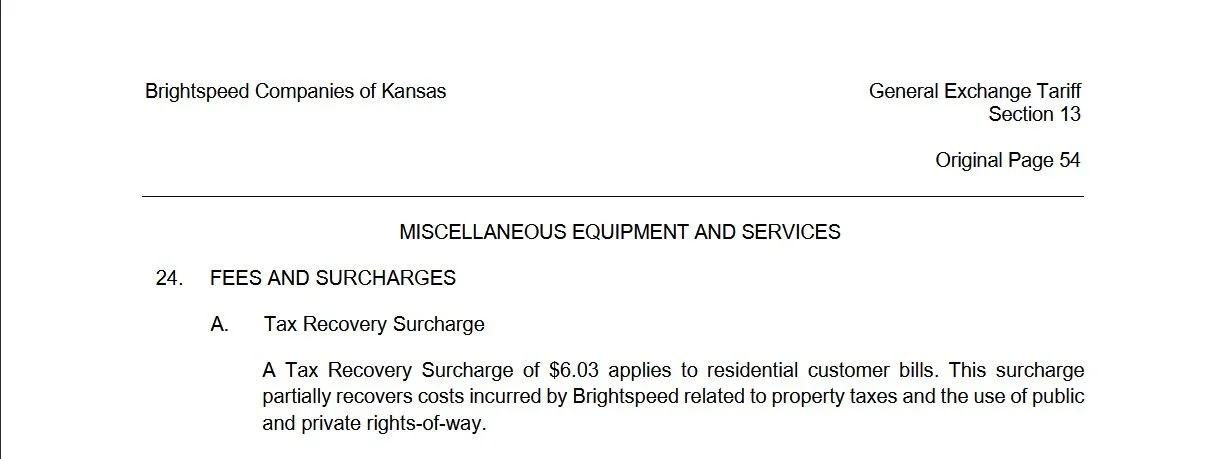
Brightspeed Companies Of Kansas Adding $6.03 To Residential Customer Bills To Recover Costs Of Property Taxes And Use Of Rights-Of-Way
July 16, 2026 – Brightspeed Companies of Kansas has filed revisions to its General Exchange Service Tariff with the Kansas Corporation Commission (KCC). Brightspeed’s filing makes revisions to its tariff that proposes “the introduction of a Tax Recovery Surcharge, which will apply to residential customers’ monthly bills.” Specifically, the tariff revisions add $6.03 to residential customer bills. In its filing, Brightspeed explains that it “is a price-cap regulated carrier and makes this tariff filing in accordance with K.S.A. 2005(q)(1)(F) which declared the services contained herein as price deregulated.” The KCC Docket Number for the proceeding is 27-UTDT-0089-TAR. The actual tariff revisions are shown below.
KDOT Launches Open Access Broadband Program – Webinar July 29
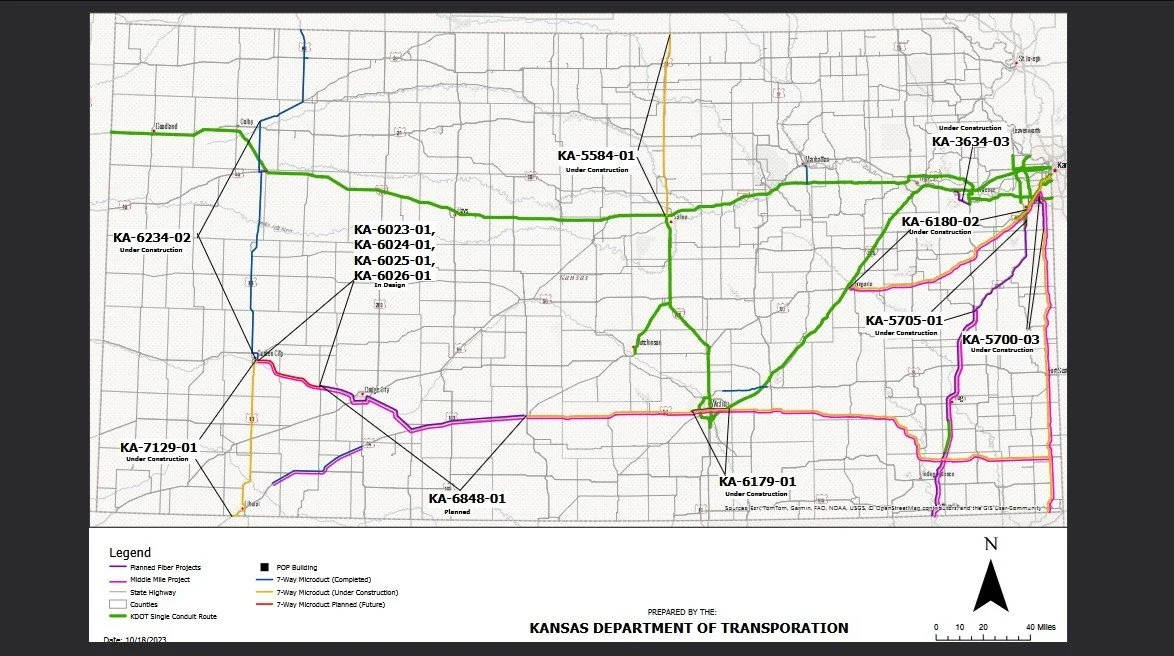
July 14, 2026 – The Kansas Department of Transportation (KDOT) has launched its new Open Access Broadband Program which is intended to make it easier for public and private partners to work together to expand high-speed internet access across Kansas. KDOT’s Open Access Broadband Program will enable broadband providers to construct and operate broadband infrastructure within Kansas highway rights-of-way, and gain access to state-owned infrastructure like conduits, vaults, and buildings in highway rights-of-way. KDOT will conduct a webinar on Wednesday July 29th at 1:00 pm to discuss how KDOT will share the broadband infrastructure where available with industry. Registration is required to attend the webinar. Additional information on the Open Access Broadband Program can be found on KDOT’s website.
Moundridge Telephone Company To Combine Operations Into Its Parent Company Rural Telephone Service Company, Inc.
July 1, 2026 – Rural Telephone Service Company, Inc. d/b/a Nex-Tech (Rural) and Moundridge Telephone Company have filed a joint application with the Kansas Corporation Commission (KCC) requesting approval of certain actions needed to combine Moundridge with Rural. Moundridge is a direct, wholly-owned subsidiary of Rural. The KCC approved Rural’s acquisition of Moundridge in July 2022. Rural is seeking to combine Moundridge’s operations under a single company – Rural. To accomplish this, the joint applicants have requested that the KCC issue an order: (1) expanding Rural’s Certificate of Convenience and Authority to include Moundridge’s two exchanges; (2) expanding Rural’s Eligible Telecommunications Carrier designation to include Moundridge’s two exchanges; (3) approving the transfer of Moundridge’s Kansas universal service fund support to Rural; and (4) stating that the Commission does not object to the merger of Moundridge’s study area into Rural’s study area. The KCC Docket Number for the proceeding is 27-MRGT-0005-MIS.
New Kansas Corporation Commission Telecom Dockets Opened In July 2026
27-MRGT-0005-MIS – Joint Application for Commission Approval to Combine Moundridge Telephone Company into Rural Telephone Service Company, Inc.
27-UTDT-0089-TAR – Brightspeed Companies of Kansas Revisions to General Exchange Service Tariff.
27-BSFT-0090-COC – Application of Brightspeed Fiber Connection LLC for Certificate of Convenience and Authority to Provide Facilities-Based and Resold Interexchange Telecommunications Services Within the State of Kansas.
27-BSFT-0091-COC – Application of Brightspeed Fiber Connection LLC for Certificate of Convenience and Authority to Provide Facilities-Based and Resold local exchange Access Services Within the State of Kansas.
27-IACC-0092-CCS – Section 63.71 Application of IDT America, Corp to Discontinue Services.
27-COXT-0104-KSF – Audit of COX KANSAS TELCOM, L.L.C. by the Kansas Universal Service Fund (KUSF) Administrator Pursuant to K.S.A. 66-2010(b) for KUSF Operating Year 29, Fiscal Year March 2025-February 2026.
27-MXTC-0105-KSF – Audit of LINGO TELECOM, LLC by the Kansas Universal Service Fund (KUSF) Administrator Pursuant to K.S.A. 66-2010(b) for KUSF Operating Year 29, Fiscal Year March 2025-February 2026.
27-NTHC-0106-KSF – Audit of NEX-TECH, LLC by the Kansas Universal Service Fund (KUSF) Administrator Pursuant to K.S.A. 66-2010(b) for KUSF Operating Year 29, Fiscal Year March 2025-February 2026.
27-SBAT-0107-KSF – Audit of AT&T ENTERPRISES, LLC by the Kansas Universal Service Fund (KUSF) Administrator Pursuant to K.S.A. 66-2010(b) for KUSF Operating Year 29, Fiscal Year March 2025-February 2026.
27-INMC-0108-KSF – Audit of INMATE CALLING SOLUTIONS, LLC by the Kansas Universal Service Fund (KUSF) Administrator Pursuant to K.S.A. 66-2010(b) for KUSF Operating Year 29, Fiscal Year March 2025-February 2026.
27-JVCV-0109-KSF – Audit of GOTO COMMUNICATIONS, INC. by the Kansas Universal Service Fund (KUSF) Administrator Pursuant to K.S.A. 66-2010(b) for KUSF Operating Year 29, Fiscal Year March 2025-February 2026.
27-LHPT-0110-KSF – Audit of LAHARPE TELEPHONE COMPANY, INC. by the Kansas Universal Service Fund (KUSF) Administrator Pursuant to K.S.A. 66-2010(b) for KUSF Operating Year 29, Fiscal Year March 2025-February 2026.
27-LHPC-0111-KSF – Audit of LAHARPE TELEPHONE COMPANY, INC. by the Kansas Universal Service Fund (KUSF) Administrator Pursuant to K.S.A. 66-2010(b) for KUSF Operating Year 29, Fiscal Year March 2025-February 2026.
27-UCAC-0112-KSF – Audit of UNITED COMMUNICATIONS ASSOCIATION, INC. by the Kansas Universal Service Fund (KUSF) Administrator Pursuant to K.S.A. 66-2010(b) for KUSF Operating Year 29, Fiscal Year March 2025-February 2026.
27-GCIT-0113-KSF – Audit of GIANT COMMUNICATIONS, INC. by the Kansas Universal Service Fund (KUSF) Administrator Pursuant to K.S.A. 66-2010(b) for KUSF Operating Year 29, Fiscal Year March 2025-February 2026.
27-FCST-0114-KSF – Audit of FUSION CLOUD SERVICES, LLC by the Kansas Universal Service Fund (KUSF) Administrator Pursuant to K.S.A. 66-2010(b) for KUSF Operating Year 29, Fiscal Year March 2025-February 2026.
27-CXWZ-0115-KSF – Audit of COX WIRELESS, LLC by the Kansas Universal Service Fund (KUSF) Administrator Pursuant to K.S.A. 66-2010(b) for KUSF Operating Year 29, Fiscal Year March 2025-February 2026.
27-NXAV-0116-KSF – Audit of NEXTIVA INC. by the Kansas Universal Service Fund (KUSF) Administrator Pursuant to K.S.A. 66-2010(b) for KUSF Operating Year 29, Fiscal Year March 2025-February 2026.
27-SGUV-0117-KSF – Audit of SANGOMA U.S. INC. by the Kansas Universal Service Fund (KUSF) Administrator Pursuant to K.S.A. 66-2010(b) for KUSF Operating Year 29, Fiscal Year March 2025-February 2026.
27-SCHV-0118-KSF – Audit of SMART COMMUNICATIONS HOLDING, INC. by the Kansas Universal Service Fund (KUSF) Administrator Pursuant to K.S.A. 66-2010(b) for KUSF Operating Year 29, Fiscal Year March 2025-February 2026.
27-SWMZ-0119-KSF – Audit of SWITCH MOBILE, LLC by the Kansas Universal Service Fund (KUSF) Administrator Pursuant to K.S.A. 66-2010(b) for KUSF Operating Year 29, Fiscal Year March 2025-February 2026.
27-S&AT-0120-TAR – S&AT Telephone Company, LLC Application for revisions to discontinue several obsolete features with Tariffs.
27-PINT-0121-ETC – Application of Plains Internet, LLC for an Order Confirming Relinquishment of its Eligible Telecommunications Carrier Designation.

June 2026
Resound Networks Declines BEAD Funding In Kansas
June 22, 2026 – Resound Networks has declined to accept its Broadband Equity, Access and Deployment (BEAD) program funding in Kansas. Resound Networks was awarded $13.88 million in BEAD funding to deploy fixed wireless broadband service to 8,455 locations in Kansas. The cost per location for Resound’s total funding was $1,641.95. A majority of Resound’s funded-locations were in Northwest Kansas. Resound has reportedly declined awarded BEAD funding in a handful of other states.
New Record! USF Contribution Factor For Third Quarter Of 2026 – 38.8%
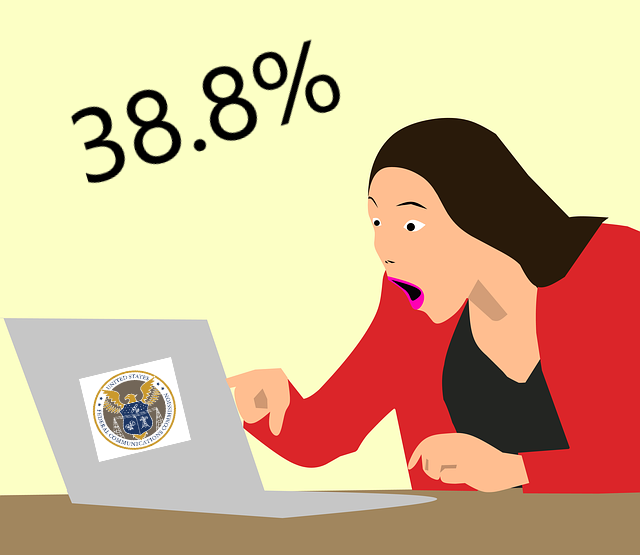
June 12, 2026 – The FCC’s Office of Managing Director (OMD) has announced that the proposed universal service fund (USF) contribution factor for the third quarter of 2026 will be 38.8 percent. If the FCC takes no action on the proposed USF contribution factor within 14 days, it will be declared approved.
The 38.8% contribution factor for 3Q 2026 is a new all-time high. The previous record for the highest USF contribution factor was 38.1% which was used for 4Q 2025. Also, the 38.8% contribution factor for 3Q 2026 is an increase of 1.8% from the 37% contribution factor that was used for 2Q 2026. Historical information on quarterly universal service fund contribution factors is available online from the FCC.
For the third quarter of 2026, the Universal Service Administrative Company (USAC) projects $7.221914 billion in total interstate and international end-user telecommunications revenues will be collected (2Q was $7.553337, and 1Q was $7.604471).
USAC estimates that $2.003130 billion is needed to cover the total demand and expenses for all Federal universal service support mechanisms (revenue requirement) in the third quarter of 2026 (2Q was $2.022700, and 1Q was $2.060770). Total third quarter 2026 demand includes projected program support, administrative expenses, and true-ups and adjustments, which breaks out among the USF support mechanisms as follows:
E-Rate Schools & Libraries: $550.73 million (2Q was $641.92 million, and 1Q was $648.93 million)
Rural Health Care: $183.04 million (2Q was $178.84 million, and 1Q was $181.11 million)
High-Cost: $1.07906 billion (2Q was $1.01156 billion, and 1Q was $1.00545 billion)
Lifeline: $190.30 million (2Q was $190.38 million, and 1Q was $225.28 million)
KCC Opens General Investigation Docket For RLEC Intrastate Switched Access Rate, Revenue, & Kansas Universal Service Fund Support Adjustments – RLEC Filings Due No Later Than August 7th
June 11, 2026 – The Kansas Corporation Commission (KCC or Commission) has opened a general investigation docket on rural local exchange carriers’ (RLECs) intrastate switched access rate, revenue, and Kansas Universal Service Fund (KUSF) support adjustments pursuant to K.S.A. 66-2005(c) and the Federal Communications Commission’s (FCC) access reforms. The KCC Docket Number for the proceeding is 26-GIMT-0461-GIT.
All RLECs must file in Docket 26-GIMT-0461-GIT a completed Attachment 1 by August 7, 2026. All RLECs also must e-mail a Microsoft Excel version of Attachment 1 to KCC Staff by the same date (attention Steve Garrett: steve.garrett@ks.gov, and Hemant Bhagat: hemant.bhagat@ks.gov). An electronic copy of Attachment 1 can be downloaded from the Commission’s website. RLECs do not need to serve Attachment 1 on any other party – only file it in Docket 26-GIMT-0461-GIT and provide a copy to KCC Staff by the required due date. Any RLEC with its own non-National Exchange Carrier Association (NECA) interstate tariff is directed to provide a copy of or link to its July 1, 2026, interstate tariff to KCC Staff concurrent with filing Attachment 1 in Docket 26-GIMT-0461-GIT. The following procedural schedule has been adopted for the proceeding:
RLECs file Attachment 1 and interstate tariff in Docket, submit Excel copy to Staff by no later than August 7, 2026;
Staff shall submit their R&R by no later than September 11, 2026;
The responses to the R&R shall be due no later than September 25, 2026;
The Commission order shall be issued no later than November 5, 2026, with new rates being effective July 1, 2027.
Telrite Corporation To Discontinue Long Distance Service Effective Immediately In Kansas
June 11, 2026 – Telrite Corporation has filed a letter with the Kansas Corporation Commission (KCC) which notifies the KCC of Telrite’s “intention to discontinue long distance service effective immediately in the state of Kansas.” The company was certified to provide long distance telecommunications services in Kansas in KCC Docket 03-RITC-1052-COC in 2003. In its letter, Telrite explains that its “request for withdrawal of Telrite’s long distance service is based on business reasons; Telrite has no long distance customers in Kansas.” It also states that its “notice does not affect any other licenses or authorizations issued to Telrite by the Commission.” The KCC Docket Number for the proceeding is 26-RITC-0484-CCS.
Wheat State Telephone Company Makes Minor Revisions To General Exchange Tariff
June 11, 2026 – Wheat State Telephone Company, Inc. d/b/a Wheat State Technologies has filed revisions to its General Exchange Tariff with the Kansas Corporation Commission (KCC). Wheat State’s filing makes minor revisions to its tariff which “include correcting typographical errors and revising the definition of a calling feature in order to more accurately describe the feature.” The KCC Docket Number for the proceeding is 26-WHST-0485-TAR.
Advantage Telecommunications, Corp. To Relinquish Certificate Of Authority As Reseller Of Telecommunications Services In Kansas
June 11, 2026 – Advantage Telecommunications, Corp. has filed a letter with the Kansas Corporation Commission (KCC) notifying the KCC that the company wishes to relinquish its Certificate of Convenience and Authority (COC) to transact the business of a reseller of telecommunications services throughout the state of Kansas. Advantage was granted a COC in 1999 in Docket 00-ATEC-168-COC. In its letter, Advantage states that it “no longer provides telecommunication services throughout the state of Kansas,” and its “last Kansas customer canceled service in June 2025; therefore no customers will be affected by this withdrawal.” The KCC Docket Number for the proceeding is 26-ATEC-0483-CCS.

Golden Belt Telephone Requests Waiver Of KCC Rule Requiring Paper Notices Of Service Suspension Or Disconnection
June 10, 2026 – Golden Belt Telephone Association, Inc. has filed an application with the Kansas Corporation Commission (KCC) requesting a waiver of certain provisions of the KCC’s telecommunications billing practice standards related to notices of service suspension or disconnection. The billing practice standards were approved by the KCC in 2010 and reflect the technology and industry norms of that time. In its application, Golden Belt requests a waiver of Section IV.D.(1) and (2) of the billing practice standards which require telecom providers to send paper notices of service suspension or disconnection to subscribers using U.S. mail. Golden Belt wants to be able to send notices of suspension or disconnection of service electronically. The company currently sends monthly bills to many customers using email. Golden Belt states that its cost “to process and mail the paper disconnect notices for the 2025 calendar year was $3,954.72.” It further explains that granting the waiver request will eliminate that cost and it will result in customers receiving the notices much faster. Golden Belt notes that the KCC has previously granted similar waivers from the requirements in Section IV.D.(1) and (2) of the telecommunications billing practice standards (Docket No. 11-RRLT-188-MIS, Docket No. 15-MRGT-110-MIS, Docket No. 25-HVDT-204-MIS, and Docket No. 25-RNBT-212-MIS). The KCC Docket Number for the proceeding is 26-GNBT-0482-MIS.
Long Distance Consolidated Billing Co. To Cancel IXC Certificate Of Authority
June 5, 2026 – Long Distance Consolidated Billing Co. has filed an application with the Kansas Corporation Commission (KCC) requesting that the KCC cancel the company’s Certification of Convenience and Authority to provide interexchange (IXC) services in Kansas. Long Distance Consolidated Billing Co. was granted IXC authority by the KCC in 1996 (Docket No. 97-LCBC-235-COC). In its application, the company states that it “closed all operations” on June 1, 2024. It further states that it “no longer has any customers in Kansas since June 1, 2024 and has no intention of acquiring any new customers as the company is out of business.” The KCC Docket Number for the proceeding is 26-LCBC-0481-CCS.
Formal Complaint Filed Against Brightspeed For Poor To Nonexistent Landline Service
June 4, 2026 – The Kansas Corporation Commission (KCC or Commission) has determined that a formal complaint that was filed against Brightspeed complies with the procedural requirements to establish a prima facie case for Commission action. The complaint was filed on May 26, 2026, by Milton Ammel (the Complainant), and alleges poor to nonexistent service for a landline at the Complainant’s residence in Linn County. The Complainant states that he contacted Brightspeed about the poor service issues to no avail and that the service issues could prevent his ability to contact emergency services. As a result of the KCC’s order establishing a prima facie case, the formal complaint will be served upon Brightspeed for an answer within 10 days of service. The KCC Docket Number for the proceeding is 26-UTDT-0409-COM.
FCC Announces Tentative Agenda For June 25th Opening Meeting
June 4, 2026 – Federal Communications Commission (FCC) Chairman Brendan Carr has announced the following tentative agenda for the FCC’s June 25, 2026 open meeting:
Cutting Red Tape and Accelerate the Buildout of Wireline Infrastructure – The Commission will consider a Notice of Proposed Rulemaking that would propose and seek comment on standards for when state and local statutes, regulations, and legal requirements have a prohibitive effect on the provision of wireline telecommunications services in violation of Section 253 of the Communications Act, particularly through the imposition of excessive delays and fees that impede infrastructure deployments and disincentivize investments in new infrastructure. (WC Docket No. 25-253)
Reviewing E-Rate Program and Student Screen Time – The Commission will consider a Notice of Proposed Rulemaking that seeks comment on measures the Commission can take to better protect children when using E-Rate-funded networks, the Commission’s progress in ensuring affordable access to high-speed broadband to and within schools and libraries, and whether the Commission’s current interpretation of the Children’s Internet Protection Act is the best reading of the statute, and a Further Notice of Proposed Rulemaking that proposes actions to strengthen E-Rate program integrity and streamline program administration. (WC Docket Nos. 26-133; 13-184; 21-93; 21-455)
Improving Next Generation 911 Reliability and Interoperability – The Commission will consider a Second Report and Order and Second Further Notice of Proposed Rulemaking to improve reliability and interoperability in the nation’s Next Generation 911 (NG911) transition. The item would modernize and streamline 911 reliability rules for IP-based networks, promote interstate interoperability of NG911 systems, and eliminate unnecessary regulatory burdens. (PS Docket Nos. 21-479, 13-75)
Modernizing of the Nation’s Alerting Systems – The Commission will consider a Report and Order and Further Notice of Proposed Rulemaking that take steps to modernize the Emergency Alert System (EAS) and Wireless Emergency Alerts (WEA). The Report and Order aims to preserve the public’s trust in EAS by requiring targeted cybersecurity improvements to protect the system from cybercriminals and our nation’s adversaries. The Further Notice would propose additional ways to modernize EAS and WEA to make them more helpful to alerting authorities, less burdensome for participating communications providers, and better able to save lives. (PS Docket Nos. 25-224, 22-329, 15-91, 15-94)
Accelerating the Buildout of Submarine Cables – The Commission will consider a Second Report and Order and Second Further Notice of Proposed Rulemaking that would accelerate buildout of secure submarine cable infrastructure, while strengthening national security. (OI 24-523, MD 24-524)
The FCC’s Thursday June 25, 2026 open meeting is scheduled to commence at 10:30 a.m. ET in the Commission Meeting Room of the Federal Communications Commission, 45 L Street, N.E., Washington, D.C. The meeting is open to the public, but the FCC headquarters building is not open access, and all guests must check in with and be screened by FCC security at the main entrance on L Street. All FCC open meetings are streamed live at www.fcc.gov/live.
New Kansas Corporation Commission Telecom Dockets Opened In June 2026
26-UTDT-0409-COM – Complaint Against Brightspeed by Milton Ammel on behalf of Donna Ammel.
26-GIMT-0461-GIT – General Investigation Into the Adjustment of Intrastate Switched Access Charges for Rural Telephone Companies in Compliance with K.S.A. 66-2005(e) and Federal Communications Commission Reforms.
26-LCBC-0481-CCS – Application of Long Distance Consolidated Billing Co. to Cancel its Certification of Convenience and Authority Granted in KCC Docket No. 97-LCBC-235-COC to Transact the Business of an Interexchange Service Provider in the State of Kansas.
26-GNBT-0482-MIS – Application of Golden Belt Telephone Association, Inc. for a Waiver of Certain Telecommunications Billing Practice Standards.
26-WHST-0485-TAR – Application of Wheat State Telephone Company to Correct Typographical Errors and Redefine a Calling Feature.
26-RITC-0484-CCS – Application of Telrite Corporation’s Request to Discontinue Long Distance Service.
26-ATEC-0483-CCS – Application of Advantage Telecommunications, Corp.’s Request to Relinquish Authority as a Reseller of Telecommunications Services.
26-VCTC-0522-SHO – General Investigation of Voicecom Telecommunications, LLC. to Show Cause Why This Commission Should Not Levy Sanctions, Penalties, and Fines or Cancel, Suspend, or Revoke Any Authority the Carrier Holds for Non-Compliance with Kansas Statutes and Commission Orders.
26-GODT-0523-SHO – General Investigation of GoDaddy.com, LLC. to Show Cause Why This Commission Should Not Levy Sanctions, Penalties, and Fines or Cancel, Suspend, or Revoke Any Authority the Carrier Holds for Non-Compliance with Kansas Statutes and Commission Orders.

May 2026
Blue Valley Tele-Communications, Inc. Revises Intrastate Access Service Tariff
May 29, 2026 – Blue Valley Tele-Communications, Inc. has filed revisions to its Kansas Intrastate Access Service Tariff with the Kansas Corporation Commission (KCC). The filing revises five pages in Appendix A to the tariff. Blue Valley explains that the filing “is being made due to companies exiting the NECA pool on July 1, 2026 and, as a result, filing exception rates in the Blue Valley tariff.” The KCC Docket Number for the proceeding is 26-BLVT-0441-TAR.

CISA Announces New Dates For Virtual Town Hall Meetings On Cyber Incident Reporting For Critical Infrastructure Act Of 2022 (CIRCIA) Rulemaking – Communications Sector Townhall Scheduled For June 16, 2026
May 26, 2026 – The U.S. Department Of Homeland Security’s Cybersecurity and Infrastructure Security Agency (CISA) has announced a revised schedule for a series of virtual town hall meetings to gather stakeholder input on the Cyber Incident Reporting for Critical Infrastructure Act of 2022 (CIRCIA) rulemaking. There will be four townhall meetings consisting of two general sessions and two sessions focused on critical infrastructure sectors. All town hall meetings are tentatively scheduled to take place from 11:30 a.m. to 3:30 p.m. Eastern Time. Registration is required to attend each town hall meeting, and can be completed at www.cisa.gov/circia. Registration closes two business days before each meeting. CISA has announced the following virtual town hall meetings that are scheduled to be held on the following dates:
Monday, June 15, 2026 – General Session 1
Tuesday, June 16, 2026 – Critical Infrastructure Sectors Grouping A – Communications Sector; Dams Sector; Emergency Services Sector; Food and Agriculture Sector; Government Facilities Sector; Healthcare and Public Health Sector; Transportation Systems Sector; and Water and Wastewater Sector.
Wednesday, June 17, 2026 – General Session 2
Thursday, June 18, 2026 – Critical Infrastructure Sectors Grouping B – Chemical Sector; Commercial Facilities Sector; Critical Manufacturing Sector; Defense Industrial Base Sector; Energy Sector; Financial Services Sector; Information Technology Sector; and Nuclear Reactors, Materials, and Waste Sector.
NTCA–The Rural Broadband Association Urges NTIA To Publicly Release BEAD Performance Testing Results
May 19, 2026 – NTCA–The Rural Broadband Association has sent a letter to the head of National Telecommunications and Information Administration (NTIA), requesting that NTIA require the public release of the Broadband Equity, Access, and Deployment (BEAD) program performance testing results. Broadband projects funded under BEAD are required to meet specific capacity, latency, and availability standards, such as speed of at least 100 Mbps for downloads and 20 Mbps for uploads. Subgrantee awardees are required to complete network testing to verify that the performance requirements have been met. In its letter, NTCA urges NTIA “to further advance accountability and transparency, however, by publicly releasing (or directing Eligible Entities to publish, as applicable) the results of each subgrantee’s performance testing.” NTCA says that posting the information on NTIA’s website will allow policymakers and the public to determine whether BEAD awardees are following through on their obligations.

SpaceX Wants FCC To Eliminate High Cost USF Support Programs
May 13, 2026 – SpaceX has filed an ex parte letter addressing the FCC’s forthcoming Notice of Proposed Rulemaking (NPRM) on the Universal Service Fund (USF) High-Cost Program. The FCC is expected to approve and release the NPRM at its May 20 open meeting. SpaceX’s ex parte covers its meetings with advisors to the FCC Chairman and the two Commissioners, as well as the FCC’s Wireless Bureau. During those meetings, SpaceX discussed the draft version of the NPRM and recommended changes to certain parts that deal with satellite broadband service. SpaceX is the parent company of low-Earth orbit satellite broadband provider Starlink.
Notably, SpaceX claims that the FCC should establish a plan to sunset the USF High-Cost support mechanisms. SpaceX claims that universal broadband access has been achieved because of unsubsidized terrestrial broadband providers, low-Earth orbit satellite systems, and the BEAD program. SpaceX then goes on to talk about the improvements Starlink it has made to its service, such as increased speeds, reduced latency, and additional capacity of its satellite constellations. Finally, SpaceX provided redline changes to six paragraphs in the NPRM.
NTIA Issues Guidance Related To BEAD Subgrantee Award Contracts – BEAD Subgrantees: Protect Your Rights
May 11, 2026 – The National Telecommunications and Information Administration (NTIA) has issued guidance related to the Broadband Equity, Access, and Deployment (BEAD) Program. Specifically, the guidance, titled “BEAD Subgrantees: Protect Your Rights,” informs BEAD subgrantees that their contracts with state broadband agencies must contain certain language mandated by the BEAD General Terms and Conditions. The required language is related to two topics: prohibition on utility-style rate regulation; and permitting commitments.
NTIA’s guidance informs subgrantees that “states are required to include specific contract language mandated by the BEAD General Terms and Conditions and may not omit, alter, or otherwise attempt to contract around such language in their subgrantee agreements.” NTIA further explains that subgrantees should confirm the required language is included, unaltered, in their award contracts, and should not sign agreements that omit or modify the provisions. Additional information on the required contract language is included in NTIA’s guidance document.
Kansas Fiber Network Announces Danny Pate As New CEO
May 8, 2026 – Kansas Fiber Network (KFN) has announced that it has hired Danny Pate as its new President and CEO. KFN is a regional fiber infrastructure provider serving Kansas, Missouri, and the surrounding Midwest. In its press release, KFN provided the following information on its new CEO:
Pate brings more than 30 years of experience in telecommunications, spanning network and field operations, construction, program management, digital transformation, and sales. Most recently, he served as Chief Operating Officer at Fatbeam Fiber, where he led daily operations, scaled performance-driven operating models, and drove process and cost efficiencies to fuel revenue growth.
“We are pleased to bring Danny on board,” said Mark Gailey, Chairman of KFN’s Board of Directors. “The Board ran a diligent search to identify a leader who can accelerate KFN’s strategic direction. Danny’s track record positions KFN to move confidently into our next phase of growth.”
Earlier in his career, Pate served as Chief Operating Officer at Fastwyre Broadband and as Executive Vice President of Operations at Summit Broadband. He began his career in telecommunications with the local division of Sprint, Qwest Communications, and CenturyLink, holding network leadership roles that culminated in Vice President positions in Engineering and Operations across multiple CenturyLink markets over 22 years.
USAC Releases Data On Legacy Rate-Of-Return Budget Control Mechanism For July
May 8, 2026 – The Universal Service Administrative Company (USAC) has released information on the legacy rate-of-return Budget Control Mechanism (BCM) for July 2026 through June 2027. The budget control mechanism was created by the FCC in the 2016 Rate-of-Return Reform Order as a method for enforcing the rate-of-return carrier legacy support budget in the event total support is forecasted to exceed the budget in a given year. Carriers that receive universal service fund High Cost legacy support, which includes Connect America Fund Broadband Loop Support (CAF BLS), High Cost Loop (HCL) and Safety Valve Support (SVS), are subject to the BCM. When the BCM is applied, carriers receive pro rata support reductions, but no carrier’s support can be reduced below a certain minimum threshold level.
For July 1, 2026 to June 30, 2027, forecasted total support for legacy rate-of-return carriers is projected to exceed the budget by 93,387,847, resulting in a projected budget control adjustment factor of 6.697%. A table showing USAC’s summary of the BCM data and calculations is shown below, all of which are subject to change.
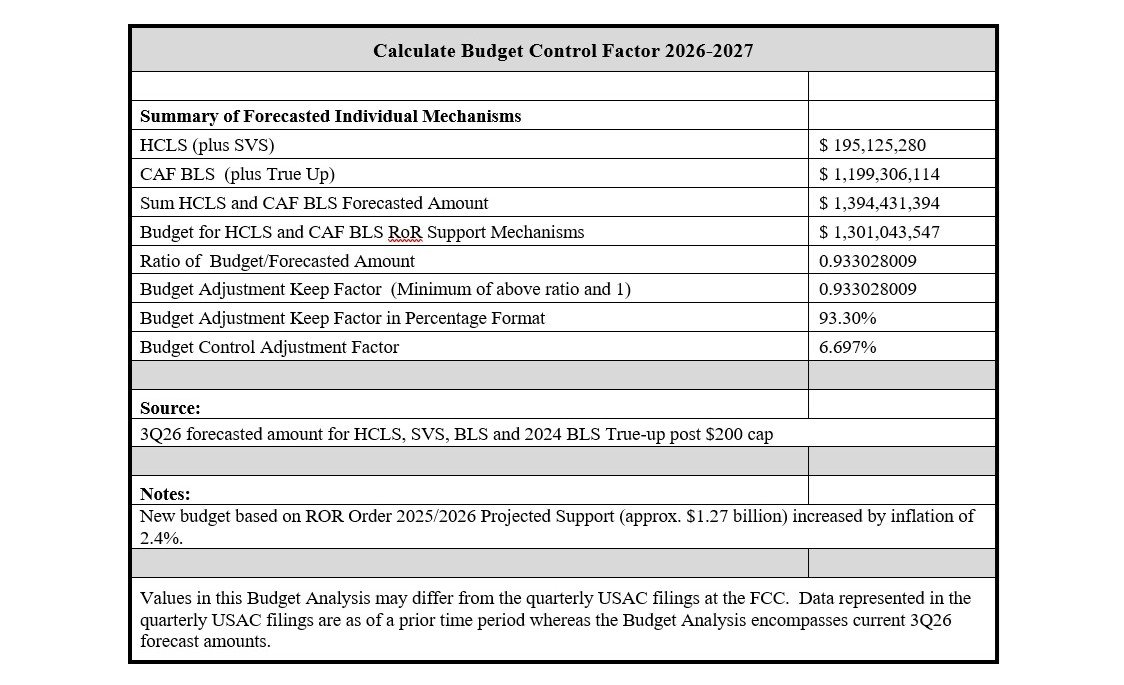
AccessLine Communications Corporation To Cancel Certificate Of Authority To Provide Interexchange Services In Kansas
May 7, 2026 – AccessLine Communications Corporation (ACC) has filed a letter notifying the Kansas Corporation Commission (KCC) that it is voluntarily requesting cancellation of its Certificate Of Convenience And Authority to provide interexchange services, with an effective date of May 21, 2026. ACC was issued a Certificate Of Convenience And Authority to provide interexchange services on February 1, 2005, in Docket No. 05-ALIC-462-COC. In support of its request, ACC has provided the following information:
The public convenience and necessity will not be adversely affected by the action described herein. ACC does not offer or provide any intrastate telecommunications services to Kansas customers pursuant to the above-referenced certificate, and therefore no customer’s services will be interrupted or disconnected.
The KCC typically does not allow a company to cancel a Certificate Of Convenience And Authority by filing a notice letter. Presumably, the KCC will inform ACC that it must file an application that adheres to the KCC’s requirements if ACC wants to cancel its IXC certificate. The KCC Docket Number for the proceeding is 26-ALIC-0312-CCS.
Court Overturns FCC Digital Discrimination Rules
May 6, 2026 – The U.S. Court of Appeals for the Eighth Circuit has issued an opinion that overturns the Federal Communications Commission’s (FCC) digital discrimination rules. In short, the Court concluded that the FCC exceeded its statutory authority in two respects – disparate impact liability and the definition of covered entities.
In November 2023, the FCC adopted a Report And Order containing “final rules to prevent digital discrimination of access to broadband services based on income level, race, ethnicity, color, religion, or national origin.” In general, the digital discrimination rules prohibited broadband providers’ policies or practices that (1) differentially impact consumers’ access to broadband internet access service based on their income level, race, ethnicity, color, religion or national origin, or (2) are intended to have such differential impact. In other words, the FCC adopted two theories of digital discrimination liability: disparate treatment and disparate impact. The scope of the rules also extended beyond broadband providers to entities that facilitate and otherwise affect consumer access to broadband internet access services.
Shortly after the digital discrimination rules were approved, petitions for review were filed by telecom and broadband industry associations in six U.S. Courts of Appeals, all of which sought to have them struck down, claiming the FCC exceeded its statutory authority; the rules are arbitrary, capricious, and an abuse of discretion; and the rules are otherwise contrary to law. The legal challenges were consolidated in the U.S. Court of Appeals for the Eighth Circuit.
That Court has now vacated the FCC’s digital discrimination rules. It found that Congress did not authorize disparate impact liability and the FCC exceeded its statutory authority in adopting a final rule authorizing the imposition of disparate impact liability. The Eighth Circuit also found that the FCC exceeded its statutory authority when it extended the final rule to cover entities other than broadband providers. While the rules have been vacated, the Court nonetheless remanded the issue back to the FCC because there is now “an unfinished obligation to ‘adopt final rules to facilitate equal access to broadband internet access service” in compliance with 47 U.S.C. § 1754.’”
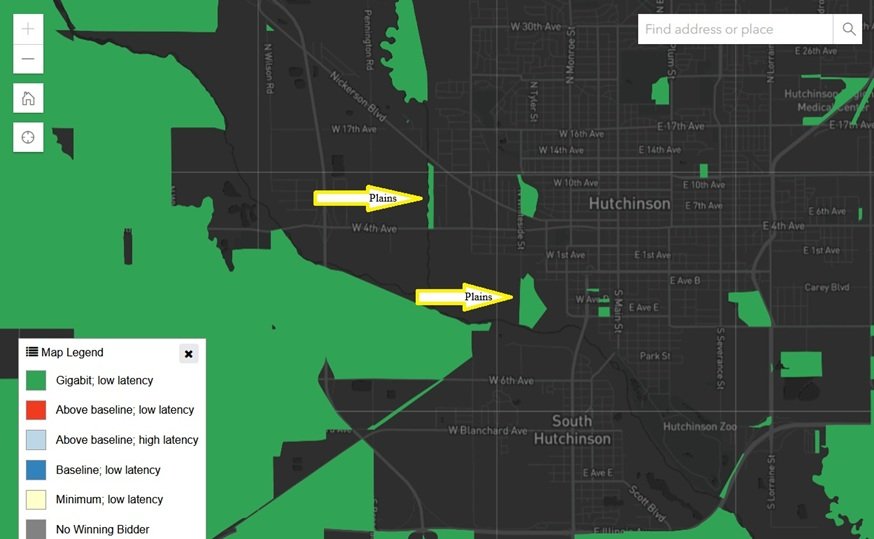
Plains Internet Defaults On RDOF Support In Kansas, Fails To Meet Obligation To Serve Three Locations
May 1, 2026 – Plains Internet, LLC has notified the Federal Communications Commission that it will default on its Rural Digital Opportunity Fund (RDOF) obligations in Kansas (SAC 419049). Plains Internet was awarded $9,834.00 in RDOF support to serve three locations in Kansas with voice and gigabit broadband service. The three RDOF locations are located on the western edge of Hutchison, Kansas. Plains Internet has not deployed service to any of the three locations.
New Kansas Corporation Commission Telecom Dockets Opened In May 2026
26-ALIC-0312-CCS – Application of AccessLine Communications Corporation to Surrender its Certificate of Convenience to Provide Interexchange Telecommunication Services Within the State of Kansas.
26-BLVT-0441-TAR – Application of Blue Valley Tele-Communications, Inc for Revisions to the 14th Revised Sheet and Original Sheets 65 Through 68 Tariff.