News Update - Broadband & Telecom - November 2025
Comment Dates Announced For FCC NPRM On IP Interconnection Issues (December 26, 2025 & January 26, 2026)
November 26, 2025 – The Federal Communications Commission’s IP Interconnection Notice Of Proposed Rulemaking (NPRM) has been published in the Federal Register. Comments are due on or before December 26, 2025. Reply comments are due on or before January 26, 2026. In the NPRM, the FCC considers numerous revisions to incumbent local exchange carrier (LEC)-specific interconnection requirements. Among other things, the FCC is seeking comment on the following issues and proposed revisions:
What is the current state of TDM and IP interconnection for voice services;
The FCC proposal to forbear from incumbent LEC-specific interconnection and related obligations in Sections 251(c)(2) and (c)(6) of the Communications Act of 1934, and the proposal to eliminate its rules implementing those statutory provisions, by December 31, 2028;
Whether and to what extent eliminating the incumbent LEC-specific interconnection regulatory framework may affect other statutory frameworks or FCC rules;
Whether the FCC should revisit any other provisions or rules that are rendered redundant by the elimination of incumbent LECs’ interconnection obligations in section 251(c)(2);
What, if any, regulatory framework for IP interconnection should replace the current interconnection framework under section 251(c)(2), and on the scope of the Commission’s authority to regulate IP interconnection under any such framework; and
To the extent that a regulatory framework governing interconnection for IP voice services is necessary, what is the best authority under which the Commission could or should adopt rules or requirements to govern IP interconnection for voice services, and which authority is most consistent with the statute as a whole.
FCC Announces Tentative Agenda For December 18th Open Meeting
November 25, 2025 –Federal Communications Commission Chairman Brendan Carr has announced the following tentative agenda for the FCC’s next open meeting scheduled for Thursday, December 18, 2025:
Updating Rules to Curb Robocallers' Access to Phone Numbers – The Commission will consider a Third Report and Order and Third Further Notice of Proposed Rulemaking to strengthen and modernize the Commission's requirements that all providers of Voice over Internet Protocol service must meet to maintain direct access to telephone numbers and protect consumers from illegal robocalling. The Commission would seek comment on ways to further bolster numbering resource protections as bad actors continue to seek new and creative methods for exploiting consumers and causing harm. (WC Docket Nos. 13-97, 07-243, 20-67)
Advancement of the Low Power Television, TV Translator and Class A Television Service – The Commission will consider a Report and Order amending its rules to provide regulatory certainty and clarity to LPTV broadcasters and reflect changes in the broadcast industry since the establishment of the LPTV service. (MB Docket No. 24-148)
Delete, Delete, Delete – The Commission will consider a Direct Final Rule that would continue the Commission’s efforts to modernize its regulatory framework by eliminating approximately 35 obsolete, outdated, and unnecessary rules from Parts 2, 15, and 18, totaling 11,970 words or approximately 25 pages of the Code of Federal Regulations. (GN Docket No. 25-133)
The FCC’s December 18, 2025 open meeting is scheduled to commence at 10:30 a.m. ET in the Commission Meeting Room of the Federal Communications Commission, 45 L Street, N.E., Washington, D.C. The meeting is open to the public, but the FCC headquarters building is not open access, and all guests must check in with and be screened by FCC security at the main entrance on L Street. All FCC open meetings are streamed live at www.fcc.gov/live.
Senators Blackburn & Lujan Introduce Broadband and Telecommunications RAIL Act
November 21, 2025 – Senators Marsha Blackburn (R-TN) and Ben Ray Luján (D-NM) have introduced the Broadband and Telecommunications RAIL Act in the U.S. Senate. The goal of the bill is to streamline the process for deploying telecommunications and broadband equipment in public and railroad rights-of-way. An identical companion bill (H.R.6046) that was introduced in the House Of Representatives was recently forwarded from the House Subcommittee on Communications and Technology to the full House Energy and Commerce Committee. According to the press release, if passed, the bill “would streamline the deployment of telecommunications and broadband equipment in public and railroad rights-of-way by establishing two separate processes:”
Notification: In public rights-of-way, broadband providers will work with the state or locality to determine the scope of work they are authorized to perform. The broadband provider will then notify the rail carrier and schedule the work to be performed. This bill sets strict timelines for the work to be performed.
Application: Broadband providers have to request permission before putting their equipment in railroad carrier owned rights-of-way. Under this bill, the rail carrier may only deny the request if the application fails to meet specific requirements related to safety, damage, or prohibiting the operations of the rail carrier. Similarly, the bill establishes timelines by which the railroad must respond and schedule the work.

NTIA Approves Texas’ BEAD Program Final Proposal
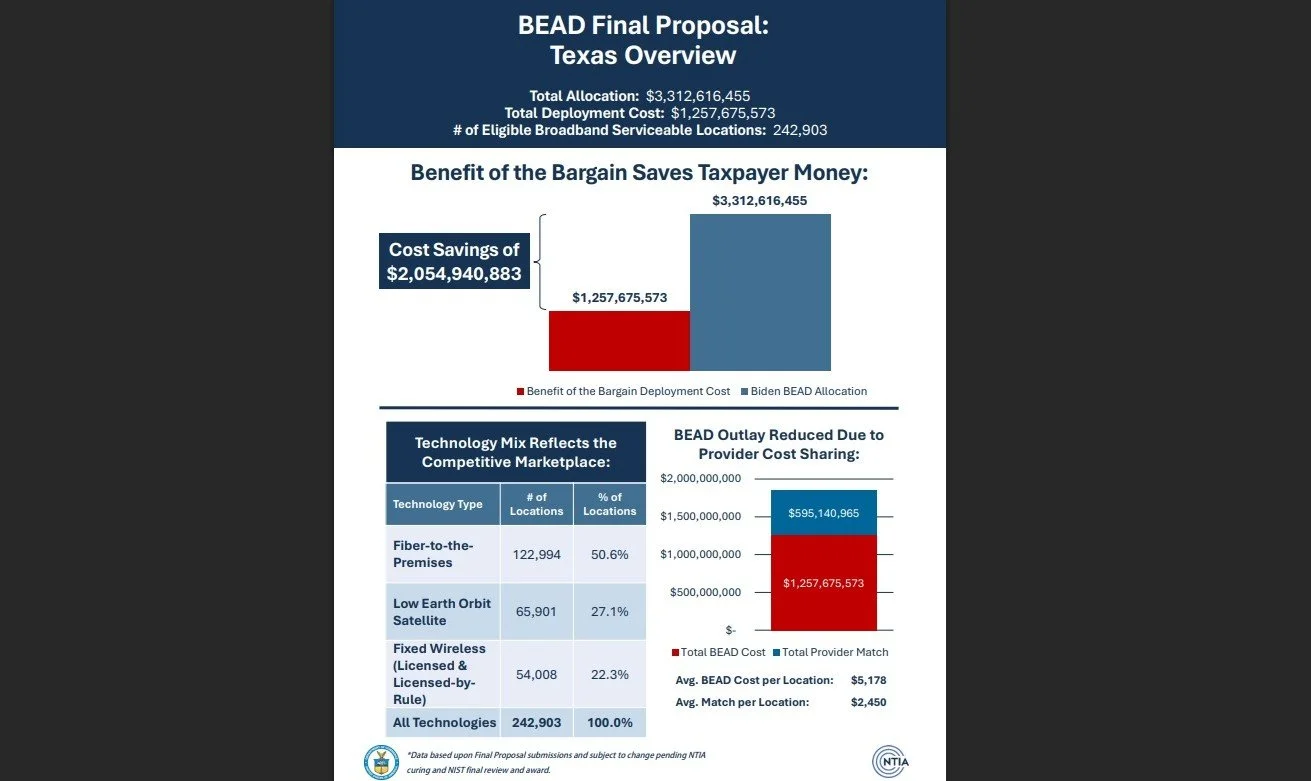
November 20, 2025 – The U.S. Department of Commerce’s National Telecommunications and Information Administration (NTIA) has announced that it has approved the state of Texas’ Broadband Equity, Access, and Deployment (BEAD) program final proposal. This is the 19th BEAD program final proposal to be approved by NTIA. Texas was originally allocated $3,312,616,455 under the BEAD program. However, Texas’s final proposal will award $1,257,675,573 for broadband projects. Additional details on Texas’ final proposal are shown on the slide below.
A few days ago, NTIA approved final proposals from 18 states and U.S. territories: Louisiana, Wyoming, Iowa, American Samoa, Georgia, Arkansas, Delaware, Guam, Maine, New Hampshire, Commonwealth of Northern Mariana Islands, Connecticut, South Carolina, North Dakota, Hawaii, Montana, Rhode Island, and Virginia. To date, 53 of the 56 states and U.S. territories have submitted their final proposals to NTIA. Additional information on BEAD final proposals is available online.
FCC Revokes California’s National Lifeline Accountability Database Exemption
November 20, 2025 – The FCC’s Wireline Competition Bureau (Bureau) has issued an Order which uses its delegated authority to (1) revoke the exemption that enabled the California Public Utilities Commission (CPUC) to opt out of the use of the National Lifeline Accountability Database (NLAD) for the federal Lifeline program, and (2) adjust the federal Lifeline National Eligibility Verifier (National Verifier) processes in California to end reliance on California state eligibility results for enrollment in the federal Lifeline program.
The NLAD, sometimes referred to as the “duplicates database”, is used to prevent individuals from receiving more than one Lifeline benefit and households from receiving multiple Lifeline benefits. Lifeline providers query the database before enrolling a prospective subscriber in Lifeline service to determine on a real-time basis whether the individual is already receiving Lifeline service or whether someone at the individual’s residential address is already receiving Lifeline service. The National Verifier is an electronic system and database that is used to verify that applicants meet the income and eligibility requirements to receive benefits from the Lifeline program. The National Verifier and NLAD are integrated, complementary components of a single electronic system designed to protect the integrity of the federal Lifeline program, which is administered by the Universal Service Administrative Company (USAC).
According to the Bureau’s Order, “[a] recently-passed California law has made it effectively impossible for the CPUC to comply with Lifeline operations and program integrity obligations placed on opt-out states.” Lifeline providers will now use federal processes to verify eligibility for the Lifeline program and perform duplicate checks for federal Lifeline program applicants in California.
NTIA Approves 18 BEAD Program Final Proposals
November 18, 2025 – The U.S. Department of Commerce’s National Telecommunications and Information Administration (NTIA) has announced that it has approved 18 Broadband Equity, Access, and Deployment (BEAD) program final proposals. The final proposals from the following 18 states and U.S. territories were approved by NTIA: Louisiana, Wyoming, Iowa, American Samoa, Georgia, Arkansas, Delaware, Guam, Maine, New Hampshire, Commonwealth of Northern Mariana Islands, Connecticut, South Carolina, North Dakota, Hawaii, Montana, Rhode Island, and Virginia. Additionally, NTIA has announced that Louisiana has signed its award amendment which allows it to access its BEAD funds. To date, 53 of the 56 states and U.S. territories have submitted their final proposals to NTIA. Additional information on BEAD final proposals is available online.
FCC Sets Final Agenda For November 20th Open Meeting
November 13, 2025 – The Federal Communications Commission has announced the following final agenda for the FCC’s open meeting scheduled for Thursday, November 20, 2025:
Freeing Up Large Swath of Upper C-band Frequencies – The Commission will consider a Notice of Proposed Rulemaking that explores options for reconfiguring the Upper C-band (3.98 GHz to 4.2 GHz) in the contiguous United States, in furtherance of Congress’ direction in the One Big Beautiful Bill Act. (GN Docket No. 25-59)
Modernizing Telecommunications Relay Service; Speech-to-Speech and Internet Protocol (IP), Speech-to-Speech Telecommunications Relay Services – The Commission will consider a Notice of Proposed Rulemaking that would seek comment on terminating the mandatory status of TTY-based relay service for state-based TRS programs; facilitate the transition of analog TRS users to Internet-based forms of TRS; propose and seek comment on recognizing IP STS as a compensable form of TRS; explore certifying a national analog relay provider; and seek comment on streamlining TRS provider certification and data collection processes, updating or eliminating obsolete rules, and closing an outdated docket. (CG Docket Nos. 03-123, 08-15)
Delete, Delete, Delete – The Commission will consider as part of the Delete, Delete, Delete proceeding a Direct Final Rule that would move to delete approximately 21 rules and requirements that have sunset by operation of law; govern an expired event; regulate an obsolete technology; are no longer used in practice by the FCC or licensees; or are otherwise duplicative, outdated, or unnecessary. (GN Docket No. 25-133)
Protecting the Nation’s Communications Systems from Cybersecurity Threats – The Commission will consider an Order on Reconsideration that advances an agile and collaborative approach to protecting the nation from cyberattacks by rescinding an unlawful and ineffective January 2025 Declaratory Ruling and NPRM. (PS Docket No. 22-329)
The FCC’s November 20, 2025 open meeting is scheduled to commence at 10:30 a.m. ET in the Commission Meeting Room of the Federal Communications Commission, 45 L Street, N.E., Washington, D.C. The meeting is open to the public, but the FCC headquarters building is not open access, and all guests must check in with and be screened by FCC security at the main entrance on L Street. All FCC open meetings are streamed live at www.fcc.gov/live.

Senate Commerce Committee To Hold FCC Oversight Hearing On December 17th
November 12, 2025 – Senator Ted Cruz (R-Texas), Chairman of the Senate Committee on Commerce, Science, and Transportation, has announced that the full Commerce Committee will hold a hearing on oversight of the Federal Communications Commission on December 17, 2025. The hearing witnesses will be Brendan Carr, FCC Chairman; Anna M. Gomez, FCC Commissioner; and Olivia Trusty, FCC Commissioner. The hearing will be streamed live on the Senate Commerce Committee’s website and YouTube channel.
NTIA Clarifies BEAD Program Federal Subsidy Restriction – Applies To BEAD-Funded Projects; Does Not Apply Existing Subsidies In Non-BEAD Areas
November 5, 2025 – The National Telecommunications and Information Administration (NTIA) has clarified that its forthcoming federal subsidy restriction on Broadband Equity, Access, and Deployment (BEAD) program awards will only apply to BEAD-funded projects.
On October 28, 2025, the head of the NTIA, Arielle Roth, gave a speech at The Hudson Institute titled Making BEAD Work: How NTIA Is Working to Minimize Defaults and Deliver Universal Broadband, which outlined how NTIA will continue its oversight role of the BEAD program after NTIA approves states’ final plans and individual BEAD awards. Assistant Secretary Roth said that “NTIA will require states to have providers certify in writing that they will not require or take additional federal subsidies—including operational subsidies—to complete or operate their BEAD projects. Those unwilling to make that commitment will not get an award. Their proposed service areas will instead go to entities that can and will deliver.”
NTIA has clarified that this prohibition will apply only to BEAD-funded projects and will not affect existing subsidies in non-BEAD areas to which a provider is already entitled, such as federal high-cost universal service fund support.
A total of 53 out of 56 states and territories have submitted their BEAD Final Proposals to NTIA for review. The remaining 3 eligible entities have been granted short-term extensions and will soon be submitting their Final Proposals. NTIA has not yet approved any BEAD Final Proposals but has committed to completing its review of Final Proposals within 90 days of submission.
Senators Introduce Bill To Strengthen USDA ReConnect Loan And Grant Program
November 1, 2025 – U.S. Senators Roger Marshall (R-Kansas) and Peter Welch (D-Vermont) have introduced the bipartisan ReConnecting Rural America Act of 2025 (S.3084) in the U.S. Senate. The bill is intended to strengthen the U.S. Department of Agriculture’s (USDA) ReConnect Loan and Grant Program. It has been referred to the Senate Committee on Agriculture, Nutrition, and Forestry. If passed, the ReConnecting Rural America Act will do the following:
Enhance the ReConnect Program by reducing bureaucratic hurdles and accelerating the installation of broadband in rural communities;
Establish 100/100 Mbps symmetrical buildout speeds for the ReConnect program;
Clarify that USDA can make grants, loans, or grant-loan combinations under the ReConnect program;
Establish clear definitions to ensure the ReConnect program prioritizes those who need broadband most;
Clarify that Communications Union Districts are eligible entities under the ReConnect program; and
Improve coordination and communication among stakeholders at the federal level.