NTIA Approves Kansas’ BEAD Program Final Proposal & Awards – $166.6 Million – 14 Awardees – 81 Projects
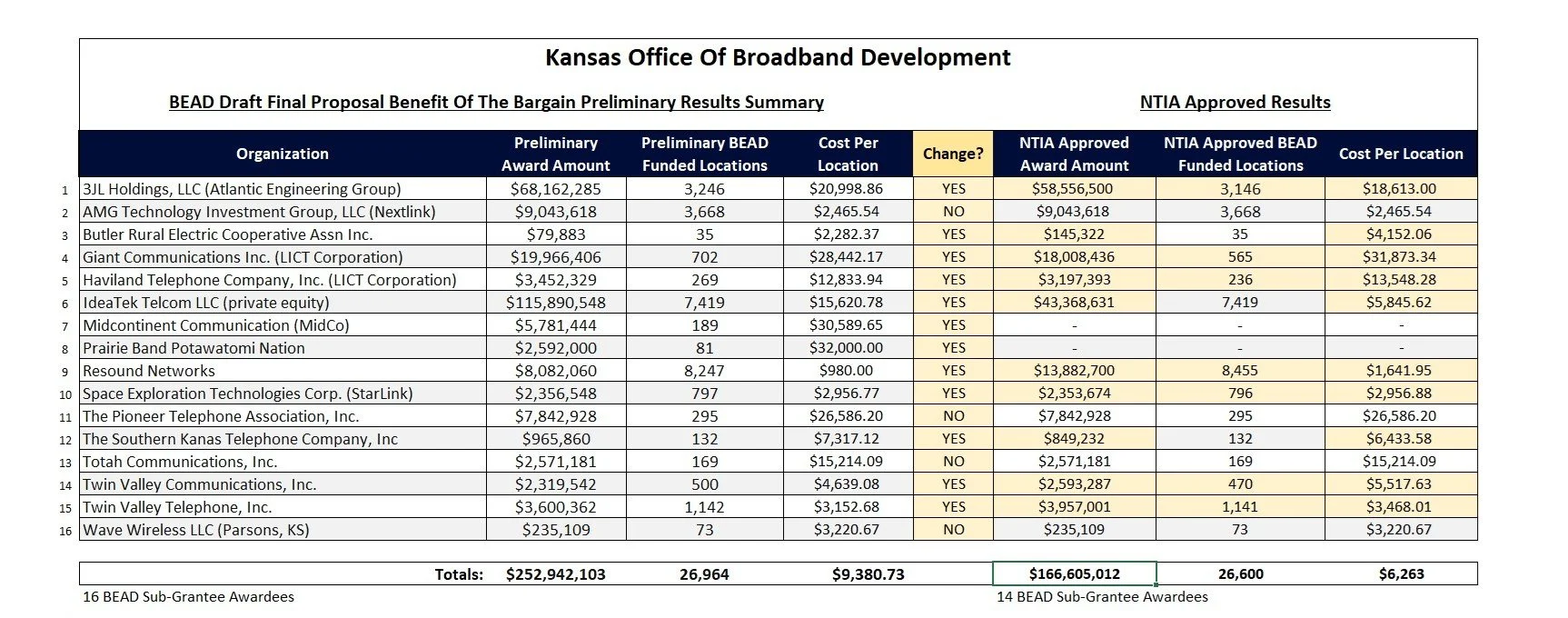
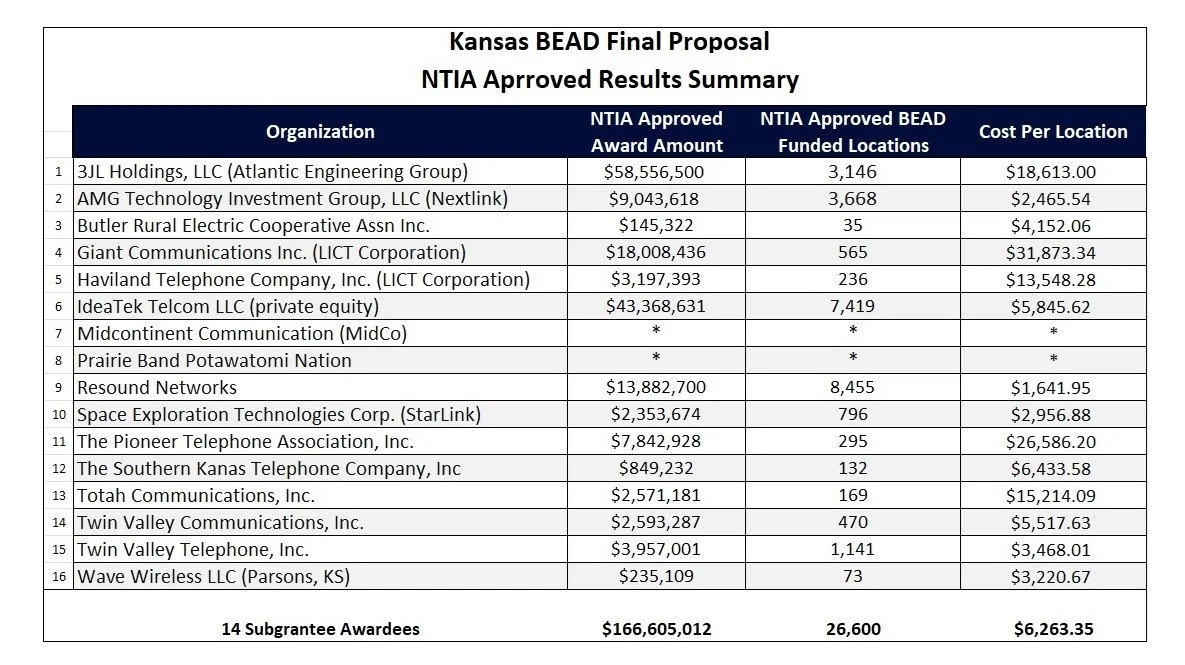
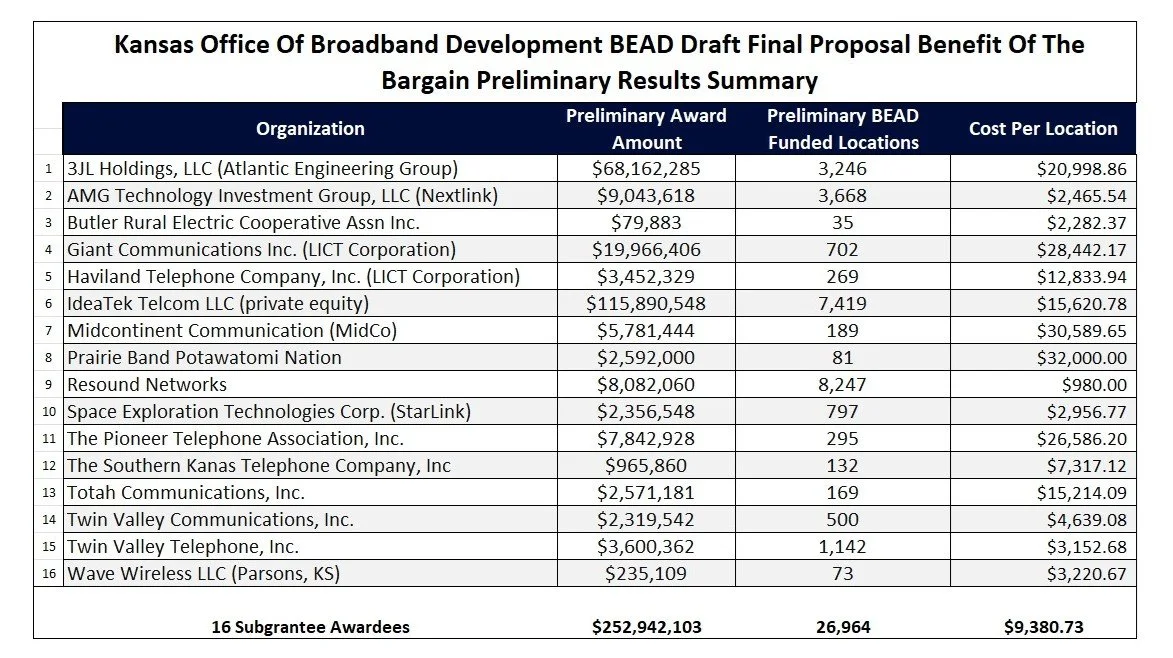
December 8, 2025 – Kansas Governor Laura Kelly has announced that the National Telecommunications and Information Administration (NTIA) has approved the Kansas Office of Broadband Development’s (KOBD) $166.6 million final proposal for the Broadband Equity, Access and Deployment (BEAD) program. The final proposal approved by NTIA selects 14 awardees to receive a total of $166,605,012 in BEAD grant funding to deploy 81 broadband projects. Roughly 30% of the funding will be used to deploy fiber-based broadband network projects. Some of this 30% could include networks that are a hybrid of fiber and fixed wireless, but that cannot be confirmed until additional information on the funded projects are released. Below is a summary of the draft final proposal that Kansas submitted to NTIA, followed by a summary of what was ultimately approved by NTIA.
Kansas’ Draft BEAD Final Proposal
On August 25, 2025, KOBD announced the preliminary selection of BEAD program “Benefit of the Bargain Round” awardees. KOBD preliminarily selected 16 awardees, out of 23 applicants, to receive a total of $252,942,107 in BEAD grant funding. Total BEAD awarded in the draft final proposal represented 56% of Kansas’ total BEAD allocation of $451.7 million (a 44% reduction). All of the 26,673 eligible broadband serviceable locations (BSLs) in the state received a competitive bid. The average cost per BSL was estimated at $8,540.35. The technology deployed for BSLs varied between fiber (46.17 %), hybrid/fixed wireless (50.83 %), and low earth orbiting satellites (3.00 %).
After KOBD submitted Kansas’ draft final proposal, like other states, KOBD was required to “cure” certain issues and concerns raised by NTIA. Assumedly, these issues concerned award amounts and the average cost-per-location of each individual award. The goal of this negotiation process between KOBD and NTIA, and other states, was to drive down the total amount of federal funding awarded under BEAD. As is shown below, there are significant changes from Kansas draft final proposal to the final proposal that was approved by NTIA.
Kansas’ NTIA-Approved BEAD Final Proposal
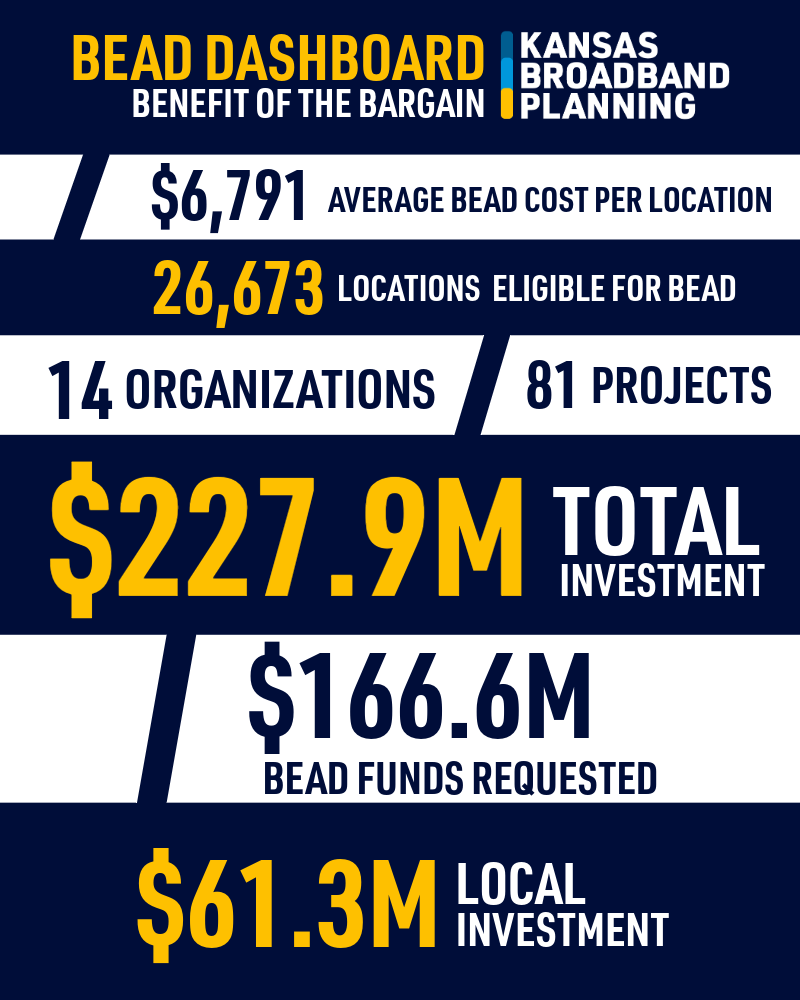
Kansas’ BEAD final proposal that was approved by NTIA selects 14 awardees to receive a total of $166,605,012 in BEAD grant funding to deploy 81 broadband projects. The total amount of BEAD funding that was awarded represents 37% of Kansas’ total original BEAD allocation of $451.725 million (a 63% reduction). Kansas loses $285,120,986 in federal funding because of NTIA’s Benefit of the Bargain Round. Other key details of the final proposal include the following:
Total BEAD funding broken down by the type of broadband technology that will be deployed is: fiber – 30%; fixed wireless – 67%; and Low Earth Orbit (LEO) satellite service – 3%.
BEAD awardees will contribute $61.3 million in matching funds.
KOBD received competitive bids for 100% of the eligible homes and businesses.
The average BEAD cost per location is $6,791.
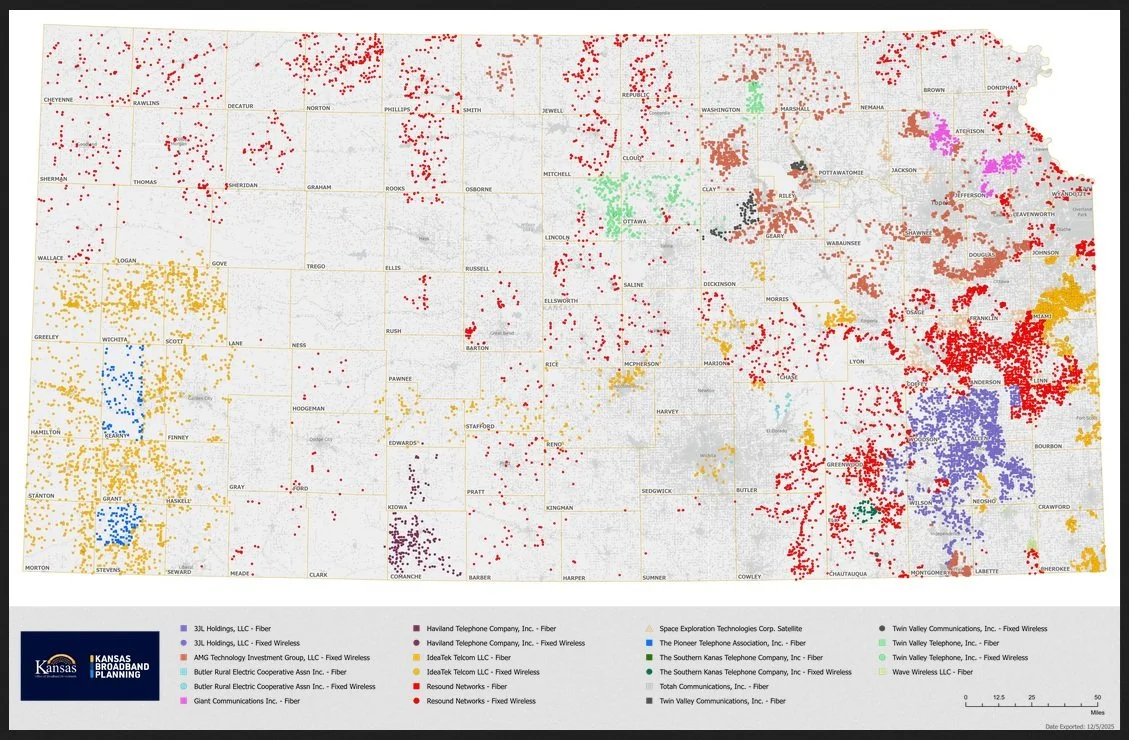
Major Changes From Draft Final Proposal To Approved Final Proposal
There are a few significant changes in the final proposal that was approved by NTIA. A summary of the noteworthy changes are below, along with what they might mean.
IdeaTek BEAD Award Reduced By $72.5 Million
The most significant change from the draft proposal to the final proposal that was approved by NTIA is the reduction in the total amount of BEAD funding awarded to IdeaTek Telcom. IdeaTek Telcom had its award decreased from $115,890,548 to $43,368,631 – a reduction of $72.5 million. Its total amount of funded locations (7,419) did not change. Accordingly, IdeaTek’s cost per location went from $15,620.78 to $5,845.62 – a difference of $9,775.16.
In the draft proposal, IdeaTek was award BEAD funding to deploy fiber broadband service. Since its total awarded funding has been cut by $72.5 million, IdeaTek will likely now deploy a hybrid fiber and fixed wireless network to serve the 7,419 locations. It’s possible some locations may still receive service from a fiber-only network. All of this, however, cannot be confirmed until additional information is released.
MidCo & The Prairie Band Potawatomi Nation BEAD Awards Rescinded
Another noteworthy change from the draft proposal to the final proposal that was approved by NTIA is that the number of subgrantee awardees decreased from 16 to 14. The BEAD awards for Midcontinent Communications (MidCo) and the Prairie Band Potawatomi Nation were not included in the final proposal. Assumedly, both were unwilling to revise their awards and had them rescinded. In the draft final proposal, MidCo was awarded $5,781,444 to serve 189 locations (at a cost per location of $30,589.65). The Prairie Band Potawatomi Nation was awarded $2,592,000 to serve 81 locations (at a cost per location of $32,000). The costs per location for both of these awards were extremely high. NTIA likely demanded that the cost per location for each award be dramatically reduced. Both likely refused to accept a smaller award amount.
3JL Holdings BEAD Award Reduced By $9.6 Million
3JL Holdings, LLC had its award decreased from $68,162,285 to $58,556,500 – a reduction of $9.6 million. Its funded locations were decreased by 100. Accordingly, 3JL Holdings’ cost per location went from $20,998.86 to $18,613.00 – a difference of $2,385.86. In the draft final proposal, 3JL Holdings was awarded BEAD funding to deploy fiber. Without additional information, it’s unclear if 3JL Holdings has decided to revise some of its network deployment plans. It’s possible 3JL will still deploy an all-fiber network since it dropped 100 funded locations.
Resound Networks Award Increased By $5.8 Million
In the draft proposal, Resound Networks was awarded BEAD funding to deploy fixed wireless service in many areas of the state, including northwest Kansas. Resound had its BEAD funding increased from $8,082,060 to $13,882,700 – an improvement of $5,800,640. Resound’s funded location were also increased by 208 – from 8,247 to 8,455. The cost per location went from $980 to $1,641.95.
What’s Next?
The awards are considered final by NTIA and will now move into the NIST approval process. Thereafter, KOBD will begin the next phase of its BEAD implementation, which includes finalization of BEAD subgrantee contracts, oversight of subgrantee compliance, and continued technical assistance. KOBD expects BEAD subgrantees will commence the groundbreaking of their funded projects during the second half of 2026. Additional specific changes from the original draft final proposal to what was approved by NTIA are shown below.