Kansas Broadband & Telecom News - February 2026
KCC Opens Docket For Annual CAF/ICC Certification Filings
February 26, 2026 – The Kansas Corporation Commission (KCC) has opened a new docket for receiving 2026 Connect America Fund (CAF) / Intercarrier Compensation (ICC) certification filings. Under the Federal Communications Commission’s (FCC) rules, price cap and rate-of-return carriers receiving CAF/ICC must certify their receipt of support by June 16, 2026. The KCC Docket Number for the proceeding is 26-GIMT-0217-CPL. Pursuant to Section 51.917(d)(vii) of the FCC’s rules, a rate-of-return carrier seeking revenue recovery must annually certify as part of its tariff filings to the FCC and to the relevant state commission that the carrier is not seeking duplicative recovery in the state jurisdiction for any Eligible Recovery subject to the recovery mechanism. Pursuant to Section 51.915(d)(3) of the FCC’s rules, a price cap carrier seeking revenue recovery must annually certify as part of its tariff filings to the FCC and to the relevant state commission that the carrier is not seeking duplicative recovery in the state jurisdiction for any Eligible Recovery subject to the recovery mechanism. For rate-of-return carriers, among other things, an officer must certify that the company has complied with the FCC’s Eligible Recovery and Access Recovery Charge rules, and that the company is eligible to receive CAF/ICC support pursuant to Section 51.917(f) of the FCC’s rules.
KCC Announces 12.67% KUSF Assessment Rate For KUSF Year 30 & RLEC Pro-Rata KUSF Support Reductions
February 26, 2026 – The Kansas Corporation Commission (KCC) has issued an Order that sets an assessment rate of 12.67% for Year 30 of the Kansas Universal Service Fund (KUSF), effective March 1, 2026, through February 28, 2027. The KUSF Year 30 assessment rate is comprised of two budgeted components: (1) the projected KUSF obligations or amounts to be paid from the KUSF; and (2) the projected revenue base, or the revenue carriers are projected to report to the KUSF for funding purposes. The KUSF Year 30 total KUSF obligations of $34.1 million are reduced by the projected $1.9 million reserve and increased by $2.4 million for the Contingency Fund Allowance, resulting in the $34.6 million net KUSF obligations to be collected from a revenue base of $272.9 million.
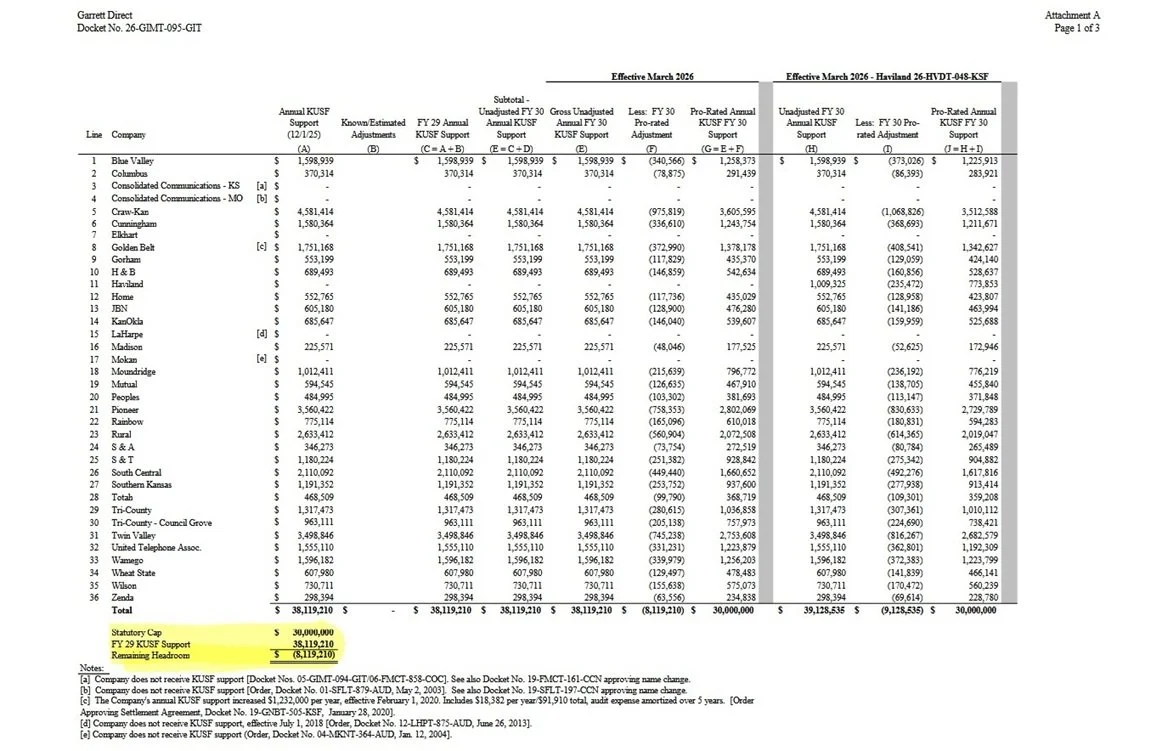
Additionally, the KCC has issued an Order adopting KUSF pro-rata support reductions for Kansas Rural Local Exchange Carriers (RLECs). Total KUSF support for RLECs is capped at $30 million, resulting in each RLEC’s being reduced on a pro-rata basis every year. Each RLEC’s revised pro-rata KUSF support reduction, monthly KUSF support, and cumulative annual KUSF FY 30 support is provided in Attachment A to KCC staff’s February 17th Report And Recommendation.
Legislation Update: KDOT Statewide Fiber Conduit System (HB 2647) Passes House
February 25, 2026 – Legislation introduced on behalf of the Kansas Department Of Transportation (KDOT) has passed the Kansas House of Representatives on a vote of 116 to 5. The bill, (HB 2647), if passed, would authorize KDOT to establish a statewide conduit system for fiber optic transmissions of broadband connections. The bill was sent to the Kansas Senate on February 25, and thereafter referred to the Senate Committee on Transportation.
KCC Opens Docket For Annual Certification Of Compliance With Section 254(e) – Appropriate Use Of Universal Service Fund Support
February 25, 2026 – The Kansas Corporation Commission (KCC) has opened a docket to be used by eligible telecommunications carriers (ETCs) to file reports required by Section 54.313 of the FCC’s rules. The KCC Docket Number for the proceeding is 26-GIMT-0234-GIT. KCC telecom staff has not yet filed its Report And Recommendation.
The KCC will use the filings to determine whether to certify that each Kansas ETC’s use of federal universal service fund (USF) support is appropriate. Pursuant to 47 U.S.C. Section 254(e), carriers that receive Federal USF support must certify annually that they have used, and will use, such support “only for the provision, maintenance, and upgrading of facilities and services for which the support is intended.” For 2026, the KCC will determine whether to certify that Kansas ETCs will use their federal USF support for 2026 in compliance with Section 254(e), and whether Kansas ETCs used their 2025 federal USF support appropriately. Each Kansas ETC also must include a certification and information showing it has used its Kansas USF support appropriately in 2025 and will do so in 2026. Kansas ETCs must file their certification forms, USF worksheets, and other data in Docket 26-GIMT-0234-GIT on or before June 30, 2026. Copies of the supporting excel files must be emailed to KCC telecom staff.
Legislation Update: Utility Railroad Crossing Act (SB 439)
February 25, 2026 – The utility railroad crossing act (SB 439) remains alive in the Kansas legislature. The bill, if enacted, would create a consistent statutory process for the placement, maintenance, relocation, and removal of a public utility’s facilities that cross or parallel a railroad right-of-way. In particular, the legislation creates a 30-day notification requirement for railroad crossings within the public right-of-way. No fee of any kind may be required or collected for crossings located within the public right-of-way. There is a 30-day prior permission application requirement for a railroad crossing or paralleling outside of the public right-of-way. This is subject only to a onetime standard fee of $1,250. Both notification and prior permission require the submission of an application that includes an engineering design and proof of insurance.
The bill was introduced and referred to the Senate Committee on Utilities, which then held a hearing on the bill on February 10, 2026. The bill was then withdrawn from the Senate Utilities Committee on February 13 and referred to the Senate Committee on Ways and Means. On February 25, 2026, the bill was then withdrawn from the Ways and Means Committee and sent back to the Senate Committee on Utilities.
U.S. Senator Jerry Moran & FCC Commissioner Olivia Trusty To Meet With Kansas Broadband Providers In Manhattan Kansas On March 21st
February 20, 2026 – U.S. Senator Jerry Moran and Federal Communications Commission Commissioner Olivia Trusty will meet with Kansas broadband providers at WTC Fiber in Manhattan Kansas on March 21, 2026. Senator Moran and Commissioner Trusty will hold a roundtable with Kansas broadband executives to discuss issues related to the universal service fund and broadband deployment challenges in Kansas. They will then visit a WTC Fiber deployment site.
Legislation Update: Utility Relocation And Reimbursement Fund (HB 2544) Fails
February 19, 2026 – Legislation to create a utility relocation reimbursement assistance fund (HB 2544) has died in the 2026 Kansas legislature. The bill would have established a relocation reimbursement assistance payment program and a corresponding fund for the purpose of reimbursing communication service providers that were required to relocate facilities located in the public right-of-way pursuant to a request, order, or directive of a municipality. It was introduced on January 26, 2026, and referred to the House Committee on Energy, Utilities and Telecommunications. On February 9, 2026, the House Utilities Committee recommended HB 2544 be passed. However, on February 19, 2025, HB 2544 was stricken from the calendar under Rule 1507, effectively killing the legislation.
LTE Wireless Inc. Files Petition For ETC Designation To Provide Lifeline Services In Kansas
February 18, 2026 – LTE Wireless Inc. has filed a petition with the Kansas Corporation Commission (KCC) requesting designation as an Eligible Telecommunications Carrier (ETC) solely for the purpose of providing Lifeline service in Kansas. Designation as an ETC will enable the company to receive support from the Federal and Kansas Universal Service Funds for providing Lifeline services to eligible Kansas consumers. LTE Wireless is requesting a statewide ETC designation that will allow the company to provide Lifeline services wherever it or its underlying, facilities-based providers have wireless coverage. The KCC Docket Number for the proceeding is 26-LWIT-0227-ETC. In its application, LTE Wireless has provided the following description of its network operations and service offerings:
LTE Wireless is a facilities Based CLEC and a Mobile Virtual Network Operator (“MVNO”) providing commercial mobile radio service (“CMRS”). LTE currently provides prepaid wireless telecommunications services to consumers by using a combination of its own facilities and the infrastructure and the underlying wireless networks of T-Mobile, through a reseller agreement with Prepaid Wireless Group. In addition, PWG provides integrated communications solutions including MVNO enablement, cellular carrier access aggregation, and voice/text/data services. LTE provides retail broadband Internet access service to end-users, provided by the Underlying Carrier T-Mobile US, Inc. on the Global System for Mobile Communications (“GSM”) standard. LTE does utilize its own facilities, including its Network Switching Subsystem (“NSS”), Business Support System (“BSS”), Operations support System (“OSS”) in combination with T-Mobile facilities, to provide service.
LTE may provide user-friendly handsets or hotspot devices. LTE products and plans are specially geared toward serving lower-income communities. The Company does not require service contracts from its customers, and it will always ensure competitively low pricing for its services and products. LTE manages all aspects of the customer experience, including setting service pricing, handset and device selection, marketing materials, and customer service. LTE's customers will depend on and benefit greatly from LTE's inexpensive and flexible pricing plans and access to federal Lifeline funds to make it possible for the company to provide service for free or at low cost. LTE will not impose credit checks, nor will it require any deposits or contractual commitments.
Kansas State 911 Board Submits Valid Request To Initiate Phase 1 Of Next-Generation 911 Service In Kansas
February 17, 2026 – The Kansas State 911 Board has submitted a valid request to initiate Phase 1 of Next-Generation 911 (NG911) service in the state of Kansas. The NG911 Phase 1 valid request, along with a separate list of each public safety answering point (PSAP) for which Phase 1 delivery is requested, was filed with the FCC in PS Docket No. 25-143.
By filing the valid request, the Kansas State 911 Board has triggered the timeline for originating service providers (OSPs) to begin complying with NG911 Phase 1 by delivering 911 traffic in Internet Protocol (IP)-based Session Initiated Protocol (SIP) format to Kansas PSAPs. There are two different compliance deadlines for two separate groups of OSPs:
Non-rural wireline providers, nationwide commercial mobile radio service (CMRS) providers, covered text providers, and interconnected VoIP providers must comply with the Phase 1 NG911 requirements within six months after receiving a Phase 1 valid request.
Rural incumbent local exchange carriers (RLECs), non-nationwide CMRS providers, and Internet-based TRS providers, must comply with the Phase 1 NG911 requirements within 12 months after receiving a Phase 1 valid request.
AT&T Enterprises, LLC operates the state of Kansas’s NG911 network – AT&T’s Emergency Service IP Network (ESInet). To reach Kansas PSAPs, OSPs will deliver 911 traffic to either of the two NG911 delivery points in Kansas or any of the AT&T ESInet nationwide delivery points. The Kansas State 911 Board has officially designated the following locations as the two NG911 delivery points in Kansas: (1) Overland Park, Kansas (Johnson County) (zip code 66213), and (2) Lenexa, Kansas (Johnson County) (zip code 66215).
For a state 911 authority’s request to be deemed valid, the 911 authority must certify that it: (1) is technically ready to receive 911 calls and texts in the IP-based format requested, (2) is specifically authorized to accept calls or texts in the IP-based format requested, and (3) has provided notification to the OSPs receiving the request that it meets these requirements. A valid request also must indicate the location of NG911 delivery points designated by the state 911 authority.
CISA Announces Virtual Town Hall Meetings On Cyber Incident Reporting For Critical Infrastructure Act Of 2022 (CIRCIA) Rulemaking
February 13, 2026 – The U.S. Department Of Homeland Security’s Cybersecurity and Infrastructure Security Agency (CISA) has announced it will hold a series of virtual town hall meetings to gather stakeholder input on the Cyber Incident Reporting for Critical Infrastructure Act of 2022 (CIRCIA) rulemaking. Registration is required to attend each town hall meeting. Interested parties may register at www.cisa.gov/circia.
CISA published a Notice of Proposed Rulemaking (NPRM) to implement CIRCIA in April 2024. Among other things, the law requires covered entities in the critical infrastructure sector to report covered cyber incidents and ransom payments to CISA within prescribed timeframes.
The series of CIRCIA town hall meetings will begin on March 9, 2026, and each meeting is tentatively scheduled to take 2 hours. The start and end times, as well as any changes or updates to dates, locations, or start and end times for the town hall meetings will be posted on www.cisa.gov/circia and communicated via email to registered attendees. CISA has announced the following virtual town hall meetings that are scheduled to be held on the following dates:
Chemical Sector; Water and Wastewater Sector; Dams Sector; Energy Sector; and Nuclear Reactors, Materials, and Waste Sector – March 9, 2026 – Virtual
Commercial Facilities Sector; Critical Manufacturing Sector; and Food and Agriculture Sector – March 12, 2026 – Virtual
Emergency Services Sector, Government Facilities Sector, Healthcare and Public Health Sector – March 17, 2026 – Virtual
Communications Sector; Transportation Systems Sector; and Financial Services Sector – March 18, 2026 – Virtual
Defense Industrial Base Sector and Information Technology Sector – March 19, 2026 – Virtual
General Town Hall Meeting – Session 1: March 31, 2026 – Virtual
General Town Hall Meeting – Session 2: April 2, 2026 – Virtual
Madison Telephone Files Revisions To General Exchange Tariff
February 10, 2026 – Madison Telephone, LLC has filed revisions to its general exchange tariff with the Kansas Corporation Commission (KCC). Madison’s tariff revisions concern changes to the charges for mailed service notifications, directory assistance, and service calls. The company estimates that the tariff revisions will result in an annual revenue increase of $3,710. The KCC Docket Number for the proceeding is 26-MDTT-0219-TAR. In its cover letter for the filing, Madison provided the following summaries of the tariff changes:
Part 2, Sheet 8: to offset labor, postage, and mailing material costs, Madison proposes to increase late, service suspension, and service disconnection notices via traditional USPS mailing from $1 to $5 per mailed notice. Madison estimates this will generate an estimated $3,600 in annual revenue, to help offset labor, postage, and materials cost since such have increased significantly since the $1 rate was set.
Part 2, Sheet 18: Directory assistance/411, increase from $0.50 to $5 would generate an increase of about $110 annually from today’s rate of about $110 annually. Madison would still be losing money on this jurisdictional service, for which Madison is required to pay $40 per month.
Part 2, Sheet 13: Maintenance of service calls. An annual estimated revenue impact cannot be ascertained due to uncertain customer demand. This requested increase is due to labor increases in wages, vehicle expenses, insurance and material cost rising over the years since our last increase.
Additional proposed tariff changes include clarifying that applications for service may be also made via the internet (Part 1, Sheet 6), and removing the “premise visit” charge (Part 2, Sheet 13.4.c.) and considering it part of “Maintenance of Service Call Charges” in Part 2, Sheet 13.5.d.
Elkhart Telephone Company Files Revisions To General Exchange Tariff
February 10, 2026 – Elkhart Telephone Company has filed revisions to its general exchange tariff with the Kansas Corporation Commission (KCC). Elkhart is making the tariff revisions to obsolete certain service bundles. As shown on the revised tariff pages, the obsolete service bundles are now “available only to existing customers at existing locations.” Elkhart states that there is no revenue effect as a result of the tariff changes. The KCC Docket Number for the proceeding is 26-ELKT-0218-TAR.
KCC Approves Increase To Haviland Telephone Company’s Annual KUSF Support
February 5, 2026 – The Kansas Corporation Commission (KCC) has approved a settlement agreement with Haviland Telephone Company, Inc. that increases the company’s annual Kansas Universal Service Fund (KUSF) support. In August 2025, Haviland filed an application to establish its annual amount of KUSF support at $1,387,380. After reviewing Haviland’s application and supporting data and documents, KCC Staff recommended setting Haviland’s KUSF annual support at $968,175 (the amount is $1,009,325 before being pro-rated by the RLEC KUSF cap). No rebuttal testimony was filed. Instead, Haviland and KCC Staff jointly moved to end the proceeding using a settlement agreement. The KCC’s order officially approves the settlement agreement increasing Haviland’s annual KUSF support, which becomes effective March 1, 2026. The KCC Docket Number for the proceeding is 26-HVDT-048-KSF.
New Kansas Corporation Commission Telecom Dockets Opened In February 2026
26-GIMT-0217-CPL – CAF/ICC Certification Filing Compliance as Required under the FCC’s regulations – 47 C.F.R. 51.917(d)(1)(vii).
26-MDTT-0219-TAR – Madison Telephone LLC Annual Revenue Increase with Revisions.
26-ELKT-0218-TAR – Elkhart Telephone Company Filing Tariff Revisions Obsoleting Service Bundles.
26-LWIT-0227-ETC – to LTE Wireless Inc. Petition for Designation as an Eligible Telecommunications Carrier.
26-GIMT-0234-GIT – Certification of Compliance with Section 254(e) of the Federal Telecommunications Act of 1996 and Certification of Appropriate Use of Kansas Universal Service Fund Support.