News Update - February 2022
FCC Releases Notice Of Inquiry To Examine Internet Global Routing System Vulnerabilities
February 28, 2022 – The Federal Communications Commission has released a Notice Of Inquiry (NOI) to “begin an inquiry into the vulnerabilities of the Internet’s global routing system.” Specifically, in the NOI, the FCC is seeking “comment on vulnerabilities threatening the security and integrity of the Border Gateway Protocol (BGP), which is central to the Internet’s global routing system, its impact on the transmission of data from email, e-commerce, and bank transactions to interconnected Voice-over Internet Protocol (VoIP) and 9-1-1 calls, and how best to address them.” Comments in response to the NOI are due on or before 30 days after the NOI is published in the Federal Register. Reply comments are due 60 days after publication.
FCC Chair Circulates Notice Of Inquiry To Examine Internet Global Routing System Vulnerabilities

February 25, 2022 – Federal Communications Commission Chairwoman Jessica Rosenworcel has circulated a Notice Of Inquiry (NOI) among her fellow FCC Commissioners which would “begin an inquiry into the vulnerabilities of the Internet’s global routing system.” If adopted and released, the NOI would request public comment on vulnerabilities threatening the security and integrity of the Internet’s Border Gateway Protocol (BGP), which “is the routing protocol used to exchange reachability information among independently managed networks on the Internet.” The NOI “would also examine the impact of these vulnerabilities on the transmission of data through email, e-commerce, bank transactions, interconnected Voice-over-Internet Protocol (VoIP), VoIP, and 911 calls – and how best to address these challenges.” According to the FCC’s News Release, the NOI proceeding is intended to help protect America’s communications networks against cyberattacks, and was released shortly after the U.S. Department of Homeland Security “warned U.S. organizations at all levels that they could face cyber threats stemming from the Russia-Ukraine conflict.”
NTIA Awards Over $277 Million In Broadband Infrastructure Program Grants
February 25, 2022 – The U.S. Department of Commerce’s National Telecommunications and Information Administration (NTIA) has announced it has awarded 13 grants under its Broadband Infrastructure Program (BIP) totaling more than $277 million. Funding “will be used to connect more than 133,000 unserved households.” The NTIA BIP grants were awarded to the following 12 states and one territory: Georgia, Guam, Kentucky, Louisiana, Maine, Mississippi, Missouri, Nevada, North Carolina, Pennsylvania, Texas, Washington, and West Virginia. Additional information on the BIP grants is available from NTIA’s press release.
FCC To Hold Virtual Public Hearing On Broadband Consumer Labels On March 11, 2022
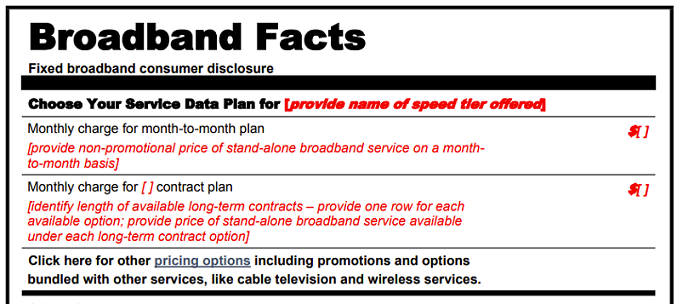
February 23, 2022 – The Federal Communications Commission (FCC) has announced it will hold a virtual public hearing on broadband consumer labels on March 11, 2022, at 1:30 p.m. ET. The virtual public hearing will stream live online at www.FCC.gov/live, and will be recorded and archived on the FCC’s website. Attendees can submit questions in advance of or during the hearing by sending an email to BroadbandLabelsHearing@fcc.gov.
The FCC kicked off the broadband consumer labels proceeding with a January 27, 2022 Notice of Proposed Rulemaking that proposed rules that would “require that broadband Internet access service providers (ISPs) display, at the point of sale, labels to disclose to consumers certain information about prices, introductory rates, data allowances, broadband speeds, and management practices, among other things.” According to the Public Notice, the first hearing will evaluate the effectiveness of the FCC’s current transparency rule, and provide necessary background for a new label requirement, including whether additional disclosure requirements may be necessary.
FCC Tentative Agenda For March 16 Open Meeting
February 23, 2022 – Federal Communications Commission Chairwoman Jessica Rosenworcel has announced a tentative agenda for the FCC’s March 16, 2022 open meeting containing the following items:
Preventing Digital Discrimination – The Commission will consider a Notice of Inquiry that would commence a proceeding to prevent and eliminate digital discrimination and ensure that all people of the United States benefit from equal access to broadband internet access service, consistent with Congress’s direction in the Infrastructure Investment and Jobs Act. (GN Docket No. 22-69)
Resolving Pole Replacement Disputes – The Commission will consider a Second Further Notice of Proposed Rulemaking that would seek comment on questions concerning the allocation of pole replacement costs between utilities and attachers and ways to expedite the resolution of pole replacement disputes. (WC Docket No. 17-84)
Selecting Final Round of Applicants for Connected Care Pilot Program – The Commission will consider a Public Notice announcing the fourth and final round of selections for the Commission’s Connected Care Pilot Program to provide Universal Service Fund support for health care providers making connected care services available directly to patients. (WC Docket No. 18-213)
Restricted Adjudicatory Matter – The Commission will consider a restricted adjudicatory matter.
National Security Matter – The Commission will consider a national security matter.
FCC Designates RDOF Auction Winners Cyber Broadband & Tombigbee Communications As ETCs In Alabama
February 22, 2022 – The FCC’s Wireline Competition Bureau has designated Cyber Broadband Inc. and Tombigbee Communications, LLC as eligible telecommunications carriers (ETCs) in Alabama. The ETC designation is limited to the areas in Alabama where the two providers were Rural Digital Opportunity Fund (RDOF) Phase I auction winners. Specifically, ETC designation in the areas in Alabama “is conditioned upon, limited to, and effective upon the carriers’ authorization to receive support under the [RDOF] program.” Additionally, the Bureau has stated that “[a]ny such ETC designation covering RDOF supported areas, however, should not be interpreted as an entitlement to support or an indication that the Bureau will ultimately authorize the petitioner for support.”
Broadband Data Collection – FCC To Start Accepting Filings On June 30, 2022 – Submissions Due No Later Than September 1, 2022

February 22, 2022 – The FCC has announced that it will begin accepting broadband availability data filed pursuant to the FCC’s new Broadband Data Collection (BDC) rules and procedures on June 30, 2022. All facilities-based providers of fixed and mobile broadband Internet access service must submit broadband availability data as of June 30, 2022, to the BDC online filing system no later than September 1, 2022.
The FCC’s new BDC program is an improved effort to collect geospatial broadband deployment data from broadband providers, as well as crowdsourced data to challenge the accuracy of the submitted data. Broadband providers will submit granular coverage maps (polygons) showing the locations where they currently provide broadband service or could provide service within 10 business days of receiving a request for service. Data will include service to residential and business locations, speed, and latency. This deployment data must conform to FCC-adopted “buffer” distances – specific network facility distances from aggregation points based on the type of technology used. Data submissions must eventually conform to the forthcoming Broadband Serviceable Location Fabric, which is a common dataset that defines all locations that need and can receive broadband service in the U.S. Broadband providers must have a corporate officer and qualified engineer certify the accuracy of their submitted data. In a future Public Notice, the FCC will provide additional information for filers, including data specifications on how to prepare their data for submission in the BDC system.
USDA Extends ReConnect Program Application Deadline To March 9, 2022

February 17, 2022 – The U.S. Department of Agriculture (USDA) has announced that it is extending the ReConnect Program application deadline to March 9, 2022. The application filing window was originally set for November 24, 2021, applications can be submitted through February 22, 2022. Now, applications must be submitted prior to 11:59 a.m. Eastern on March 9, 2022. In this iteration of the ReConnect Program, USDA is making available $200 million in ReConnect loans, $250 million in loan/grant combinations, $350 million in grants with a 25% matching requirement, and $350 million in grants with no matching requirement for Tribes and projects in socially vulnerable communities. Funding will be awarded to expand the availability of high-speed broadband internet access services in rural areas. ReConnect Program applications must be submitted through USDA Rural Development’s online application system. Additional information on ReConnect Program funding requirements can be found in the Funding Opportunity Announcement. Eligible applicants are state, local or territory governments; corporations; Native American Tribes; limited liability companies and cooperative organizations. To be eligible for ReConnect Program funding, a proposed project must serve a rural area where at least 90 percent of households do not have access to broadband service at speeds of 100 Mbps download and 20 Mbps upload, and commit to building facilities capable of providing broadband service at speeds of 100 Mbps, download and upload, to every location in its proposed service area. USDA will prioritize projects that will serve low-density rural areas with locations lacking internet access services at speeds of at least 25/3Mbps. USDA will also consider, among other things, the economic needs of the community to be served; the extent which a provider will offer affordable service options; a project’s commitment to strong labor standards; and whether a project is serving tribal lands or is submitted by a local government, Tribal Government, non-profit or cooperative.
Mergers & Acquisitions: Goldman Sachs Purchasing ImOn Communications

February 17, 2022 – Global investment firm Goldman Sachs has entered into an agreement to purchase ImOn Communications, a communications service provider based in Cedar Rapids, Iowa. Goldman Sachs’s asset management division is making the acquisition. ImOn was originally created as a cable TV provider, but today operates a fiber-to-the-premises network that covers over 60,000 homes and businesses in Cedar Rapids, Marion, Hiawatha, Iowa City, and Dubuque, Iowa. The parties have not disclosed the purchase price or other financial terms of the agreement.
Rural Digital Opportunity Fund: FCC Authorizes RDOF Support For 2,576 Winning Bids (6th RDOF Authorization)
February 14, 2022 – The FCC’s Wireline Competition Bureau has announced it has authorized Rural Digital Opportunity Fund (RDOF) Phase I auction support for 2,576 winning bids. This is the sixth Public Notice authorizing RDOF support. A list of the authorized winning bids is available as Attachment A to the Bureau’s Public Notice. The authorizations were granted after the Bureau reviewed long-form application information for each authorized winning bidder, including letters of credit and Bankruptcy Code opinion letters, and concluded the submissions were acceptable. Consequently, the Bureau has directed and authorized the Universal Service Administrative Company to obligate and disburse Universal Service Fund support to each winning bidder. Support will be disbursed in 120 monthly payments, beginning at the end of February 2022.
FCC Releases Information on Applications For Secure and Trusted Communications Networks Reimbursement Program – 161 Applications Accepted – Roughly $5.6 Billion In Funding Requested
February 9, 2022 – The FCC’s Wireline Competition Bureau has released further details on the applications filed for participation in the Secure and Trusted Communications Networks Reimbursement Program. A total of 181 applications were filed to participate in the program, and of those, 162 have been initially found eligible and acceptable. Applicants whose applications are found materially deficient will have a 15-day opportunity to cure the deficiency before their application is denied.
Of the 162 acceptable filings, the gross cost estimate demand for support for the removal, replacement, and disposal of Huawei and ZTE equipment is approximately $5.6 billion.
The gross demand for requested funding in the submitted applications exceeds the $1.9 billion appropriated for the program. Also, the Bureau has determined that “the cost estimates submitted with applications appear to be significantly higher than the estimated amounts reported to the Commission in the 2019 data collection.”
The Wireline Competition Bureau and Reimbursement Program Fund Administrator will now carefully evaluate all cost estimates and “closely scrutinize Reimbursement Claim Requests to ensure that reimbursement is limited to reasonable expenses that are actually incurred.” However, because of the amount and complexity of filed applications, the Wireline Competition Bureau has announced it will extend the application review period by an additional 45 days, moving the deadline to approve or deny submitted applications from May 1, 2022, to Wednesday, June 15, 2022.
Annual CPNI Certifications Due March 1, 2022
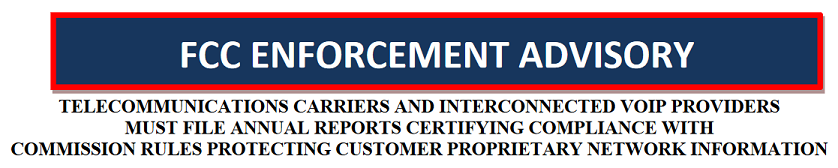
February 7, 2022 – The FCC’s Enforcement Bureau has released an Enforcement Advisory reminding telecommunications carriers that they must file an annual Customer Proprietary Network Information (CPNI) certification by March 1, 2022. The annual certification documents a telecommunications carrier’s compliance with the FCC’s CPNI rules, and must be filed in EB Docket No. 06-36. The telecommunications carriers that must file an annual CPNI certification include, but are not limited to, local exchange carriers, interexchange carriers, commercial mobile radio services providers, resellers, prepaid telecommunications providers, and calling card providers. Failure to comply with the FCC’s CPNI rules, including failing to file an annual certification, may result in an enforcement action, including monetary forfeitures of up to $220,213 for each violation or each day of a continuing violation, up to a maximum of $2,202,123. Additional information on the annual CPNI certification is available from the Bureau’s Enforcement Advisory.
Comments On FCC’s Proposed Broadband Consumer Label Requirements Due March 9th
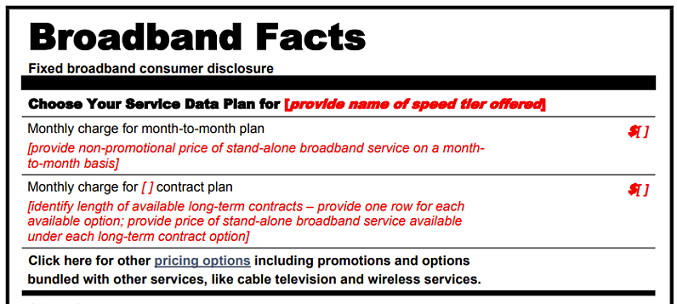
February 7, 2022 – The Federal Communications Commission’s (FCC) broadband consumer labels Notice of Proposed Rulemaking (NPRM) has been published in the Federal Register. As a result, comments on the NPRM are due on or before March 9, 2022, and reply comments are due on or before March 24, 2022. In the NPRM, the FCC proposes to “require that broadband Internet access service providers (ISPs) display, at the point of sale, labels to disclose to consumers certain information about prices, introductory rates, data allowances, broadband speeds, and management practices, among other things.” Among other things, the FCC’s NPRM seeks comment on the following issues:
In order to allow sufficient time for providers to implement the measures necessary to
comply with these requirements, the FCC proposes to make these rules effective six months following publication in the Federal Register of the Office of Management and Budget’s (OMB’s) approval of the adopted rules. Is six months sufficient for both large and smaller providers?Should the FCC adopt a different implementation timeline or temporary exemption for smaller providers to allow them more time to come into compliance with the labels’ requirements, and does the FCC have the discretion to do so?
Are there alternative ways, other than different implementation timeframes, to minimize the economic impact on smaller service providers while achieving the FCC’s transparency objectives?
Have broadband service offerings and consumers’ use of broadband services changed sufficiently since the release of the 2016 labels to necessitate modifications to the labels’ content and/or format, or are there any other reasons to change the content or format of the labels?
Where should the labels be displayed to best inform consumers?
Are there enforcement issues related to the label requirement, including how the FCC should ensure the accuracy of label content?
Are there any implementation issues, including the time by which broadband providers should be required to display the labels?
What is needed to ensure that any required labels are accessible to persons with disabilities and that any broadband consumer label advances equity in the provision of and access to digital communications services and products for all people of the United States, without discrimination on the basis of race, color, religion, national origin, sex, or disability?
NTIA Receives Public Comments On Implementing Infrastructure Act’s Broadband Funding Programs
February 5, 2022 – The U.S. Department of Commerce’s National Telecommunications and Information Administration (NTIA) has posted the comments it has received in response to a Notice and Request for Comment concerning implementation of the broadband funding programs created by the Infrastructure Investment and Jobs Act. NTIA’s Notice and Request for Comment was released on January 10, 2022, and public input was due no later than 5 p.m. on February 4, 2022. The Infrastructure Act directs NTIA to distribute over $48 billion in funding through the Broadband Equity, Access, and Deployment Program, the Enabling Middle Mile Broadband Infrastructure Program, and the State Digital Equity Planning Grant Program. NTIA sought public comment on 36 specific topics related to the three broadband funding programs.
FCC Receives 181 Applications For Secure and Trusted Communications Networks Reimbursement Program – Roughly $5.6 Billion In Funding Requested

February 4, 2022 – FCC Chairwoman Jessica Rosenworcel has notified Congress that the FCC has received over 181 applications from U.S. communications service providers requesting approximately $5.6 billion from the Secure and Trusted Communications Networks Reimbursement Program. Funding will be used to “reimburse providers of advanced communications services for costs reasonably incurred for removing, replacing, and disposing of communications equipment and services produced or provided by Huawei Technologies Company and ZTE Corporation.” Applications to participate in the Program, which was allocated $1.9 billion, were due January 28, 2022. The FCC is now reviewing each application to, among other things, confirm the eligibility of the applicant, identify reimbursable network equipment and services, and analyze cost estimates.
FCC Announces Online Portal For Submitting Supply Chain Annual Report – Providers Of Advanced Communications Services Must File By May 5, 2022

February 4, 2022 – The FCC’s Office of Economics and Analytics and Wireline Competition Bureau have announced the creation of an online portal for use by providers of advanced communications services to file Supply Chain Annual Reports detailing whether their networks contain or use “covered” communications equipment or services. The Supply Chain Annual Report must be submitted to the online portal no later than May 5, 2022.
“Covered” equipment or services are prohibited from U.S. communications networks because they have been “deemed to pose an unacceptable risk to the national security of the U.S. or the security and safety of U.S. persons.” Providers of advanced communications services must file a Supply Chain Annual Report, regardless of whether they have covered equipment or services or whether they are eligible to participate in the Secure and Trusted Communications Networks Reimbursement Program. The FCC has explained that “as this is a new information collection, past participation in the 2019 Supply Chain Information Collection does not constitute compliance with this reporting requirement.” Thus, a provider of advanced communications service that does not have any covered communications equipment or services must file a report and certify as such through the online reporting portal by May 5, 2022.
If a provider certifies its network does not contain or use “covered” communications equipment or services, it will not be required to file again, unless there is a change in its status. A subsequent annual report is not needed “unless the provider purchases, rents, leases, or obtains covered communications equipment or services at a later date, or if additional equipment or services are added to the Covered List that would mean that the provider can no longer certify that it does not have any covered communications equipment or services to report.” However, according to the Public Notice, after this year’s Supply Chain Annual Report, any provider that has previously certified that it had purchased, rented, leased, or otherwise obtained covered communications equipment and services on the Covered List must continue to submit a report once per year on or before March 31 with respect to information as of December 31 of the previous year until such covered communications equipment and services are removed. Additional information on the online reporting portal, reporting requirements, and filing instructions are available from the FCC’s Supply Chain website at https://www.fcc.gov/supplychain.
The FCC’s Public Safety and Homeland Security Bureau has published a list of the prohibited equipment and services, which is periodically reviewed and updated. Currently, this Covered List contains equipment or services produced by five entities, which extends both to subsidiaries and affiliates of the entities, as well as to telecommunications or video surveillance services provided by such entities or using such equipment:
Huawei Technologies Company – Telecommunications equipment, including telecommunications or video surveillance services provided by such entity or using such equipment.
ZTE Corporation – Telecommunications equipment, including telecommunications or video surveillance services provided by such entity or using such equipment.
Hytera Communications Corporation – Video surveillance and telecommunications equipment, to the extent it is used for the purpose of public safety, security of government facilities, physical security surveillance of critical infrastructure, and other national security purposes, including telecommunications or video surveillance services provided by such entity or using such equipment.
Hangzhou Hikvision Digital Technology Company – Video surveillance and telecommunications equipment, to the extent it is used for the purpose of public safety, security of government facilities, physical security surveillance of critical infrastructure, and other national security purposes, including telecommunications or video surveillance services provided by such entity or using such equipment.
Dahua Technology Company – Video surveillance and telecommunications equipment, to the extent it is used for the purpose of public safety, security of government facilities, physical security surveillance of critical infrastructure, and other national security purposes, including telecommunications or video surveillance services provided by such entity or using such equipment.
Broadband Industry Groups Urge Federal Agencies To Waive “Buy American” Provisions For Infrastructure Act Broadband Funding
February 1, 2022 – Broadband industry advocacy groups TIA, CCA, CTIA, NCTA, NTCA, TechNet, and US Telecom have sent a letter to Commerce Secretary Gina Raimondo, Transportation Secretary Pete Buttigieg, and Agriculture Secretary Tom Vilsack urging the agency leaders to consider a waiver of the “Buy American” provisions in the Infrastructure Investment and Jobs Act for information and communication technology products. Those provisions generally require that materials and products included in infrastructure projects funded by the Act be produced in the U.S., and they apply to the Infrastructure Act’s broadband funding programs. The Infrastructure Act provides for exceptions to or waiver of Buy American provisions under certain conditions. The broadband associations maintain that “the waiver would allow better investment in broadband infrastructure to ensure Americans are connected.” They claim “the limited waiver would be in line with previous waivers from the NTIA and other agencies implemented in the 2009 American Recovery and Reinvestment Act, and it is a vital and necessary step toward the goal of ensuring that every American has access to high-speed broadband.”
USAC Files Estimated 2Q 2022 Universal Service Funding Requirements

February 1, 2022 – The Universal Service Administrative Company (USAC) has filed the Federal Universal Service Support Mechanisms Fund Size Projections For Second Quarter 2022. USAC’s filing shows the following total projected 2Q 2022 funding requirements for each Universal Service Fund (USF) support mechanism:
High Cost Support Mechanism – $880.14 million (The 1Q 2022 funding requirement was $1.04452 billion). The 2Q 2022 total funding requirement for the High Cost Support Mechanism was initially projected at $999.62 million, but was adjusted as follows: decreased by prior period adjustments of $134.73 million and increased by administrative costs of $15.25 million; resulting in a total projected 2Q 2022 funding requirement of $880.14 million.
Low Income Support Mechanism – $220.47 million (The 1Q 2022 funding requirement was $137.51million). The 2Q 2022 total funding requirement for the Low Income Support Mechanism was initially projected at $277.76 million, but was adjusted as follows: decreased by prior period adjustment of $72.98 million and increased for administrative costs of $15.69 million; resulting in a total projected 2Q2022 funding requirement of $220.47 million.
Rural Health Care Support Mechanism – negative $7.62 million (The 1Q 2022 funding requirement was $11.72 million). The 2Q 2022 Rural Health Care Support Mechanism collection requirement of $153.01 million represents one quarter of the cap for Funding Year 2021. The amount includes collection requirements for the Telecommunications Program, the Healthcare Connect Fund, and administrative costs. The collection requirement of $153.01 million is adjusted as follows: decreased by funds available for roll forward from prior years of $153.01 million, decreased by prior period adjustment of $7.62 million; resulting in a total projected 2Q 2022 funding requirement for the Rural Health Care Support Mechanism of negative $7.62 million.
Connected Care Pilot Program – $7.81 million (The 1Q 2022 funding requirement was $9.21 million). The 2Q 2022 Connected Care Pilot Program initial collection requirement of $8.33 million was adjusted as follows: decreased by prior period adjustment of $0.59 million and increased by $0.07 million for administrative expenses, resulting in a total projected 2Q 2022 funding requirement of $7.81 million.
E-Rate Schools and Libraries Support Mechanism – $563.22 million (The 1Q 2022 funding requirement was $637.95 million).
For its consolidated budget, USAC projects total administrative costs of $58.09 million for 2Q 2022, which breaks out to $34.02 million in direct costs for all four support mechanisms, and $24.07 million in joint and common costs which include costs associated with billing, collection, and disbursement of universal service funds. This is a slight increase in administrative costs from last quarter (USAC projected a consolidated budget of $55.57 million for 1Q 2022). The FCC will use the of the quarterly funding requirements for the four USF Support Mechanisms, the projected administrative expenses, and the USF contribution base amount, to establish a quarterly USF contribution factor.