
News Update – Broadband & Telecom – March 2026
Supreme Court Says Cox Communications Not Contributorily Liable For Subscribers’ Illegal Downloads
March 25, 2026 – The Supreme Court of the United States has issued a decision in Cox Communications v. Sony Music Entertainment, a case involving whether an internet service provider (ISP) can be held contributorily liable when its subscribers use its broadband service to infringe copyrighted works.
In a 9-0 opinion, the Supreme Court concluded that Cox Communications is not contributorily liable for its subscribers’ infringement of Sony Music’s copyrighted works. The decision is a huge win for ISPs and crushes the content industry’s dream of making broadband providers act as copyright police. Justice Thomas authored the opinion for the Court. Justice Sotomayor wrote an opinion concurring in the judgment, which was joined by Justice Jackson.
To put this in a nutshell, SCOTUS has declared that an ISP is contributorily liable for its users’ direct infringement of copyrighted works only if the ISP intended its broadband service to be used for infringement. As for proving intent, the Court said that “the intent required for contributory liability can be shown only if the party induced the infringement or the provided service is tailored to that infringement.”
The Court explained that a provider induces infringement if it actively encourages infringement through specific acts. The best example of this is the Grokster case, where the Court held that a jury could find two file-sharing software companies liable for inducement because they promoted and marketed their software as a tool to infringe copyrights, and the principal object of their business models was use of their software to download copyrighted works.
Applying this to Cox v. Sony, the Court said Cox did not induce or encourage its broadband subscribers to infringe in any manner; Sony provided no evidence of express promotion, marketing, and intent to promote infringement; and Cox repeatedly discouraged copyright infringement by sending warnings, suspending services, and terminating accounts. In other words, the details of Grokster are inapposite to an ISP’s business model or an ISP’s marketing of its service.
What is a service is tailored to infringement? The Court said a service is tailored to infringement if it is not capable of substantial or commercially significant noninfringing uses. To provide the best example of this theory, the Court pointed back to the Betamax case from 1984. Betamax was a video tape recorder that could be used to record copyrighted television programs for later personal viewing, which would not constitute infringement. In that case, the Court concluded that Betamax is capable of substantial noninfringing uses, like personal use, so the sale of such equipment to the general public does not constitute contributory infringement.
With respect to Cox v. Sony, the Court found Cox’s broadband service is clearly capable of substantial or commercially significant noninfringing uses, and Cox did not tailor its service to make copyright infringement easier. Cox simply provided Internet access, which is used for many purposes other than copyright infringement. In other words, an ISP’s broadband service is capable of substantial or commercially significant noninfringing uses, and thus is not tailored to infringement.
FCC Bans New Routers Produced In A Foreign Country
March 23, 2026 – The FCC’s Public Safety and Homeland Security Bureau (PSHSB) has added “routers produced in a foreign country” to the Covered List. The PSHSB’s decision to add routers produced in a foreign country to the Covered List was made after the FCC received a National Security Determination regarding the unacceptable risks posed by routers produced in foreign countries on March 20, 2026.
The FCC’s decision “does not impact a consumer’s continued use of routers they previously acquired. Nor does it prevent retailers from continuing to sell, import, or market router models approved previously through the FCC’s equipment authorization process. By operation of the FCC’s Covered List rules, the restrictions imposed today apply to new device models.”
The FCC’s Covered List is a list of equipment and services that have been determined to “pose an unacceptable risk to the national security of the United States or the security and safety of U.S. persons. The use, importation, marketing, sale, provision, or receipt of communications equipment and services on the FCC’s Covered List may threaten American national security, as may interconnection with such equipment or services. Providers of advanced communications service must report and certify annually whether they have purchased, rented, leased, or otherwise obtained any covered communications equipment or service on the Covered List.
FCC Bans Seven Individuals From The E-Rate And Other Universal Service Support Programs
March 20, 2026 – The Federal Communications Commission (FCC) has barred seven individuals from participating in activities associated with the E-Rate program and any Universal Service Fund-supported programs. Each of the seven individuals previously had been convicted of defrauding the E-Rate program. The FCC’s Enforcement Bureau (Bureau) sent Notices of Debarment to each of the seven individuals notifying them that they “are prohibited from participating in activities associated with or related to the federal schools and libraries universal service support mechanism (E-Rate program) and any other program funded by federal universal service support mechanisms for three years, commencing on either the date of [their] receipt of [the] Notice of Debarment or of its publication in the Federal Register, whichever comes first.” Relatedly, the FCC is working to streamline the suspension and debarment processes in order to more quickly and effectively prevent bad actors from defrauding the universal service support programs. During the FCC’s March 26, 2026 open meeting, the FCC will consider a Report and Order, Direct Final Rule, and Further Notice of Proposed Rulemaking that will revise the FCC’s current nonprocurement suspension and debarment rules to expand the FCC’s tools for combatting fraud, waste, and abuse, and remove bad actors from FCC programs.
AT&T To Discontinue Residential Voice Service In Portions Of 16 Different Wire Centers In 7 States – Due To Road Construction & Other Impairment
March 19, 2026 – AT&T Services, Inc., on behalf of its affiliates in Alabama, Georgia, Arkansas, Kansas, Missouri, Oklahoma, and Texas, has filed a Section 214 discontinuance application with the FCC, requesting “to discontinue legacy TDM- and IP-based residential voice in portions of 16 different AT&T wire centers where planned road construction or other impending impairments would otherwise require AT&T to move its facilities to continue providing service.” AT&T will replace the discontinued legacy voice services with AT&T Phone – Advanced and AT&T Phone for Business – Advanced, both of which use AT&T’s wireless LTE network for connectivity. AT&T’s Section 214 discontinuance application will be deemed granted automatically on April 19, 2026, unless the FCC notifies AT&T that it will not be automatically effective. Public comments on AT&T’s application are due on or before April 3, 2026. The following information in the application summarizes AT&T’s request:
Through this application, AT&T seeks to discontinue on or after May 15, 2026, the following “Affected Services”: AT&T Residential Local Service (residential POTS), AT&T Business Local Exchange Access Line Service (business POTS), and AT&T Phone Service (AT&T’s residential, wireline VoIP service).
In the areas impacted by this application, the Affected Services are provided to 98 residential customers and 5 business customers (the “Affected Customers”) in portions of 16 different wire centers (the “Affected Service Area”).
AT&T seeks to discontinue services in these areas due to planned road work or other impending impairments that would require AT&T to move its facilities to continue providing service. Performing this work would, collectively, cost AT&T approximately $1.2M and require weeks of labor. It does not make economic sense or serve the public interest for AT&T to spend its time and money to restore such small portions of its legacy network serving relatively few customers, particularly when AT&T plans to retire the vast majority of its legacy copper network, including the facilities in these areas, within the next few years. The public interest is better served by allowing AT&T to redeploy its limited resources toward the next-generation networks necessary to compete in today’s communications marketplace, especially when replacement services are available.

Mergers & Acquisitions: Subsidiary Of LICT Corporation Acquiring Gunnison Telephone Company In Utah
March 16, 2026 – The FCC’s Wireline Competition Bureau is seeking public comment on a Section 214 application filed by Gunnison Telephone Company (Gunnison) and Lynch Telephone Corporation X (Lynch X), requesting FCC consent for the transfer of control of Gunnison to Lynch X. Comments are due on or before March 30, 2026. Reply comments are due April 6, 2026.
Gunnison is a Utah incumbent local exchange carrier (LEC) that serves approximately 530 access lines in its Utah study areas, which consist of the communities of Gunnison, Centerfield, Mayfield, Fayette, and Axtell. Gunnison operates as an average schedule rate-of-return carrier pursuant to blanket domestic Section 214 authority. It has one affiliate, Gunnison Long Distance, Inc. (GLD), that provides long-distance service to customers in Gunnison’s service areas.
Lynch X is a Delaware corporation that is indirectly held by LICT Corporation, a Delaware corporation. Since 1989, LICT Corporation has acquired 17 rural incumbent LECs, which range in size from approximately 800 to over 7,000 access lines, operate as integrated providers of broadband, voice, and video services in California, Iowa, Kansas, Michigan, New Mexico, Utah, and Wisconsin.
Pursuant to a Stock Purchase Agreement dated August 25, 2025, Lynch X will acquire all of the stock of Gunnison. As a result, Gunnison will be a direct, wholly owned subsidiary of Lynch X. Because the proposed transaction is more complex than those accepted for streamlined treatment, and in order to analyze whether the proposed transaction would serve the public interest, Wireline Competition Bureau has accepted the application for non-streamlined processing.

Mergers & Acquisitions: Point Broadband Holdings Acquiring Clearwave Fiber & Operating Subsidiaries
March 16, 2026 – The FCC’s Wireline Competition Bureau is seeking public comment on a Section 214 application filed by Point Broadband Holdings, LLC (PB Holdings, or with its operating subsidiaries, Point Broadband) and Clearwave Fiber LLC, (Clearwave Fiber, with its operating subsidiaries, Clearwave), requesting Commission consent for the transfer of control of Clearwave to PB Holdings. Comments are due on or before March 30, 2026. Reply comments are due April 6, 2026.
PB Holdings, a Delaware limited liability company, is the parent company of U.S. fiber-to-the-premise provider, Point Broadband Fiber Holding, LLC, which serves residential and commercial customers in the Midwest and Eastern United States. Through its affiliates, PB Holdings offers telecommunications services pursuant to domestic Section 214 authorizations in Alabama, Michigan, New York, Tennessee and Virginia. The companies also provide VoIP services in Alabama, Florida, Georgia, Maryland, Michigan, New York, Ohio, and Texas. Through its affiliates, PB Holdings also provides internet access services.
Clearwave Fiber LLC is a Delaware limited liability company and is a joint venture among: (i) an affiliate of Cable One, Inc., a publicly traded Delaware corporation; (ii) affiliates of GTCR Strategic Growth Investment I LLC, a Delaware limited liability company; (iii) an affiliate of Stephens Capital Partners LLC; (iv) an affiliate of The Pritzker Organization, L.L.C.; and (v) a limited number of other accredited investors. Clearwave and its subsidiaries provide domestic telecommunications services as competitive local exchange carriers (CLECs) in Florida, Georgia, Illinois, and Missouri, and other types of voice services in Kansas. Clearwave’s indirect, wholly owned subsidiaries, Hargray of Georgia LLC and Hargray of Florida LLC , operate as CLECs in Georgia and Florida, respectively. Clearwave also provides certain internet access and interconnected VoIP services in Kansas.
In December 2025, Point Broadband Acquisition, LLC PB Acquisition), a subsidiary of PB Holdings, and Clearwave Fiber LLC and CWF Alloy Merger Sub, LLC, a newly formed, wholly owned subsidiary of PB Acquisition, entered into an Agreement and Plan of Merger. Pursuant to that agreement, PB Acquisition will acquire 100% of the outstanding equity interests in Clearwave as a result of a merger of CWF Alloy Merger Sub LLC with and into Clearwave, with Clearwave surviving the merger.
After the closing and consummation, there will be certain pro forma transfers and various complex internal reorganizations. Ultimately, PB Holdings will indirectly own approximately 99.8% of the equity interests in Clearwave through Point Broadband Intermediate, and the remaining approximately 0.2% through Point Broadband Corporation Holdings, Inc. Clearwave will become an indirect, wholly owned subsidiary of PB Holdings.
PB Holding’s acquisition of Clearwave will not include Clearwave’s assets in southern Illinois and Missouri that are the subject of an October 2025 asset purchase agreement with MCC Network Services, LLC and Metro CW Holdings, LLC. Because the proposed transaction is more complex than those accepted for streamlined treatment, and in order to analyze whether the proposed transaction would serve the public interest, Wireline Competition Bureau has accepted the application for non-streamlined processing.

USF Contribution Factor For Second Quarter Of 2026 – 37%
March 16, 2026 – The FCC’s Office of Managing Director (OMD) has announced that the proposed universal service fund (USF) contribution factor for the second quarter of 2026 will be 37 percent. If the FCC takes no action on the proposed USF contribution factor within 14 days, it will be declared approved.
The 37% contribution factor for 2Q 2026 is a slight decrease from 37.6% which was used for 1Q 2026. Historical information on quarterly universal service fund contribution factors is available online from the FCC.
For the second quarter of 2026, the Universal Service Administrative Company (USAC) projects $7.553337 billion in total interstate and international end-user telecommunications revenues will be collected (1Q was $7.604471). USAC estimates that $2.022700 billion is needed to cover the total demand and expenses for all Federal universal service support mechanisms (revenue requirement) in the second quarter of 2026 (1Q was $2.060770). Total second quarter 2026 demand includes projected program support, administrative expenses, and true-ups and adjustments, which breaks out among the USF support mechanisms as follows:
E-Rate Schools & Libraries: $641.92 million (1Q was $648.93 million)
Rural Health Care: $178.84 million (1Q was $181.11 million)
High-Cost: $1.01156 billion (1Q was $1.00545 billion)
Lifeline: $190.38 million (1Q was $225.28 million)

FCC Removes Belthrough LLC From Robocall Mitigation Database – Voice Service Providers Must Cease Accepting Its Calls
March 12, 2026 – The FCC’s Enforcement Bureau has issued a Final Determination Order And Removal Order that finds that Belthrough LLC has not complied with section 64.1200(n)(2) of the FCC’s rules for voice service providers and removes Belthrough’s certification from the FCC Robocall Mitigation Database (RMD). Consequently, all intermediate providers and voice service providers are required to cease accepting all calls directly from the company within two business days of the release of the order. All voice providers immediately downstream of Belthrough must block and cease accepting all traffic directly from Belthrough beginning no later than 30 calendar days after the release date of the order.
The Bureau notified Belthrough of suspected illegal traffic in September 2025, and thereafter, issued an Initial Determination Order and Order to Show Cause in February 2026. Belthrough acknowledging receipt of the suspected illegal traffic notice, but took no action in response to either the notice or the initial determination. Belthrough cannot not re-file an RMD certification without the prior approval of the Enforcement Bureau and the Wireline Competition Bureau.
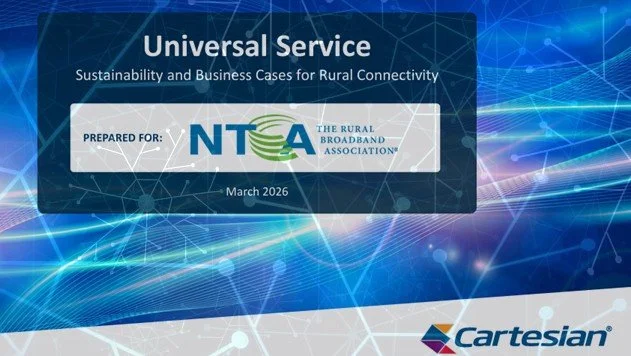
NTCA Releases Study On Universal Service – Sustainability And Business Cases For Rural Connectivity
March 11, 2026 – NTCA–The Rural Broadband Association has released a data study on the universal service fund (USF) that was conducted by Cartesian, a global consulting firm. The study, Universal Service – Sustainability and Business Cases for Rural Connectivity, “highlight[s] the critical role the USF plays in sustaining rural connectivity and ensuring affordable broadband and voice service in rural communities that otherwise lack a business case for investment.” Key findings in the Cartesian USF study include the following:
Without high-cost USF support, the sustainability of existing rural networks and services would be called into question. If USF support were eliminated, operating margins associated with the delivery of services over existing networks built in fulfillment of universal service would become unsustainable. Moreover, once the costs of maintaining and upgrading networks over time to keep pace with consumer demands are factored in, negative cash flows would pose even greater risks to ongoing service delivery and affordability. For example, a 40% reduction in USF support would prevent operators from sustaining operations on existing networks, threatening the long-term viability of broadband access in rural areas.
High labor costs present a substantial challenge. Labor costs make up about 50% of network operating expenses. With rural labor costs rising faster than inflation, operator margins will continue to shrink, especially where support fails to help address such impacts.
Funding cuts would threaten rural connectivity and put local economies at risk. Because USF support is targeted to the areas that need it most, the loss of USF support could force operators to discontinue or scale back services being delivered today. This could have a significant impact on essential services, education and commerce, exacerbating the digital divide and leaving many communities unserved or underserved.
FCC Network Modernization Report And Order Will Overhaul Copper Retirement Rules
March 5, 2026 – During its March 26th open meeting, the FCC is expected to approve a Report And Order that eliminates and revises certain rules related to retiring copper lines, in hopes of hastening the transition from legacy TDM-based networks to competitive all IP-based networks. Key regulatory changes that will likely be adopted by the FCC in the Report and Order would do the following:
Eliminate all filing requirements in the FCC’s network change disclosure rule (47 U.S.C. § 251(c)(5); 47 CFR §§ 51.325 et seq);
Simplify the process for technology transitions discontinuance applications by adopting one consolidated rule applicable to all technology transitions discontinuance applications and eliminating rule provisions thereby rendered irrelevant;
Ease burdens associated with outdated services by granting blanket section 214(a) authority for carriers to grandfather legacy voice services, lower-speed data telecommunications services, and interconnected VoIP service provisioned over copper wire;
Adopt requirements for applications to discontinue a service supporting interconnection trunks or the exchange of traffic to ensure seamless 911 connectivity;
Grant forbearance relief from section 214(a) discontinuance requirements to resellers when the wholesale provider of their resold service engages in a technology transition discontinuance, conditioned on appropriate notice to customers;
Apply the 31-day automatic grant period to all discontinuance applications regardless of applicants’ status as a dominant or non-dominant carrier but retain the ability to remove an application from streamlined processing at any point during the 31-day period should the discontinuance raise concerns;
Clarify the required contents of discontinuance applications to ensure that discontinuances do not adversely affect public convenience and necessity;
Revise the FCC’s emergency discontinuance rules to permit permanent discontinuance of the affected service under specific circumstances to support service modernization during recovery efforts;
Eliminate various obsolete, irrelevant, or redundant discontinuance rules; and
Finds that federal law preempts any state or local legal requirements that – either by law or in practice – have the effect of continuing to require carriers to provide legacy voice services in an area where carriers have obtained FCC authorization under section 214(a) of the Act to discontinue the legacy service in question or where carriers have been discouraged from seeking such FCC authorization.
FCC Announces Tentative Agenda For March 26th Open Meeting
March 5, 2026 – Federal Communications Commission Chairman Brendan Carr has announced the following tentative agenda for the FCC’s next open meeting scheduled for Thursday, March 26, 2026:
Improving Customer Service and Consumer Protection – The Commission will consider a Notice of Proposed Rulemaking that proposes a range of actions to address problems with offshore call centers, including actions to encourage and facilitate onshoring of call centers, improve customer service and security of communications, and steps to address illegal robocall scams that originate inside foreign call centers. (CG Docket Nos. 26-52, 17-59, 02-278)
Combatting Illegal Robocalls Through FCC Numbering Policies – The Commission will consider a Notice of Proposed Rulemaking that would seek comment on and evaluate whether to adopt changes to its numbering policies with respect to how assigned numbering resources are utilized, reported, and resold by service providers as part of its continuing effort to combat illegal robocalls. (WC Docket Nos. 26-49, 20-67, 13-97, 07-243)
Reducing Barriers to Network Improvements and Service Changes Accelerating Network Modernization – The Commission will consider a Report and Order that adopts measures to reduce regulatory barriers and costs that hinder the transition from outdated legacy networks and services to next-generation, IP-based infrastructure. (WC Docket Nos. 25-208, 25-209)
Spectrum Abundance for Weird Space Stuff – The Commission will consider a Notice of Proposed Rulemaking that proposes and seeks comment on ways in which to make additional spectrum available for command and control of spacecraft supporting emergent space operations, but which do not use spectrum as part of any radiocommunications services provided to the public. (SB Docket No. 26-54)
Modernizing Suspension and Debarment Rules – The Commission will consider a Report and Order, Direct Final Rule, and Further Notice of Proposed Rulemaking that would revise the FCC’s current nonprocurement suspension and debarment rules by adopting the Office of Management and Budget’s (OMB) Guidance for Governmentwide Debarment and Suspension and supplemental FCC-specific rules to expand the Commission’s tools for combatting fraud, waste, and abuse, and remove bad actors from Commission programs. (GN Docket No. 19-309)
Amending Part 1, 73, 74 and 76 Rules Applicable to Broadcast Stations – The Commission will consider a Report and Order to update rules for broadcast radio and television stations to reflect current application processing requirements, clarify and harmonize provisions, and remove references to outdated procedures and legacy filing systems. (MB Docket No. 24-626; GN Docket No. 25-133)
Rescinding Obsolete Provisions – The Commission will consider as part of the In re: Delete, Delete, Delete proceeding a Direct Final Rule that would remove 18 rules, including 17 rule provisions impacting the Office of Economics and Analytics’ (OEA) Auction Division that are no longer in use by the Commission or govern expired events and one rule impacting the Office of International Affairs (OIA). The OEA rules mainly impact Auctions and cover rules that required upfront payments for Universal Service Fund auctions that the Commission has never required for any Universal Service Fund Auction and a host of rules surrounding installment payments, which the Commission has not used since 1997. This Direct Final Rule also deletes one rule provision relating to the OIA that required carriers to submit a filing to a long-deleted requirement. This item would amend three rules that reference one of the Auctions’ rules that would be removed by this Direct Final Rule. (GN Docket 25-133)
The FCC’s March 26, 2026 open meeting is scheduled to commence at 10:30 a.m. ET in the Commission Meeting Room of the Federal Communications Commission, 45 L Street, N.E., Washington, D.C. The meeting is open to the public, but the FCC headquarters building is not open access, and all guests must check in with and be screened by FCC security at the main entrance on L Street. All FCC open meetings are streamed live at www.fcc.gov/live.

Mergers & Acquisitions: Vero Fiber Networks, LLC Acquiring Network Assets Of Velocity Fiber LLC
March 3, 2026 – The FCC’s Wireline Competition Bureau is seeking public comment on a Section 214 application filed by Velocity Fiber LLC and Vero Fiber Networks, LLC, requesting FCC approval for the acquisition of certain assets of Velocity Fiber by Vero Fiber. Comments are due on or before March 17, 2026. Reply comments are due March 24, 2026.
Velocity Fiber is a Kansas limited liability company that is authorized to provide intrastate telecommunications services in Georgia, Illinois, Iowa, Kansas, and Pennsylvania. Velocity Fiber’s business model is centered around “designing, constructing and operating robust fiber Wide Area Networks” that sere K-12 school districts.
Vero Fiber is a Colorado limited liability company that is authorized to provide intrastate telecommunications services in 31 states. Its current communications service provider affiliates are Vero Broadband, LLC, ClearNetworx, LLC. and FastTrack Communications, Inc. Vero Fiber’s business model is centered around providing telecommunications and broadband infrastructure to underserved schools and libraries. Vero Fiber is wholly owned by VFN Holdings, Inc., a Delaware limited liability company.
Pursuant to a November 2025 Asset Purchase Agreement, Vero Fiber will acquire substantially all of the network assets of Velocity Fiber, including the company’s fiber optic network, cabling and telecommunications equipment used to provide services on or over the network, unregulated assets, contracts related to those assets, and customer accounts and related contracts. Because the proposed transaction is more complex than those accepted for streamlined treatment, and in order to analyze whether the proposed transaction would serve the public interest, Wireline Competition Bureau has accepted the application for non-streamlined processing.