Kansas Broadband & Telecom News - March 2026
Midco Requests Expansion Of Lifeline ETC Area To Include Several Census Blocks In Douglas County
March 26, 2026 – Midcontinent Communications (Midco) has filed an application with the Kansas Corporation Commission (KCC) requesting an expansion of the area where the company has been designated as an eligible telecommunications carrier (ETC) solely for purposes of providing state and federal Lifeline services. Midco, a South Dakota general partnership holds a Certificate of Convenience and Authority to provide competitive local exchange service in areas of Kansas served by AT&T and Century Link. The company was designated as a Lifeline-only ETC by the KCC in April 2017, and had its ETC area expanded in March 2025. With its current application, Midco wants to expand its ETC designated area to include “several census blocks in Douglas County for which Midco was recently awarded support under the BAG 3 grant program.” It currently provides voice, broadband, and video services in and around Lawrence and Eudora in Douglas County, Kansas. Midco also filed a concurrent application to amend its Video Services Authorization to include the same areas in Douglas County. The KCC Docket Number for the proceeding is 26-MCCT-0270-ETC.
FCC Commissioner Olivia Trusty Highlights Connectivity, Innovation, And Local Impact During Kansas And Utah Visit
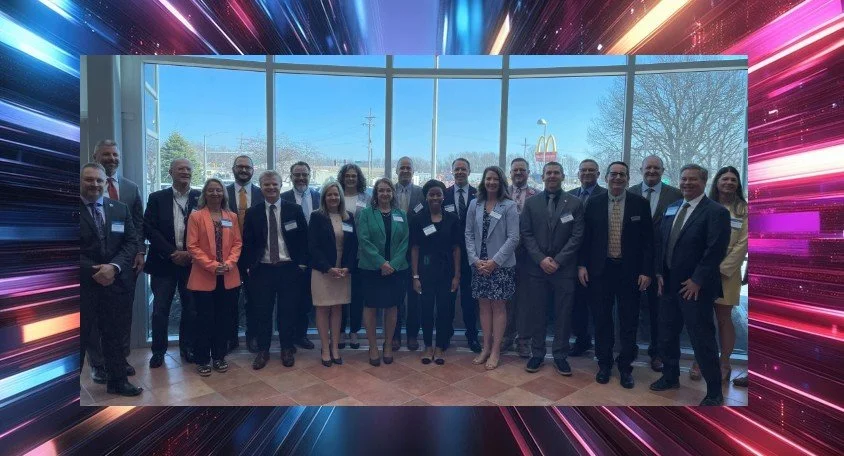
March 25, 2026 – Federal Communications Commission Commissioner Olivia Trusty has issued a press release that provides a summary of her recent “multi-day trip to Kansas and Utah, where she met with communications providers, innovators, and local stakeholders advancing connectivity and technology leadership across the United States.” Commissioner Trusty’s press release includes the following information about who she met with while in Kansas:
In Kansas, Commissioner Trusty participated in a visit hosted by Senator Jerry Moran, where she began by touring Garmin’s facilities and observed how the company is strengthening U.S. leadership in aviation and consumer technology. Garmin highlighted its growing investment in domestic engineering, manufacturing, and testing, as well as the importance of continued coordination between the wireless and aviation industries on spectrum usage.
Commissioner Trusty also joined a roundtable with broadband providers, including members of the Communications Coalition of Kansas, who discussed the critical role they play in expanding connectivity to rural communities. Participants emphasized the importance of universal service programs and other federal and state funding mechanisms, noting that effective policy design is essential to sustaining broadband service.
At a site visit with WTC Fiber, Commissioner Trusty saw firsthand how fiber expansion I connecting small towns and local businesses, strengthening economic opportunities in mutually reinforcing ways.
The Commissioner also met with local broadcasters, including WIBW in Topeka, who demonstrated how smaller stations are leveraging shared resources and new technologies to enhance service to their communities. Representatives from the Kansas Association of Broadcasters and other radio and television stations highlighted the competitive pressures they face and underscored the need for FCC policies that ensure a level playing field.
Supreme Court Says Cox Communications Not Contributorily Liable For Subscribers’ Illegal Downloads
March 25, 2026 – In a 9-0 opinion, the U.S. Supreme Court has concluded that Cox Communications is not contributorily liable for its broadband subscribers’ direct infringement of copyrighted works owned by a group of music labels. The decision is a huge win for ISPs, and fundamentally alters the legal framework for proving contributory liability for copyright infringement.
The Supreme Court’s holding in the case is that an ISP is contributorily liable for its users’ direct infringement of copyrighted works only if the ISP intended its broadband service to be used for infringement. The Court said that the intent required for contributory liability can be shown only in two ways: (1) the party induced the infringement, or (2) the provided service is tailored to infringement.
The Court explained that a provider induces infringement if it actively encourages infringement through specific acts. Applying this to the facts of Cox v. Sony, the Court said Cox did not induce or encourage its broadband subscribers to infringe in any manner; Sony provided no evidence of express promotion, marketing, and intent to promote infringement; and Cox repeatedly discouraged copyright infringement by sending warnings, suspending services, and terminating accounts.
When or what is a service tailored to infringement? The Court said that a service is tailored to infringement if it is not capable of substantial or commercially significant noninfringing uses. With respect to Cox v. Sony, the Court found Cox’s broadband service is clearly capable of substantial or commercially significant noninfringing uses, and Cox did not tailor its service to make copyright infringement easier. Cox simply provided Internet access, which is used for many purposes other than copyright infringement.
The Court’s decision reverses and remands a judgment of the Fourth Circuit Court of Appeals. That Fourth Circuit judgement found Cox liable for willful infringement of over 10,000 copyrighted works and awarded $1 billion in statutory damages to a group of major music copyright owners, including Sony Music Entertainment, Universal Music Group, Warner Music, and others.
AT&T To Discontinue Residential Voice Service In Four Areas In Kansas – Rather Than Move Its Facilities Due To Road Construction
March 19, 2026 – AT&T Services, Inc., on behalf of its affiliates in Alabama, Georgia, Arkansas, Kansas, Missouri, Oklahoma, and Texas, has filed a Section 214 discontinuance application with the FCC, requesting “to discontinue legacy TDM- and IP-based residential voice in portions of 16 different AT&T wire centers where planned road construction or other impending impairments would otherwise require AT&T to move its facilities to continue providing service.”
AT&T will discontinue residential voice service in the following four wire centers in three cities in Kansas: Paola, KS – PAOLKSPE; Hutchinson, KS – HTSNKS02; Wichita Amherst, KS – WCHTKSAM; and Wichita Kechi, KS – WCHTKSKE.
AT&T will replace the discontinued legacy voice services with AT&T Phone – Advanced and AT&T Phone for Business – Advanced, both of which use AT&T’s wireless LTE network for connectivity. AT&T’s Section 214 discontinuance application will be deemed granted automatically on April 19, 2026, unless the FCC notifies AT&T that it will not be automatically effective. Public comments on AT&T’s application are due on or before April 3, 2026. The following information in the application summarizes AT&T’s request:
Through this application, AT&T seeks to discontinue on or after May 15, 2026, the following “Affected Services”: AT&T Residential Local Service (residential POTS), AT&T Business Local Exchange Access Line Service (business POTS), and AT&T Phone Service (AT&T’s residential, wireline VoIP service).
In the areas impacted by this application, the Affected Services are provided to 98 residential customers and 5 business customers (the “Affected Customers”) in portions of 16 different wire centers (the “Affected Service Area”).
AT&T seeks to discontinue services in these areas due to planned road work or other impending impairments that would require AT&T to move its facilities to continue providing service. Performing this work would, collectively, cost AT&T approximately $1.2M and require weeks of labor. It does not make economic sense or serve the public interest for AT&T to spend its time and money to restore such small portions of its legacy network serving relatively few customers, particularly when AT&T plans to retire the vast majority of its legacy copper network, including the facilities in these areas, within the next few years. The public interest is better served by allowing AT&T to redeploy its limited resources toward the next-generation networks necessary to compete in today’s communications marketplace, especially when replacement services are available.
USF Contribution Factor For Second Quarter Of 2026 – 37%
March 16, 2026 – The FCC’s Office of Managing Director (OMD) has announced that the proposed universal service fund (USF) contribution factor for the second quarter of 2026 will be 37 percent. If the FCC takes no action on the proposed USF contribution factor within 14 days, it will be declared approved.
The 37% contribution factor for 2Q 2026 is a slight decrease from 37.6% which was used for 1Q 2026. Historical information on quarterly universal service fund contribution factors is available online from the FCC.
For the second quarter of 2026, the Universal Service Administrative Company (USAC) projects $7.553337 billion in total interstate and international end-user telecommunications revenues will be collected (1Q was $7.604471). USAC estimates that $2.022700 billion is needed to cover the total demand and expenses for all Federal universal service support mechanisms (revenue requirement) in the second quarter of 2026 (1Q was $2.060770). Total second quarter 2026 demand includes projected program support, administrative expenses, and true-ups and adjustments, which breaks out among the USF support mechanisms as follows:
E-Rate Schools & Libraries: $641.92 million (1Q was $648.93 million)
Rural Health Care: $178.84 million (1Q was $181.11 million)
High-Cost: $1.01156 billion (1Q was $1.00545 billion)
Lifeline: $190.38 million (1Q was $225.28 million)
S&T Telephone Requests Waiver Of KCC Telecom Billing Standards Waiver To Send Electronic Notices Of Service Suspension & Disconnection
March 12, 2026 – S&T Telephone Cooperative Association, Inc. has filed an application with the Kansas Corporation Commission (KCC) requesting a waiver from certain provisions of the telecommunications billing practice standards. Specifically, S&T is seeking a waiver of Section IV.D.(1) and (2) of the billing practice standards which require telecom providers to send paper notices of service suspension or disconnection to subscribers using U.S. mail. The company would like to be able to deliver these notices via electronic means rather than traditional “snail” mail. In its application, S&T explains that granting the waiver will generate an estimated $600 in annual cost savings, and will allow it to deliver the notices to subscribers much faster than U.S. mail. The company notes that the KCC has previously granted similar waivers from the requirements in Section IV.D.(1) and (2) of the telecommunications billing practice standards (Docket No. 11-RRLT-188-MIS, Docket No. 15-MRGT-110-MIS, Docket No. 25-HVDT-204-MIS, Docket No. 25-RNBT-212-MIS, and Docket No. 25-GRHT-337-MIS). The KCC Docket Number for the proceeding is 26-S&TT-0249-MIS.
Broadvox-CLEC, LLC To Surrender Its Certificates of Convenience and Authority; No Longer Provides Service Or Has Customers In Kansas
March 12, 2026 – Broadvox-CLEC, LLC has filed an application with the Kansas Corporation Commission (KCC) requesting approval to surrender its Certificate of Convenience and Authority (COC) to provide switched local exchange services, exchange access services and interexchange telecommunications services within Kansas. Broadvox-CLEC, LLC was granted COCs in 2009 by the KCC to provide switched local exchange services, exchange access services and interexchange telecommunications services in Docket Nos. 09-BDVT-699-COC and 09-BDVT-700-COC. The company is requesting approval to surrender its COCs because it “no longer provides local or interexchange in the state of Kansas,” and it “Broadvox does not have any customers in the state of Kansas.” The KCC Docket Number for the proceeding is 26-BDVT-0248-CCS.
NTCA Releases Study On Universal Service – Sustainability And Business Cases For Rural Connectivity
March 11, 2026 – NTCA–The Rural Broadband Association has released a data study on the universal service fund (USF) that was conducted by Cartesian, a global consulting firm. The study, Universal Service – Sustainability and Business Cases for Rural Connectivity, “highlight[s] the critical role the USF plays in sustaining rural connectivity and ensuring affordable broadband and voice service in rural communities that otherwise lack a business case for investment.” Key findings in the Cartesian USF study include the following:
Without high-cost USF support, the sustainability of existing rural networks and services would be called into question. If USF support were eliminated, operating margins associated with the delivery of services over existing networks built in fulfillment of universal service would become unsustainable. Moreover, once the costs of maintaining and upgrading networks over time to keep pace with consumer demands are factored in, negative cash flows would pose even greater risks to ongoing service delivery and affordability. For example, a 40% reduction in USF support would prevent operators from sustaining operations on existing networks, threatening the long-term viability of broadband access in rural areas.
High labor costs present a substantial challenge. Labor costs make up about 50% of network operating expenses. With rural labor costs rising faster than inflation, operator margins will continue to shrink, especially where support fails to help address such impacts.
Funding cuts would threaten rural connectivity and put local economies at risk. Because USF support is targeted to the areas that need it most, the loss of USF support could force operators to discontinue or scale back services being delivered today. This could have a significant impact on essential services, education and commerce, exacerbating the digital divide and leaving many communities unserved or underserved.
Google Fiber Combining With Astound Broadband
March 11, 2026 – Alphabet Inc. has announced that it has entered into an agreement with Stonepeak, a private equity fund focusing on infrastructure investments, to combine Google Fiber, now known as GFiber, with Astound Broadband. The deal creates a major independent fiber provider with a presence in 26 states and coverage to over 7 million locations. Though, most of Astound’s network is not fiber-based. The new company will be majority owned by Stonepeak, with Alphabet retaining a significant minority ownership interest. Press releases announcing the deal did not indicate whether the new combined company will have a new name or will operate as either GFiber or Astound. The transaction is subject to customary closing conditions and regulatory approvals. Financial details were not publicly disclosed. The parties expect the deal to close in the fourth quarter of 2026.
Stonepeak acquired Astound in 2020 from TPG Capital and Patriot Media Management for $8.1 billion. At the time, Astound Broadband, which is a holding company, was considered the sixth largest U.S. cable operator in the U.S., operating regional providers RCN, Grande Communications, Wave Broadband, and enTouch. Google Fiber was launched in 2010. It now provides broadband service in 19 states.
KOBD Releases Updated Draft BEAD Subrecipient Subaward Agreement
March 10, 2026 – The Kansas Office of Broadband Development (KOBD) has released an updated draft Subrecipient Subaward Agreement for Broadband Equity, Access and Deployment (BEAD) program awardees. The draft agreement is subject to further changes as necessary. Every BEAD program awardee will be required to enter into a Subrecipient Subaward Agreement.
In December 2025, the National Telecommunications and Information Administration (NTIA) approved the KOBD’s $166.6 million final proposal for the BEAD program. The final proposal selects 14 awardees to receive a total of $166,605,012 in BEAD grant funding to deploy 81 broadband projects. The total amount of BEAD funding that was awarded represents 37% of Kansas’ total original BEAD allocation of $451.725 million (a 63% reduction). Kansas loses $285,120,986 in federal funding because of NTIA’s Benefit of the Bargain Round. Roughly 30% of the funding will be used to deploy fiber-based broadband network projects. Some of which include networks that are a hybrid of fiber and fixed wireless. Fixed wireless networks received 67% of the total funding, and Low Earth Orbit (LEO) satellite service received 3%. BEAD awardees will contribute $61.3 million in matching funds. KOBD received competitive bids for 100% of the eligible homes and businesses. The average BEAD cost per location is $6,791.
Brightspeed Of Southern Kansas, Inc. Converts To LLC, Requests Name Change On Certificate Of Authority
March 6, 2026 – Brightspeed Of Southern Kansas, Inc. has filed a notice and application with the Kansas Corporation Commission (KCC) requesting to change the company’s name to Brightspeed of Southern Kansas, LLC on its Certificate of Convenience and Authority. In December 2025, the company surrendered its authority to transact business in Kansas, converted to an Arkansas limited liability company, and registered Brightspeed of Southern Kansas, LLC as foreign (non-Kansas) business. Brightspeed states that the “change in corporate status and name will be entirely transparent to the company’s customers and will have no impact on the day-to-day operations of the company, its customers, or the public generally.” Additionally, Brightspeed requests that it be allowed to submit new tariffs reflecting the new name, as needed, within 90 days of an order approving its application. The KCC Docket Number for the proceeding is 26-USCT-0244-CCN.

Mergers & Acquisitions: IdeaTek (Private Equity) Acquires Velocity Broadband Assets From Butler Rural Electric Cooperative
March 3, 2026 – IdeaTek Telcom, LLC has announced that it has acquired the broadband assets of Butler Rural Electric Cooperative Association, Inc. which are used to provide service under the name Velocity. The structure of the deal was not publicly disclosed. Terms of the deal were not publicly disclosed.
Velocity, a division within Butler Rural Electric, was created in 2018 to provide internet access to the electric cooperative’s members. It generally consists of network assets, residential and business services, and customers of those services. Velocity provides fiber-based internet access in the communities of Rose Hill and El Dorado, and fixed wireless service to residents of parts of Butler, Sedgwick, Harvey, Cowley, Marion, Chase, and Greenwood counties. (Velocity is the name used by Butler Electric to provide internet services, and is not a separate company. It is not and should not be confused with Velocity Fiber, LLC, a different Kansas broadband company that is in the process of being acquired by Vero Fiber Networks, LLC.)
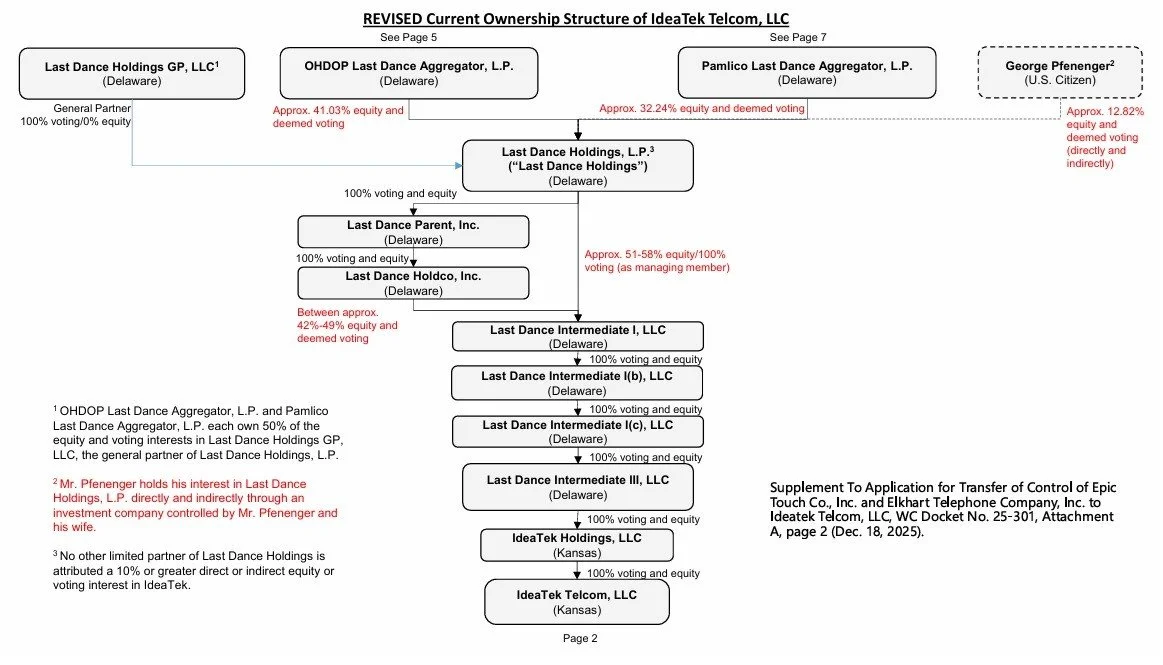
Ideatek is directly, wholly owned by IdeaTek Holdings, which is directly wholly owned by Last Dance Intermediate III, LLC (LDI), a Delaware limited liability company and investment fund created for the purpose of purchasing Ideatek in March 2025. LDI is indirectly and wholly owned by Last Dance Holdings, L.P. (LDH), a Delaware limited partnership and investment fund. LDH is primarily owned and controlled by funds and entities affiliated with Oak Hill Capital Management and Pamlico Capital Management, which are private equity funds based in the United States.
IdeaTek primarily operates in Kansas, where it is authorized to provide local exchange and interexchange services and is designated as an Eligible Telecommunications Carrier. It is also authorized to provide local exchange, interexchange, and interconnected VoIP services in Missouri. IdeaTek has been authorized by the FCC to receive Connect America Fund Phase II auction support and Rural Digital Opportunity Fund Phase I support.

Mergers & Acquisitions: Vero Fiber Networks, LLC Acquiring Network Assets Of Velocity Fiber LLC
March 3, 2026 – The FCC’s Wireline Competition Bureau is seeking public comment on a Section 214 application filed by Velocity Fiber LLC and Vero Fiber Networks, LLC, requesting FCC approval for the acquisition of certain assets of Velocity Fiber by Vero Fiber. Comments are due on or before March 17, 2026. Reply comments are due March 24, 2026.
Velocity Fiber is a Kansas limited liability company that is authorized to provide intrastate telecommunications services in Georgia, Illinois, Iowa, Kansas, and Pennsylvania. Velocity Fiber’s business model is centered around “designing, constructing and operating robust fiber Wide Area Networks” that sere K-12 school districts.
Vero Fiber is a Colorado limited liability company that is authorized to provide intrastate telecommunications services in 31 states. Its current communications service provider affiliates are Vero Broadband, LLC, ClearNetworx, LLC. and FastTrack Communications, Inc. Vero Fiber’s business model is centered around providing telecommunications and broadband infrastructure to underserved schools and libraries. Vero Fiber is wholly owned by VFN Holdings, Inc., a Delaware limited liability company.
Pursuant to a November 2025 Asset Purchase Agreement, Vero Fiber will acquire substantially all of the network assets of Velocity Fiber, including the company’s fiber optic network, cabling and telecommunications equipment used to provide services on or over the network, unregulated assets, contracts related to those assets, and customer accounts and related contracts. Because the proposed transaction is more complex than those accepted for streamlined treatment, and in order to analyze whether the proposed transaction would serve the public interest, Wireline Competition Bureau has accepted the application for non-streamlined processing.
Peoples Services, LLC Files Complaint Against Zoom Drain For Alleged Violations Of Kansas Underground Utility Damage Prevention Act
March 1, 2026 – Peoples Services, LLC has filed a complaint against Missouri Drain and Sewer, LLC d/b/a Zoom Drain, for alleged violations of the Kansas Underground Utility Damage Prevention Act. In its complaint, Peoples alleges that Zoom Drain performed an excavation in an area where Zoom Drain had not called in a locate request to the Kansas One Call Center, resulting in a cut to fiber optic cable owned by Peoples. The complaint further alleges that Zoom Drain failed to alert either the Kansas One Call Center or Peoples about the fiber cut. The KCC Docket Number for the proceeding is 26-PPST-0228-COM.
New Kansas Corporation Commission Telecom Dockets Opened In March 2026
26-PPST-0228-COM – Complaint of Peoples Services, LLC Against Missouri Drain and Sewer, LLC d/b/a Zoom Drain, for Violations of the Kansas Underground Utility Damage Prevention Act, K.S.A. 66-1801.
26-USCT-0244-CCN – Brightspeed of Southern Kansas, Inc. Changing its Name to Brightspeed of Southern Kansas, LLC.
26-BDVT-0248-CCS – Application of Broadvox-CLEC, LLC to Surrender its Certificate of Convenience to Provide Switched Local Exchange and Exchange Access Services and Interexchange Services Within the State of Kansas.
26-S&TT-0249-MIS – Application of S&T Telephone Cooperative Association, Inc. for Waiver of Certain Telecommunications Billing Practice Standards.
26-MCCT-0270-ETC – Application of Midcontinent Communications, a South Dakota General Partnership for Designation as an Eligible Telecommunications Carrier.