
Kansas Broadband & Telecom News – May 2026
Blue Valley Tele-Communications, Inc. Revises Intrastate Access Service Tariff
May 29, 2026 – Blue Valley Tele-Communications, Inc. has filed revisions to its Kansas Intrastate Access Service Tariff with the Kansas Corporation Commission (KCC). The filing revises five pages in Appendix A to the tariff. Blue Valley explains that the filing “is being made due to companies exiting the NECA pool on July 1, 2026 and, as a result, filing exception rates in the Blue Valley tariff.” The KCC Docket Number for the proceeding is 26-BLVT-0441-TAR.

CISA Announces New Dates For Virtual Town Hall Meetings On Cyber Incident Reporting For Critical Infrastructure Act Of 2022 (CIRCIA) Rulemaking – Communications Sector Townhall Scheduled For June 16, 2026
May 26, 2026 – The U.S. Department Of Homeland Security’s Cybersecurity and Infrastructure Security Agency (CISA) has announced a revised schedule for a series of virtual town hall meetings to gather stakeholder input on the Cyber Incident Reporting for Critical Infrastructure Act of 2022 (CIRCIA) rulemaking. There will be four townhall meetings consisting of two general sessions and two sessions focused on critical infrastructure sectors. All town hall meetings are tentatively scheduled to take place from 11:30 a.m. to 3:30 p.m. Eastern Time. Registration is required to attend each town hall meeting, and can be completed at www.cisa.gov/circia. Registration closes two business days before each meeting. CISA has announced the following virtual town hall meetings that are scheduled to be held on the following dates:
Monday, June 15, 2026 – General Session 1
Tuesday, June 16, 2026 – Critical Infrastructure Sectors Grouping A – Communications Sector; Dams Sector; Emergency Services Sector; Food and Agriculture Sector; Government Facilities Sector; Healthcare and Public Health Sector; Transportation Systems Sector; and Water and Wastewater Sector.
Wednesday, June 17, 2026 – General Session 2
Thursday, June 18, 2026 – Critical Infrastructure Sectors Grouping B – Chemical Sector; Commercial Facilities Sector; Critical Manufacturing Sector; Defense Industrial Base Sector; Energy Sector; Financial Services Sector; Information Technology Sector; and Nuclear Reactors, Materials, and Waste Sector.
NTCA–The Rural Broadband Association Urges NTIA To Publicly Release BEAD Performance Testing Results
May 19, 2026 – NTCA–The Rural Broadband Association has sent a letter to the head of National Telecommunications and Information Administration (NTIA), requesting that NTIA require the public release of the Broadband Equity, Access, and Deployment (BEAD) program performance testing results. Broadband projects funded under BEAD are required to meet specific capacity, latency, and availability standards, such as speed of at least 100 Mbps for downloads and 20 Mbps for uploads. Subgrantee awardees are required to complete network testing to verify that the performance requirements have been met. In its letter, NTCA urges NTIA “to further advance accountability and transparency, however, by publicly releasing (or directing Eligible Entities to publish, as applicable) the results of each subgrantee’s performance testing.” NTCA says that posting the information on NTIA’s website will allow policymakers and the public to determine whether BEAD awardees are following through on their obligations.
Fixed Wireless Provider Vistabeam Activates First BEAD-Funded Broadband Connection
May 14, 2026 – The National Telecommunications and Information Administration (NTIA) has announced that Vistabeam has activated the first household broadband connection funded through the Broadband Equity, Access, and Deployment (BEAD) Program. The household is located near Ogallala, Nebraska, and it now receives broadband service with speeds exceeding 800/200 Mbps. Vistabeam is a fixed wireless provider that covers over 50,000 square miles across western Nebraska, northeastern Colorado, and southeastern Wyoming. Vistabeam was awarded BEAD funding for three tower upgrades totaling $423,375 to serve 93 locations across Nebraska.

SpaceX Wants FCC To Eliminate High Cost USF Support Programs
May 13, 2026 – SpaceX has filed an ex parte letter addressing the FCC’s forthcoming Notice of Proposed Rulemaking (NPRM) on the Universal Service Fund (USF) High-Cost Program. The FCC is expected to approve and release the NPRM at its May 20 open meeting. SpaceX’s ex parte covers its meetings with advisors to the FCC Chairman and the two Commissioners, as well as the FCC’s Wireless Bureau. During those meetings, SpaceX discussed the draft version of the NPRM and recommended changes to certain parts that deal with satellite broadband service. SpaceX is the parent company of low-Earth orbit satellite broadband provider Starlink.
Notably, SpaceX claims that the FCC should establish a plan to sunset the USF High-Cost support mechanisms. SpaceX claims that universal broadband access has been achieved because of unsubsidized terrestrial broadband providers, low-Earth orbit satellite systems, and the BEAD program. SpaceX then goes on to talk about the improvements Starlink it has made to its service, such as increased speeds, reduced latency, and additional capacity of its satellite constellations. Finally, SpaceX provided redline changes to six paragraphs in the NPRM.
NTIA Issues Guidance Related To BEAD Subgrantee Award Contracts – BEAD Subgrantees: Protect Your Rights
May 11, 2026 – The National Telecommunications and Information Administration (NTIA) has issued guidance related to the Broadband Equity, Access, and Deployment (BEAD) Program. Specifically, the guidance, titled “BEAD Subgrantees: Protect Your Rights,” informs BEAD subgrantees that their contracts with state broadband agencies must contain certain language mandated by the BEAD General Terms and Conditions. The required language is related to two topics: prohibition on utility-style rate regulation; and permitting commitments.
NTIA’s guidance informs subgrantees that “states are required to include specific contract language mandated by the BEAD General Terms and Conditions and may not omit, alter, or otherwise attempt to contract around such language in their subgrantee agreements.” NTIA further explains that subgrantees should confirm the required language is included, unaltered, in their award contracts, and should not sign agreements that omit or modify the provisions. Additional information on the required contract language is included in NTIA’s guidance document.
Kansas Fiber Network Announces Danny Pate As New CEO
May 8, 2026 – Kansas Fiber Network (KFN) has announced that it has hired Danny Pate as its new President and CEO. KFN is a regional fiber infrastructure provider serving Kansas, Missouri, and the surrounding Midwest. In its press release, KFN provided the following information on its new CEO:
Pate brings more than 30 years of experience in telecommunications, spanning network and field operations, construction, program management, digital transformation, and sales. Most recently, he served as Chief Operating Officer at Fatbeam Fiber, where he led daily operations, scaled performance-driven operating models, and drove process and cost efficiencies to fuel revenue growth.
“We are pleased to bring Danny on board,” said Mark Gailey, Chairman of KFN’s Board of Directors. “The Board ran a diligent search to identify a leader who can accelerate KFN’s strategic direction. Danny’s track record positions KFN to move confidently into our next phase of growth.”
Earlier in his career, Pate served as Chief Operating Officer at Fastwyre Broadband and as Executive Vice President of Operations at Summit Broadband. He began his career in telecommunications with the local division of Sprint, Qwest Communications, and CenturyLink, holding network leadership roles that culminated in Vice President positions in Engineering and Operations across multiple CenturyLink markets over 22 years.
USAC Releases Data On Legacy Rate-Of-Return Budget Control Mechanism For July
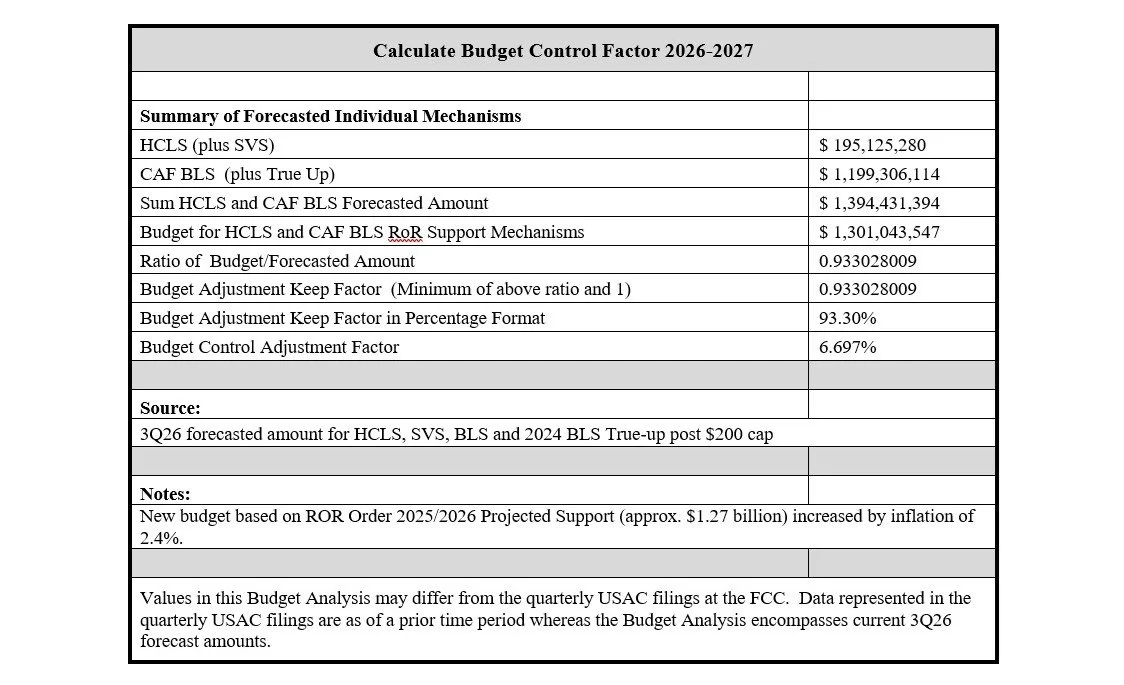
May 8, 2026 – The Universal Service Administrative Company (USAC) has released information on the legacy rate-of-return Budget Control Mechanism (BCM) for July 2026 through June 2027. The budget control mechanism was created by the FCC in the 2016 Rate-of-Return Reform Order as a method for enforcing the rate-of-return carrier legacy support budget in the event total support is forecasted to exceed the budget in a given year. Carriers that receive universal service fund High Cost legacy support, which includes Connect America Fund Broadband Loop Support (CAF BLS), High Cost Loop (HCL) and Safety Valve Support (SVS), are subject to the BCM. When the BCM is applied, carriers receive pro rata support reductions, but no carrier’s support can be reduced below a certain minimum threshold level.
For July 1, 2026 to June 30, 2027, forecasted total support for legacy rate-of-return carriers is projected to exceed the budget by 93,387,847, resulting in a projected budget control adjustment factor of 6.697%. A table showing USAC’s summary of the BCM data and calculations is shown below, all of which are subject to change.
AccessLine Communications Corporation To Cancel Certificate Of Authority To Provide Interexchange Services In Kansas
May 7, 2026 – AccessLine Communications Corporation (ACC) has filed a letter notifying the Kansas Corporation Commission (KCC) that it is voluntarily requesting cancellation of its Certificate Of Convenience And Authority to provide interexchange services, with an effective date of May 21, 2026. ACC was issued a Certificate Of Convenience And Authority to provide interexchange services on February 1, 2005, in Docket No. 05-ALIC-462-COC. In support of its request, ACC has provided the following information:
The public convenience and necessity will not be adversely affected by the action described herein. ACC does not offer or provide any intrastate telecommunications services to Kansas customers pursuant to the above-referenced certificate, and therefore no customer’s services will be interrupted or disconnected.
The KCC typically does not allow a company to cancel a Certificate Of Convenience And Authority by filing a notice letter. Presumably, the KCC will inform ACC that it must file an application that adheres to the KCC’s requirements if ACC wants to cancel its IXC certificate. The KCC Docket Number for the proceeding is 26-ALIC-0312-CCS.

Court Overturns FCC Digital Discrimination Rules
May 6, 2026 – The U.S. Court of Appeals for the Eighth Circuit has issued an opinion that overturns the Federal Communications Commission’s (FCC) digital discrimination rules. In short, the Court concluded that the FCC exceeded its statutory authority in two respects – disparate impact liability and the definition of covered entities.
In November 2023, the FCC adopted a Report And Order containing “final rules to prevent digital discrimination of access to broadband services based on income level, race, ethnicity, color, religion, or national origin.” In general, the digital discrimination rules prohibited broadband providers’ policies or practices that (1) differentially impact consumers’ access to broadband internet access service based on their income level, race, ethnicity, color, religion or national origin, or (2) are intended to have such differential impact. In other words, the FCC adopted two theories of digital discrimination liability: disparate treatment and disparate impact. The scope of the rules also extended beyond broadband providers to entities that facilitate and otherwise affect consumer access to broadband internet access services.
Shortly after the digital discrimination rules were approved, petitions for review were filed by telecom and broadband industry associations in six U.S. Courts of Appeals, all of which sought to have them struck down, claiming the FCC exceeded its statutory authority; the rules are arbitrary, capricious, and an abuse of discretion; and the rules are otherwise contrary to law. The legal challenges were consolidated in the U.S. Court of Appeals for the Eighth Circuit.
That Court has now vacated the FCC’s digital discrimination rules. It found that Congress did not authorize disparate impact liability and the FCC exceeded its statutory authority in adopting a final rule authorizing the imposition of disparate impact liability. The Eighth Circuit also found that the FCC exceeded its statutory authority when it extended the final rule to cover entities other than broadband providers. While the rules have been vacated, the Court nonetheless remanded the issue back to the FCC because there is now “an unfinished obligation to ‘adopt final rules to facilitate equal access to broadband internet access service” in compliance with 47 U.S.C. § 1754.’”
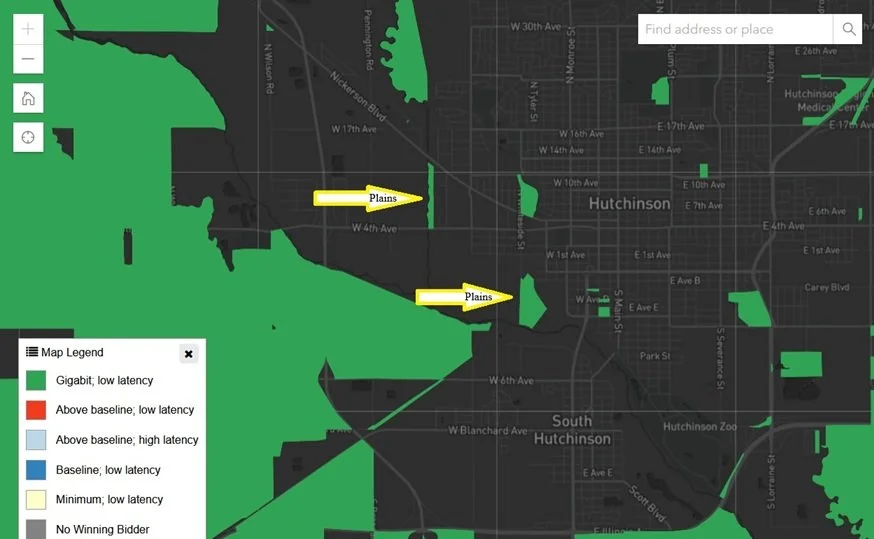
Plains Internet Defaults On RDOF Support In Kansas, Fails To Meet Obligation To Serve Three Locations
May 1, 2026 – Plains Internet, LLC has notified the Federal Communications Commission that it will default on its Rural Digital Opportunity Fund (RDOF) obligations in Kansas (SAC 419049). Plains Internet was awarded $9,834.00 in RDOF support to serve three locations in Kansas with voice and gigabit broadband service. The three RDOF locations are located on the western edge of Hutchison, Kansas. Plains Internet has not deployed service to any of the three locations.
New Kansas Corporation Commission Telecom Dockets Opened In May 2026
26-ALIC-0312-CCS – Application of AccessLine Communications Corporation to Surrender its Certificate of Convenience to Provide Interexchange Telecommunication Services Within the State of Kansas.
26-BLVT-0441-TAR – Application of Blue Valley Tele-Communications, Inc for Revisions to the 14th Revised Sheet and Original Sheets 65 Through 68 Tariff.