Kansas Broadband & Telecom News - January 2026
FCC Chairman Announces NPRM Aimed At Safeguarding The Lifeline Program
January 27, 2026 – Federal Communications Commission (FCC) Chairman Brendan Carr has announced that during the FCC’s open meeting on February 18, 2026, the FCC will consider a Notice of Proposed Rulemaking (NPRM) to reform the universal service Lifeline program. If approved, the NPRM will seek public comment on proposed rules that are intended to help prevent fraud, waste, and abuse in the Lifeline program, including the following:
Propose that Lifeline is a federal public benefit restricted to U.S. citizens and qualified aliens under the Personal Responsibility and Work Opportunity Reconciliation Act of 1996.
Seek comment on enhanced requirements to ensure that program participants are legal beneficiaries of Lifeline discounts, predictable minimum service standards, ending the voice support phase-down, and preventing duplicative support.
Propose and seek comment on collecting the full nine-digit Social Security Number from applicants and using the Systematic Alien Verification for Entitlements program to support household eligibility verifications.
Propose and seek comment on requiring secondary verification of a consumer’s consent to enroll in Lifeline or transfer to a new eligible telecommunications carrier (ETC).
Seek comment on workable minimum data capacity and speeds for Lifeline supported broadband services and maintaining support for voice-only services.
Propose and seek comment on codifying the existing requirement that an ETC must search its own internal records to ensure that it does not already provide Lifeline-supported service to someone within the applicant’s household.
Seek comment on rule changes to improve program integrity and efficiency, including whether to continue to permit “opt-out” states to use their own verification processes and whether the Commission should reduce annual reporting burdens for ETCs.
Seek comment on changes to promote more principled ETC conduct, including changes to the requirements for non-facilities-based ETCs to participate in the Lifeline program and whether additional enforcement mechanisms are necessary to ensure that only ETCs directly providing Lifeline service receive Lifeline reimbursement.
Propose and seek comment on requiring usage tracking and non-usage de-enrollment for all Lifeline service plans regardless of whether a monthly fee is assessed and collected.
Propose and seek comment on streamlining the Lifeline rules, including deleting Emergency Broadband Benefit Program and Affordable Connectivity Program rules, and minimizing stakeholder confusion.
The upcoming Lifeline NPRM was made public in an FCC press release. Chairman Carr also announced the NPRM in a blog post about the full agenda for the FCC’s February 18th open meeting. Chairman Carr provided the following paragraph explaining the need for the Lifeline program NPRM:
First up, we will take another important step in our work to protect federal USF expenditures from waste, fraud, and abuse. The federal Lifeline program plays a critical role in helping eligible low‑income Americans stay connected. However, the FCC’s Office of Inspector General has found concerning patterns of fraud that merit the Commission’s attention. As a recent Inspector General Advisory shows, millions of Lifeline dollars have been flowing to accounts of deceased individuals. And the FCC itself recently took action to prevent California’s unlawful abuse of the federal Lifeline program. On top of this, the FCC has not updated its rules recently to ensure that federal dollars are only flowing to people that are both here legally and lawfully qualified to receive these federal benefits. So next month, the Commission will vote on proposals aimed at strengthening the integrity of the federal Lifeline program—ensuring USF dollars flow only to living and lawful beneficiaries. These changes are designed to ensure that the Lifeline program is efficient, transparent, and accountable—while continuing to support Americans who rely on it.

SpaceX Wants LEO Satellite Exemptions From Certain Requirements In BEAD Award Contracts
January 27, 2025 – SpaceX has sent a letter to state broadband agencies asking for the removal of certain provisions found in Broadband Equity Access and Deployment (BEAD) program subgrantee contracts. SpaceX’s wholly owned subsidiary Starlink, a Low-Earth Orbit (LEO) satellite broadband provider, was awarded BEAD funding in numerous states. Like other BEAD award winners, Starlink will be required to enter into a subgrant agreement with each state where it was awarded funding. However, SpaceX wants Starlink and other LEO satellite providers to be exempt from certain provisions found in those BEAD award contracts.
In its letter, SpaceX claims that a number of issues remain that, if unaddressed, could render LEO participation in the BEAD program untenable. SpaceX then lays out a set of terms that it intends to function as a contract rider to all subgrant agreements across the country. Key information from the letter and contract rider are summarized below.
Performance Obligations – SpaceX will include the capacity needs of BEAD users into its network planning efforts. These activities are multifaceted and include real time capacity allocation at the network level, launch activities, and sales efforts. As a result, there is no single “document” evidencing the reservation of capacity. Network performance testing shall exclude subscribers who have installed CPE such that its view of the sky is obstructed and subscribers with damaged or malfunctioning CPE.
Payments – SpaceX seeks to clarify that payment schedule releases 50% of the total grant funds upon the time SpaceX certifies it is capable of initiating BEAD-quality service, upon request, to any BSL in a project area within 10 business days. Thereafter, the state would pay SpaceX the remaining 50% of funds in equal quarterly installments over the 10-year period of performance.
Penalties – The Infrastructure Investment and Jobs Act (IIJA), and the BEAD Notice of Funding Opportunity (NOFO) authorizes certain penalties for subgrantee non-compliance: (1) the claw back of previously disbursed funds and (2) the mechanisms of suspension and debarment where appropriate. As such, SpaceX seeks to clarify these two remedies are the exclusive remedies available in the event of grantee default.
Reporting, Records and Audits – The realities of LEO deployment, involving globally utilized, space-based infrastructure simply do not support the structures around documentation of costs applicable to serving specific BSLs or project areas. For SpaceX, this issue is particularly acute given its substantial vertical integration, meaning that invoices from third parties for finished products (launch activities, satellites, CPE, ground network) simply do not exist because these are each manufactured by SpaceX itself.
Labor, Contractors and Procurement Issues – Just as there are no identifiable pieces of SpaceX infrastructure equipment (other than satellite capacity delivered from Space) being funded via BEAD to support BSLs in the state, there are no identifiable employees, contractors, or contracts being funded to support BSLs in the state. As such, all requirements related to labor issues (e.g., prevailing wage and similar obligations), contractors, and procurement are inapplicable to SpaceX.
Insurance – The various insurance requirements contained in subgrant agreements do not make sense for a LEO provider like SpaceX. SpaceX is not conducting any dangerous or material activities in state for which insurable risks might arise. As such, all insurance requirements should be removed from the agreement.
FCC Chairman Announces Intercarrier Compensation NPRM
January 27, 2026 – Federal Communications Commission (FCC) Chairman Brendan Carr has announced that during the FCC’s open meeting on February 18, 2026, the FCC will consider a Notice of Proposed Rulemaking (NPRM) on phasing-out the intercarrier compensation regime. Chairman Carr announced the intercarrier compensation NPRM in a blog post covering the full agenda for the FCC’s February 18th open meeting. Chairman Carr provided the following paragraph on the NPRM:
Finally, we are continuing our work on the transition to all-IP networks by voting on an NPRM that explores the best way to phase carriers out of the intercarrier compensation regime to a full bill-and-keep framework. Over the last year, we have been hard at work creating the right incentives for providers to update their networks to modern, high-speed ones. But it’s just as important that we eliminate some of the potentially perverse incentives embedded in our decades-old rules that keep Americans on old ones. This ICC NPRM aims to do just that, while also recognizing that the Commission must be thoughtful in its approach—mindful of the complex issues, transition timelines, and paramount connectivity goals.
According to the FCC, the NPRM is intended to accelerate the transition of the nation’s telecommunications networks to more efficient all-Internet Protocol (IP) networks by transitioning remaining access charges to bill-and-keep, detariffing those charges, and deregulating and detariffing end-user charges. The move from access charges to bill-and-keep began in 2011 with the release of the FCC’s USF/ICC Transformation Order. The FCC’s summary of the NPRM’s key proposals are included below:
Finalize the Transition of Intercarrier Access Charges to Bill-and-Keep: Propose capping the remaining intrastate originating switched access charges for rate-of-return and competitive local exchange carriers (LECs or carriers) and transitioning these, along with all remaining interstate originating and terminating switched access charges, to a bill-and-keep framework over a twenty-four month period and explore alternatives.
Implementation: Seek comment on how to define the network edge for allocating transport cost responsibilities between carriers, both during the transition and after full IP migration, and seek comment on whether the Commission should forbear from tariffing access charges after the transition to bill-and-keep.
Cost Recovery: To enable carriers to recover their costs directly from end users, seek comment on eliminating ex ante pricing regulation of end-user charges, detariffing them, phasing out CAF ICC support, and on the potential need for any additional funding that may be required to facilitate the IP transition.
Interexchange Marketplace Reforms: Propose and seek comment on deregulating and detariffing domestic interstate and international interexchange services and eliminating outdated reporting requirements.
Industry Input: Invite industry collaboration and input on the most effective and efficient strategies for thoughtfully transitioning carriers to a bill-and-keep framework and all-IP networks.
KS Senate Committee On Government Efficiency Holds Informational Hearing On Kansas Universal Service Fund
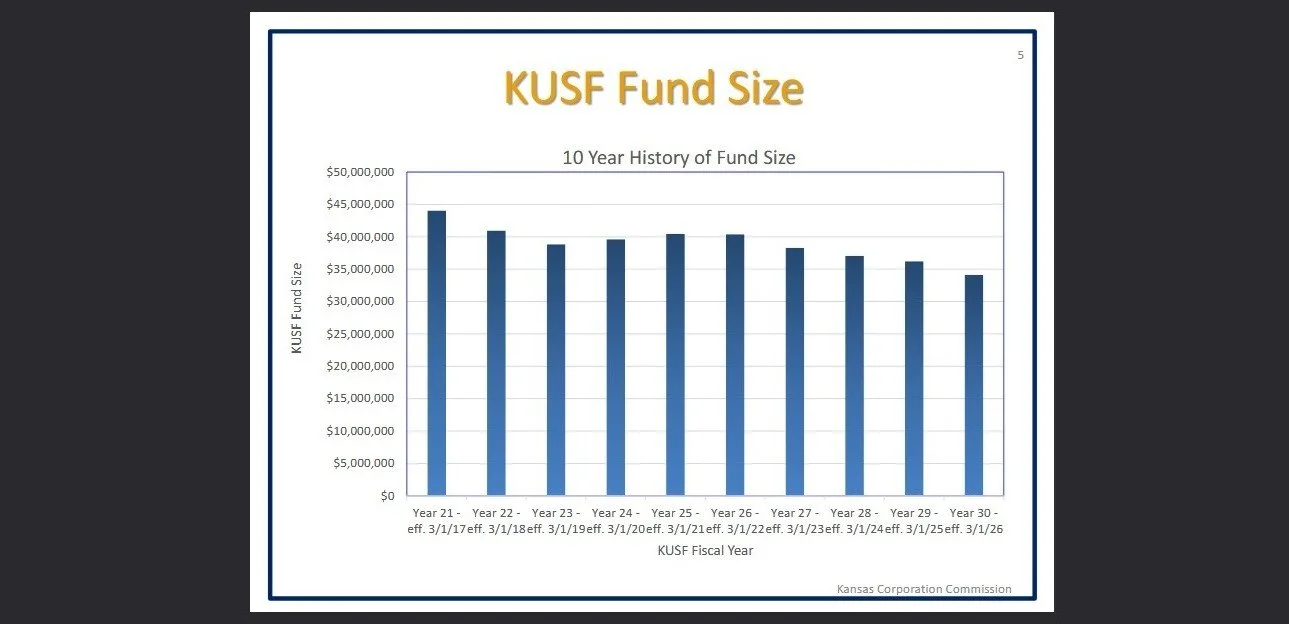
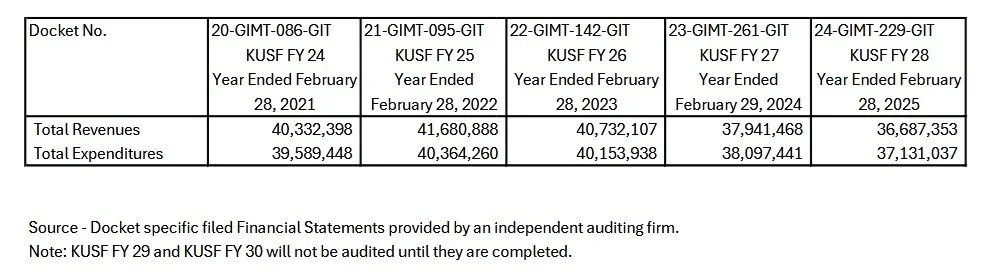
January 22, 2206 – The Kansas Senate Committee on Government Efficiency held an informational hearing on the Kansas Universal Service Fund (KUSF). Steve Garrett, the Kansas Corporation Commission’s Deputy Chief of Telecommunications, provided testimony and answered questions from the nine-member committee. Mr. Garrett’s testimony, which included a PowerPoint presentation, covered the creation, purpose, and current state of the KUSF.
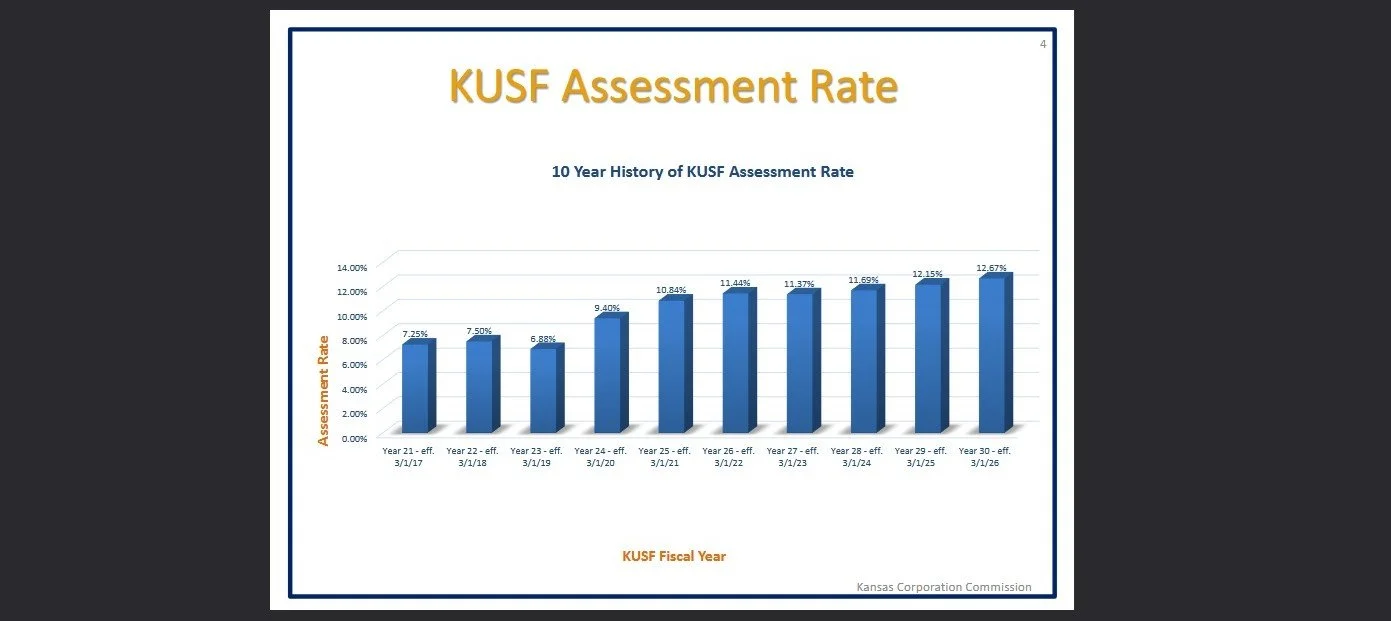
Garrett, KCC, presentation, Senate Committee on Government Efficiency (Jan. 22, 2026).
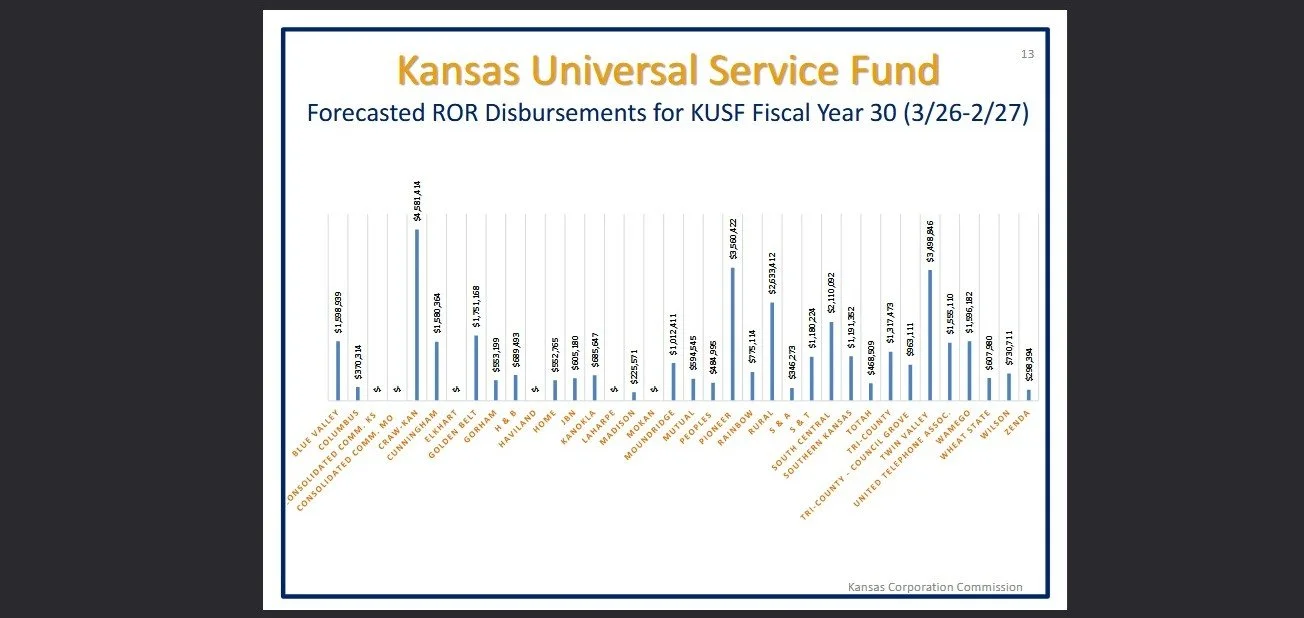
Garrett, KCC, presentation, Senate Committee on Government Efficiency (Jan. 22, 2026).
KCC Approves Settlement Agreement Allowing AT&T Kansas To Relinquish ETC Designation In 1,289 Census Blocks
January 22, 2026 – The Kansas Corporation Commission (KCC) has issued an order approving a settlement agreement between the KCC’s telecom staff and Southwestern Bell Telephone Company, LLC d/b/a AT&T Kansas, concerning AT&T Kansas’ request to relinquish its Eligible Telecommunications Carrier (ETC) designation in 1,289 Census Blocks (CBs). By approving the settlement agreement, the KCC has effectively brought an end to AT&T Kansas’ lengthy ETC relinquishment proceeding. The KCC Docket Number for the proceeding is 25-SWBT-364-MIS.
Under the terms of the settlement agreement, there are three different theories granting AT&T Kansas’ request for relinquishment of its ETC designation, and each theory applies to a different number of CBs. The first two grant ETC relinquishment for 1,152 of the 1,289 CBs. For the remaining 137 CBs, relinquishment is contingent upon confirmation that AT&T Kansas POTS service customers have switched to an AT&T Kansas replacement service, moved to a different service provider, or simply refused to end their POTS service. Each of the three different theories for granting AT&T Kansas’ request for relinquishment of its ETC designation are summarized below.
ETC relinquishment is granted in 65 CBs where the requirements for relinquishment in 47 U.S.C. § 214(e)(4), as interpreted by previous KCC orders, have been met. (The CBs in question are served by at least one other ETC, and all customers in those CBs that are currently served by AT&T Kansas will continue to be served by another ETC.)
ETC relinquishment is granted in 1,087 CBs where AT&T Kansas either has no serviceable locations or has serviceable locations but no Plain Old Telephone Service (POTS) customers.
For each of the remaining 137 CBs, ETC relinquishment is contingent upon AT&T Kansas’ existing POTS customers accepting one of the following: (1) switching to a substantially similar adequate replacement service offered by AT&T Kansas (VoIP with backup battery power); (2) transferring to a different telecommunications provider; or (3) refusing to migrate off of POTS service.

New Robocall Mitigation Database Filing Rules Now Effective; Robocall Recertification Filings Due March 1, 2026; Filing Window Opens February 1, 2026
January 22, 2026 – The FCC’s Wireline Competition Bureau has issued a Public Notice announcing the approval of and the effective dates for revised Robocall Mitigation Database (RMD) filing requirements and related rules adopted in the FCC’s 2025 Robocall Mitigation Database Report and Order. The revised RMD filing requirements and rules include the following: requiring prompt updates when a change to a provider’s information occurs; establishing a higher base forfeiture amount for providers submitting false or inaccurate information; creating a dedicated reporting portal for deficient filings; issuing substantive guidance and filer education; developing the use of a two-factor authentication log-in solution; and requiring providers to recertify their RMD filings annually.
Pursuant to the new RMD filing requirements and rules, RMD filers must recertify their RMD filings by March 1, 2026. The RMD filing window opens on February 1, 2026. The Bureau’s Public Notice includes a Robocall Mitigation Database Frequently Asked Questions For Filers which includes additional information for completing the RMD annual recertification. Additionally, the Bureau has updated the Robocall Mitigation Database External Filing Instructions, current as of January 2026, which are available online.
Velocity Fiber Requests Cancellation Of Certificates Of Authority To Provide Local Exchange And Interexchange Services In Kansas
January 22, 2026 – Velocity Fiber, LLC has filed an application with the Kansas Corporation Commission (KCC) requesting the cancellation of its Certificates of Convenience and Authority (COC) to provide local exchange and interexchange services in Kansas. In support of its application, Velocity Fiber states that it “does not have a customer base in the state of Kansas,” and “therefore, no customer notice is required.” Velocity Fiber further states that it “does not provide VoIP or Wireless services in the state of Kansas.” The KCC Docket Number for the proceeding is 26-VFLT-0208-CCS.
In November 2025, the company filed a “Letter of Notice of Discontinuance” for its CLEC and IXC services. Presumably, the KCC informed Velocity Fiber that the letters were insufficient, and that if it wanted to surrender its COCs, it must submit a pleading that adheres to the KCC’s requirements. On January 13, 2026, Velocity Fiber filed an application requesting the cancellation of its COCs to provide local exchange and interexchange services, signed by the company’s consultant. Thereafter, the company withdrew the application after being advised it was not submitted in compliance with K.A.R. 82-1-219(f), which requires that such filings be submitted by an officer of the company or by Kansas counsel. Velocity Fiber then filed the instant application which is signed by the company’s Chief Operating Officer.
Velocity Fiber is cancelling its COCs after having them for less than four years. The KCC granted Velocity Fiber a COC in April 2022 to provide competitive local exchange and exchange access services within the territories of Southwestern Bell Telephone Company d/b/a AT&T Kansas and United Telephone Companies of Kansas d/b/a CenturyLink in Kansas (Docket No. 22-VFLT-451-COC). Notably, Velocity Fiber was granted a CLEC COC even though it stated, in its application, that it did not intend to provide switched access services and its facilities would not require interconnection with incumbent local exchange carriers. In May 2022, the KCC granted Velocity Fiber a COC to provide interexchange telecommunications services in Kansas (Docket No. 22-VFLT-452-COC. In its CLEC and IXC applications, Velocity Fiber described its services as follows:
“Velocity Fiber constructs private fiber optic wide area networks (WANs) for businesses, K-12 school districts and other governmental entities. Applicant’s networks are constructed via a combination of aerial and underground fiber and the Applicant builds, owns and operates the networks and leases them back to the customer over a fixed term. Velocity Fiber will deploy dedicated dark fiber optic wide area networks (WANs) upon execution of customer contracts for these facilities and services.”
HHS Announces 2026 U.S. Federal Poverty Guidelines Used To Determine Financial Eligibility For Lifeline Program
January 15, 2026 – The U.S. Department of Health and Human Services (HHS) has issued the 2026 Federal poverty guidelines which are used to determine financial eligibility for certain programs, including the universal service Lifeline program. The 2026 Federal poverty guidelines have been published in the Federal Register with an effective date of January 13, 2026. A consumer can qualify for benefits from the Lifeline program if their household income is 135% or less than the federal poverty guidelines, or if they participate in a federal support program such as SNAP, Medicaid, or others. There are separate 2026 Federal poverty guidelines for the 48 contiguous states and the District of Columbia, Alaska, and Hawaii.

Kansas Broadband Acceleration Grant Program Fifth Round Awards – $6.7 Million Awarded To 5 Providers For 10 Broadband Deployment Projects In 8 Counties
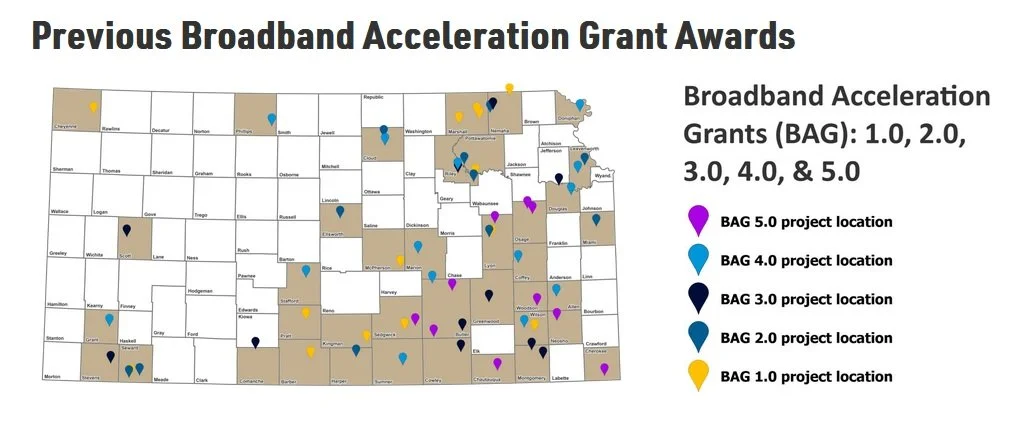
January 1, 2026 – Kansas Governor Laura Kelly has announced that a total of $6.7 million has been awarded to five broadband providers for 10 broadband deployment projects in eight rural Kansas counties through the latest round of the Broadband Acceleration Grant (BAG) program. A total of $6.7 million in matching funds have been pledged, bringing the total broadband investment for round five of the BAG program to $13.4 million.
Counting the latest round of awards, the BAG program’s total investment for broadband infrastructure in Kansas stands at nearly $70 million. BAG is a 10-year, $85 million program that was created to bring essential internet access to Kansas communities. It is administered by the Kansas Office of Broadband Development, and funded through the Kansas Department of Transportation’s Eisenhower Legacy Transportation Program (IKE).
The round five BAG awards were selected following an executive committee review process and public comment period. All of the awards are listed below:
Butler Rural Electric Cooperative Association, Inc., dba Velocity, Butler County –$268,850 to support 20 homes and businesses
Butler Rural Electric Cooperative Association, Inc., dba Velocity, Butler County –$74,813 to support 7 homes and businesses
Butler Rural Electric Cooperative Association, Inc., dba Velocity, Sedgwick County – $154,750 to support 15 homes and businesses
ITC Broadband Operating, LLC, Lyon County – $1,053,701 to support 93 homes and businesses
ITC Broadband Operating, LLC, Osage County – $1,167,891 to support 282 homes and businesses
ITC Broadband Operating, LLC, Osage County – $509,887 to support 72 homes and businesses
The Junction Internet, Cherokee County – $314,493 to support 119 homes and businesses
Twin Valley Communications, Inc., Chautauqua County – $249,372 to support 175 homes and businesses
3JL Holdings, LLC, Anderson County – $1,494,288 to support 161 homes and businesses
3JL Holdings, LLC, Woodson County – $1,382,686 to support 124 homes and businesses

Annual HUBB Broadband Deployment Filings Due March 2, 2026
January 1, 2026 – The Universal Service Administrative Company (USAC) has released an announcement reminding broadband providers that deployment data must be submitted to the High Cost Universal Broadband (HUBB) portal by March 2, 2026. Broadband providers that receive universal service support from Connect America Fund (CAF) programs with defined fixed broadband buildout obligations must file and certify their broadband deployment data with USAC’s HUBB portal showing where they built out mass-market, high-speed Internet service in calendar year 2025 or certify that they have no locations to upload. The HUBB portal is accessible through USAC’s E-File system. Additional information on submitting broadband deployment data to the HUBB is available online from USAC.
FCC Form 555 Lifeline Recertifications Due January 31, 2026
January 1, 2026 – All eligible telecommunications carriers (ETCs) must submit the results of their Lifeline recertification efforts using FCC Form 555 on or before January 31, 2026. The FCC Form 555 certification must be submitted annually by January 31 to the Universal Service Administrative Company (USAC), the Federal Communications Commission (FCC), and the Kansas Corporation Commission (KCC). The KCC has opened docket 26-GIMT-128-CPL for the filing of annual FCC Form 555 Lifeline recertifications.
New Kansas Corporation Commission Telecom Dockets Opened In January 2026
26-VFLT-0200-CCS – Application of Velocity Fiber, LLC to Surrender its Certificate of Convenience to Provide Local and Interexchange Telecommunication Services Within the State of Kansas (WITHDRAWN).
26-VFLT-0208-CCS – Application of Velocity Fiber to Surrender its Certificate of Convenience to Provide Local and Interexchange Telecommunications Services.

Certificate Of Convenience And Authority Tracker: 7 Applications Pending Before The Kansas Corporation Commission
January 1, 2026 – There are seven applications for Certificates of Convenience and Authority currently pending before the Kansas Corporation Commission (KCC). The applications were filed by a total for four communications providers. Four of the applications request authority to provide competitive local exchange services, and three applications request authority to provide interexchange telecommunications services.
Brightspeed Fiber Services LLC – CLEC – 26-BSFT-0182-COC – Brightspeed Fiber Services Certificate of Convenience and Authority to Provide Facilities Based Resold Local Exchange and Exchange Access Services within the State of Kansas. (CLEC application filed Jan. 2, 2026; KCC order assessing costs Jan. 13, 2026)
Brightspeed Fiber Services LLC – IXC – 26-BSFT-0183-COC – Application of Brightspeed Fiber Services LLC for Certificate of Convenience and Authority to Provide Facilities-Based and Resold Interexchange Telecommunications Services Within the State of Kansas. (IXC application filed Jan. 2, 2026; KCC order assessing costs Jan. 13, 2026)
GW Operating, LLC – CLEC – 26-V74T-0157-COC – Application of GW Operating, LLC for Certificate of Convenience and Authority to Provide Resold and Facilities-Based Local Exchange Services Within the State of Kansas. (CLEC application filed Nov. 25, 2025; KCC order assessing costs Dec. 9, 2025)
GW Operating, LLC – IXC – 26-V74T-0158-COC – Application of GW Operating, LLC for Certificate of Convenience and Authority to Provide Resold and Facilities-Based Interexchange Telecommunications Services Within the State of Kansas. (IXC application filed Nov. 25, 2025; KCC order assessing costs Dec. 9, 2025)
Fiber AssetCo LLC – CLEC – 26-FACT-022-COC – Application of Fiber AssetCo LLC for a Certificate of Authority to Provide Resold and Facilities-Based Local Exchange Telecommunications Services in the State of Kansas (CLEC). (CLEC application filed July 10, 2025; KCC order assessing costs July 17, 2025; Joint Motion for extension of statutory deadline (CLEC) filed Dec. 19, 2025; KCC order granting extension of time Dec. 30, 2025)
Fiber AssetCo LLC – IXC – 26-FACT-021-COC – Application of Fiber AssetCo LLC for a Certificate of Authority to Provide Resold and Facilities-Based Interexchange Telecommunications Services in the State of Kansas (IXC). (IXC application filed July 10, 2025; KCC order assessing costs July 17, 2025; Joint motion for extension of statutory deadline (IXC) filed Dec. 19, 2025; KCC order granting extension of time Dec. 30, 2025)
Zayo Network Services, LLC – CLEC – 26-ZNST-020-COC – Application of Zayo Network Services, LLC for a Certificate of Authority to Provide Resold and Facilities-Based Interexchange Telecommunications Services in the State of Kansas (CLEC). (CLEC application filed July 8, 2025; KCC order assessing costs July 18, 2025; Supplement to application filed Nov. 21, 2025; Joint Motion for extension of statutory deadline filed Dec. 1, 2025; KCC order granting extension of time Dec. 9, 2025)
ETC Tracker: 4 ETC Applications Currently Pending Before The Kansas Corporation Commission
January 1, 2026 – There are currently four eligible telecommunications carrier (ETC) applications pending before the Kansas Corporation Commission (KCC). Two applicants are requesting initial designations as Lifeline-only ETCs, one applicant is seeking relinquishment of its ETC designation, and one applicant is seeking an expansion of its ETC designated service area. The KCC dockets for all of the ETC applications, along with filing dates are listed below:
25-GOMT-124-ETC – Application of Go MD USA LLC For a Limited Designation as an Eligible Telecommunications Carrier for the Purpose of Offering and Operating a Lifeline Service for Low Income Consumers (Lifeline-Only ETC application filed August 9, 2024) (Revised Application filed June 20, 2025).
25-AVWZ-250-ETC – Application of Air Voice Wireless, LLC for Designation as an Eligible Telecommunications Carrier Under the Telecommunications Act of 1996 for Lifeline Purposes Only (Lifeline-Only ETC application filed December 23, 2024) (KCC Order Assessing Costs filed Dec. 31, 2024).
#25-SWBT-364-MIS – Petition of Southwestern Bell Telephone Company, LLC d/b/a AT&T Kansas for an Order Confirming Relinquishment of Eligible Telecommunications Carrier Designation in Specified Areas (application filed March 27, 2025; KCC Staff Report and Recommendation filed Oct. 27, 2025; AT&T Kansas Final Comments on KCC Staff R&R filed Nov. 21, 2025; Joint Motion for Approval of Settlement Agreement filed Jan. 20, 2026) (# likely to conclude in January 2026)
26-VMBZ-119-ETC – Application of Assurance Wireless USA, L.P. to Expand Its Eligible Telecommunications Carrier Designated Service Area (application filed October 21, 2025; KCC Order Assessing Costs filed Oct. 28, 2025; Supplemented Application filed Jan. 20, 2026).