News Update – Broadband & Telecom & FCC – July 2026
FCC Seeking Comment On Two Section 253 Petitions For Preemption Of Local Rules Preventing Broadband Providers From Accessing Public Rights-Of Way
July 8, 2026 – The FCC’s Wireline Competition Bureau is seeking public comment on two petitions for preemption and declaratory ruling filed pursuant to Section 253(d) of the Communications Act. Comments in response to either petition are due on or before August 24, 2026. Reply comments are due September 23, 2026. Section 253(a) of the Communications Act states that no state or local statute or regulation, or other state or local legal requirement, may prohibit or have the effect of prohibiting the ability of any entity to provide any interstate or intrastate telecommunications service. Section 253(d) states that if, after notice and an opportunity for public comment, the FCC determines that a state or local government has permitted or imposed any statute, regulation, or legal requirement that violates subsection (a) or (b), the FCC shall preempt the enforcement of such statute, regulation, or legal requirement to the extent necessary to correct such violation or inconsistency.
The first Section 253 petition was filed by Gateway Infrastructure, LLC d/b/a Gateway Fiber. The company is seeking a declaratory ruling preempting the City of Maple Grove, Minnesota, from imposing and requiring a cable communications system franchise agreement as a predicate to issue public right-of-way use permits. Gateway Fiber is not a cable operator, nor has it held itself out as one. It has a certificate of authority from the Minnesota Public Utilities Commission to provide regulated telecommunications services in Minnesota. Gateway Fiber explains that the City of Maple Grove is requiring the company to enter into a cable franchise agreement, and the city has said “it will defer action on permit applications until the franchising process has been completed.” Gateway Fiber argues that the City of Maple Grove’s “refusal to act on permits pending completion of a Cable Franchise is barred by Section 253(a) of the Act because it has the effect of (1) prohibiting Gateway from operating its network to provide telecommunications services; and (2) preventing Gateway from building out fiber in new geographic areas.
The second petition was filed by Lumos Fiber of Ohio, LLC. Lumos Fiber is seeking a declaratory ruling preempting Stark County, Ohio, and Mahoning County, Ohio, from enforcing certain right-of-way requirements that, acting both independently and in combination, have prohibited the company from providing telecommunications service in violation of Section 253(a). More specifically, Lumos Fiber requests that the FCC preempt: (1) per-foot construction charges, inspection fees, and a professional survey requirement imposed by Stark County, Ohio; and (2) a professional survey requirement imposed by Mahoning County, Ohio. Lumos Fiber says these local requirements have forced Lumos to cancel large-scale fiber expansions in both counties, and since the requirements fall far outside the safe harbors in Sections 253(b) and 253(c), they subject to mandatory preemption under Section 253(d).
FCC Announces Tentative Agenda For July 22nd Open Meeting
July 1, 2026 – Federal Communications Commission Chairman Brendan Carr has announced the following tentative agenda for the FCC’s next open meeting scheduled for Wednesday, July 22, 2026:
Upper C-Band Auction Rules – To maintain U.S. spectrum leadership, create a robust spectrum pipeline, and fulfill Congress’ direction in the One Big Beautiful Bill Act, the Commission will consider a Report and Order, Order of Proposed Modification, and Order on Reconsideration that makes 160 megahertz of the Upper C-band available in the contiguous United States for flexible-use, next-generation terrestrial wireless services via a system of competitive bidding. The introduction of new wireless services may begin in December 2030, following the first tranche of adjacent band radio altimeter retrofits to be required by FAA. Among other steps, the item also adopts measures designed to ensure successful co-existence with adjacent band radio altimeters, creates a transition process to fairly and expeditiously relocate incumbent satellite operations, establishes rebates to support the FAA’s radio altimeter retrofit requirements, and resolves various pending petitions for reconsideration related to the 2020 Report and Order and Order of Proposed Modification reconfiguring the Lower C-band. (GN Docket No. 25-59, 18-122)
Space Modernization for the 21st Century – The Commission will consider a Report and Order and Further Notice of Proposed Rulemaking that would overhaul the Commission’s rules for licensing space and earth stations to increase speed, predictability, and flexibility in order to support the American space economy. The Order would replace part 25 with a new rule part—part 100—that would create a “licensing assembly line” to process applications. The FNPRM would seek comment on and propose additional changes which build upon the new part 100. (SB Docket No. 25-306)
Improving the Effectiveness of the Robocall Mitigation Database – The Commission will consider a Further Notice of Proposed Rulemaking that aims to materially strengthen the integrity of the United States voice ecosystem and further deter illegal calls by proposing measures to ensure that only legitimate, transparent, and accountable providers gain or maintain access to the Robocall Mitigation Database. (WC Docket Nos. 24-213, 17-97; CG Docket No. 17-59)
Strengthening Rules Governing Dangerous Gear – The Commission will consider a Third Report and Order and Third Further Notice of Proposed Rulemaking aimed at further strengthening national security in the equipment authorization program by closing component-level and supply-chain loopholes in the Commission’s Covered List rules. The item would close the “component part loophole” by prohibiting authorization of devices that incorporate logic-bearing hardware components produced by Covered List entities; clarify that the marketing rules reach online marketplaces that list, distribute, or offer unauthorized equipment and require those marketplaces to display the FCC ID at the online point of sale; require full certification for any modification or permissive change made by a Covered List entity; and adopt a narrowed, statutorily-grounded definition of “critical infrastructure” in response to the D.C. Circuit’s partial remand. The accompanying Further Notice would seek comment on bifurcating the Covered List into producer/provider-based and production location-based categories, enhancing supply-chain transparency through hardware and software bills of materials, and strengthening enforcement. (ET Docket No. 21-232)
The FCC’s Wednesday July 22, 2026 open meeting is scheduled to commence at 10:30 a.m. ET in the Commission Meeting Room of the Federal Communications Commission, 45 L Street, N.E., Washington, D.C. The meeting is open to the public, but the FCC headquarters building is not open access, and all guests must check in with and be screened by FCC security at the main entrance on L Street. All FCC open meetings are streamed live at www.fcc.gov/live.
Mergers & Acquisitions: Verizon Buying Carolina West Wireless
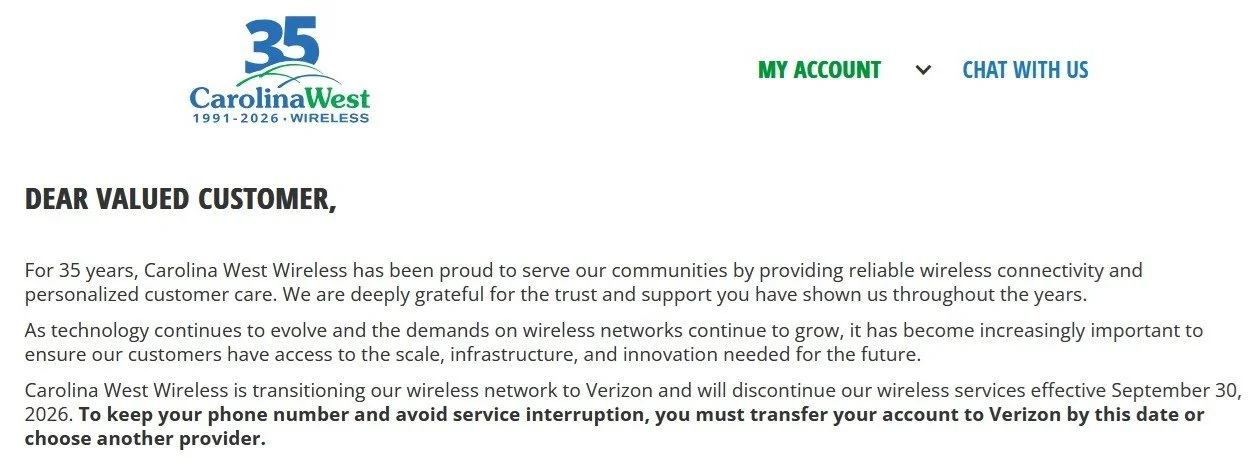
July 1, 2026 – Verizon has entered into an agreement to acquire regional mobile wireless service provider Carolina West Wireless. Carolina West Wireless was formed in 1991 and is headquartered in in Wilkesboro, North Carolina. It is owned by two telecommunications cooperatives, Skyline Telephone and Surry Telephone. In a notification to its customers, Carolina West Wireless stated it will discontinue its wireless services effective September 30, 2026. The company has had a close relationship with Verizon since 2011 when CWW joined Verizon Wireless’ LTE in Rural America program.
Mergers & Acquisitions: Fox Acquiring Roku
July 1, 2026 – Fox Corporation has announced that it has entered into an agreement to acquire Roku, Inc. Pursuant to the agreement, “Fox will acquire Roku for $160.00 per share in combination of cash and Fox Class A common stock, valuing Roku at approximately $22 billion in enterprise value.” The announcement contains the following additional details:
The transaction combines FOX’s leading sports, news and entertainment content and the Tubi service, with Roku’s leading connected TV platform, The Roku Channel, first-party data and direct relationship with more than 100 million global streaming households. Together, FOX and Roku will create a scaled next-generation media and technology company positioned at the intersection of two of the most important forces reshaping video consumption: the enduring primacy of live sports and news, and the continued rise of streaming.
FOX and Roku are committed to continuing to operate Roku as an open, partner-friendly platform and to the continued ubiquitous distribution of FOX content. On a pro forma basis, the combined company will become the third-largest player in U.S. television by share of viewing, with an attractive mix of FOX’s sports, news, and entertainment content, alongside streaming services Tubi and The Roku Channel. That distribution and engagement scale spans every major viewing environment – broadcast, cable, local and streaming – creating broad and diversified reach that benefits viewers, partners and advertisers.