
Kansas Broadband & Telecom News - December 2025
Brightspeed Fiber Services LLC Applies For CLEC & IXC Certificates Of Convenience And Authority – Will Provide Services Using Assets Acquired From Brightspeed Kansas ILEC Affiliates
December 31, 2025 – Brightspeed Fiber Services LLC has filed two applications with the Kansas Corporation Commission (KCC) requesting Certificates of Convenience and Authority (COC). Both COC applications are being filed “in connection with certain restructuring and financing arrangements through which [Brightspeed Fiber Services] will receive certain assets, including communications optical fiber, customer contracts, and associated telecommunications equipment, from its Kansas incumbent local exchange carrier (ILEC) affiliates Brightspeed of West Missouri, LLC, Brightspeed of Eastern Kansas, Inc., Brightspeed of Kansas, Inc., and Brightspeed of Southern Kansas, Inc.”
First, Brightspeed Fiber Services has applied for a COC to provide competitive facilities-based and resold local exchange and exchange access telecommunications services (CLEC) in Kansas. Specifically, Brightspeed Fiber Services is seeking CLEC authority “in the ILEC service territories of Southwestern Bell Telephone Company d/b/a AT&T Kansas and [its] Kansas ILEC affiliates…and all other services territories in the State that are currently open to competition.” The KCC Docket Number for the CLEC COC application proceeding is 26-BSFT-0182-COC.
In its CLEC application, Brightspeed Fiber Services states that it plans to provide fiber-based transport services, such as private line, Ethernet, and optical wavelength to enterprise and wholesale customers, as well as unregulated services such as broadband and VoIP. Brightspeed Fiber Services “will enter interconnection agreements with its Kansas affiliate ILECs as needed and obtain the [KCC’s] approval for such agreements prior to commencing operations.” Notably, Brightspeed Fiber Services also states that it “does not currently have any plans to provide switched voice local retail services or switched voice interexchange services to customers in Kansas.”
Second, Brightspeed Fiber Services has applied for a COC to provide facilities-based and resold interexchange telecommunications services (IXC) throughout the State of Kansas. Brightspeed Fiber Services is seeking IXC authority statewide. The KCC Docket Number for the IXC COC application proceeding is 26-BSFT-0183-COC.
Brightspeed Fiber Services does not currently provide telecommunications service in any state, and does not have any customers, but it is authorized or registered to provide competitive local exchange and interexchange services in Arkansas and Missouri. Pursuant to the restructuring and financing arrangement, Brightspeed Fiber Services “will acquire the fiber facilities of its Kansas ILEC affiliates and operate them to continue to provide high-quality services to Kansas customers in an efficient and cost-effective manner.” Brightspeed Fiber Services states that approvals of the CLEC COC and IXC COC applications will allow it to complete the aforementioned restructuring and financing arrangement, which “will better enable it to continue its fiber buildout throughout the State, including in rural and underserved communities.”
Wheat State Technologies Revises General Exchange Tariff To Remove Services That Are No Longer Provided
December 30, 2025 – Wheat State Telephone Company, Inc. d/b/a Wheat State Technologies has filed revisions to its General Exchange Tariff with the Kansas Corporation Commission (KCC). Wheat State’s tariff revisions remove services that the company no longer provides. In its filing, Wheat State explains that there are no customers subscribing to the services, and there is no revenue effect as a result of the tariff changes. The KCC Docket Number for the proceeding is 26-WHST-0179-TAR.
CBTS Technology Solutions LLC To Cancel Authorization To Provide Interexchange Services In Kansas
December 22, 2025 – CBTS Technology Solutions LLC (CBTS-TS) has requested that the Kansas Corporation Commission (KCC) cancel its Certificate of Public Convenience and Necessity, which authorized the company to provide interexchange services. CBTS-TS also has requested that the KCC cancel and withdraw any CBTS-TS tariff that is on file with the KCC. The KCC Docket Number for the proceeding is 26-BWTC-0176-CCS. In its filing, CBTS-TS has provided the following information in support of its request:
CBTS-TS no longer provides regulated telecommunications services in the state of Kansas. The public will not be harmed by the surrender (and cancellation by the Commission) of the Certificate held by CBTS-TS because the company no longer has customers receiving regulated telecommunications services. Further, the surrender is reasonable and necessary and not disruptive to the present or future public interest, convenience and necessity.
KCC Staff Recommends Setting Haviland’s KUSF Support At $968,175
December 19, 20205 – Telecom Staff of the Kansas Corporation Commission (KCC) have recommended setting Haviland Telephone Company, Inc.’s annual Kansas Universal Service Fund (KUSF) support amount at $968,175. Haviland filed its application in August 2025, requesting a total of $1,387,380 annually from the KUSF. It has not received KUSF support since late 2010. KCC Staff’s recommendation setting Haviland’s annual KUSF support amount can be found in the direct testimony of Katie L. Figgs, Utilities Division Kansas Corporation Commission:
Q. What is Staff’s proposed level of cost-based KUSF support after incorporating Staff’s adjustments to the Haviland’s filed position?
A. The total effect of Staff’s recommended adjustments results in an intrastate revenue increase in the amount of $968,175 and an equal increase to the Company’s current KUSF support. Therefore, Staff recommends the Commission set Haviland’s KUSF draw to $968,175.

Fiber AssetCo LLC Asks KCC For Additional Time For Review Of CLEC Application (Can Fiber AssetCo Prove It Will Actually Provide CLEC Services?)
December 19, 2025 – Fiber AssetCo LLC and the Kansas Corporation Commission (KCC) telecom Staff have filed a joint motion requesting an extension of the statutory deadline for the KCC to issue a decision on Fiber AssetCo’s Application for a Certificate of Convenience and Authority (COC) to provide facilities-based and resold local exchange and access telecommunications (CLEC) services in Kansas. They have requested that the deadline be extended 40 days from the current date of January 7, 2026, to February 17, 2026.
Pursuant to K.S.A. 66-131(b), the KCC is required to “issue a decision on a common carrier or public utility’s application for a certificate of public convenience and necessity within 180 days of receiving the application.” The statute, however, allows for an applicant and the KCC to agree to a waiver or an extension of the 180-day period.
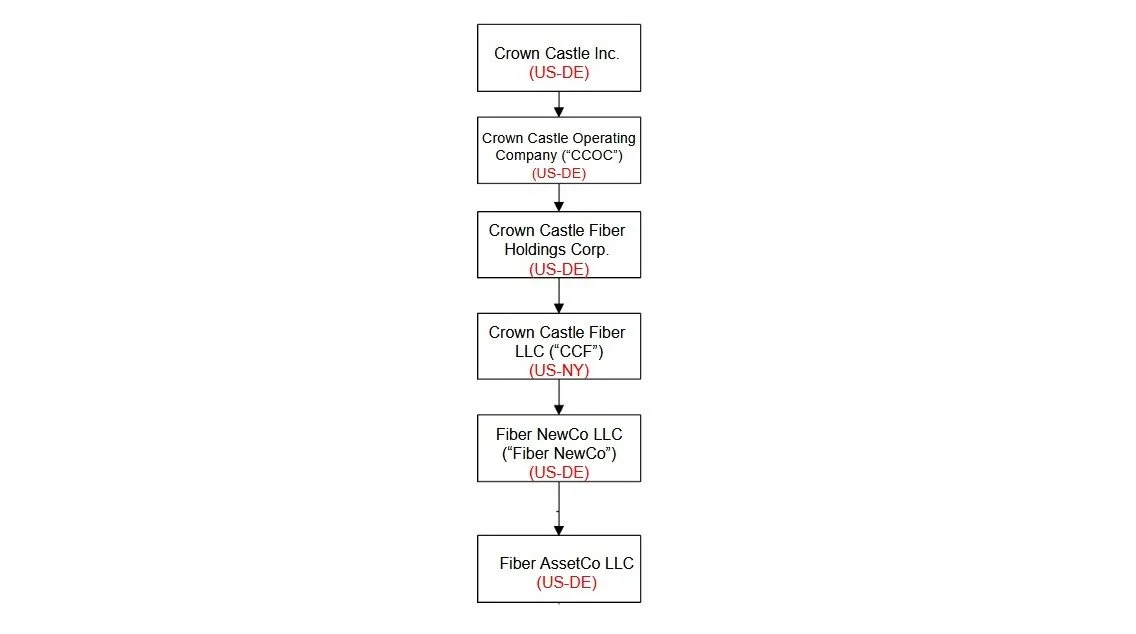
Fiber AssetCo filed its CLEC COC application in July 2025. It has requested CLEC authority in the service territories and exchanges of Southwestern Bell Telephone Company d/b/a AT&T Kansas, United Telephone Companies of Kansas d/b/a CenturyLink, and all other service territories that are currently open to competition. Fiber AssetCo is a newly formed company and is not currently authorized to provide intrastate telecommunications service in any state. Fiber AssetCo’s indirect parent is Crown Castle Fiber LLC, who plans to transfer certain fiber assets and customers to Fiber AssetCo as part of a larger related transaction.
On December 9, 2025, Fiber AssetCo and Staff met to discuss the company’s application. KCC telecom Staff submitted supplemental discovery requests to Fiber AssetCo on December 10, 2025. The extension, if granted, will provide Fiber AssetCo additional time to complete the ongoing discovery efforts.
Assumedly, the new discovery requests require Fiber AssetCo to explain that it will actually provide CLEC services. In its initial application, Fiber AssetCo stated that it “only seeks a Certificate to provide facilities-based and resold local exchange telecommunications services that do not require an interconnection agreement in the State of Kansas.” Fiber AssetCo further explained that it “does not intend to offer voice services at the present time and does not seek authority to do so.” In order for a telecommunications carrier to provide local exchange service and exchange access service, it must provide voice service and the means to interconnect. The KCC Docket Number for the proceeding is 26-FACT-022-COC
FCC Announces 2026 Reasonable Comparability Benchmarks For Fixed Voice And Broadband Services
December 19, 2025 – The FCC’s Wireline Competition Bureau and Office of Economics and Analytics have announced the 2026 reasonable comparability benchmarks for fixed voice and broadband services for eligible telecommunications carriers (ETCs) that are subject to broadband public interest obligations.
Basic Residential Voice Service Rate – $61.29. The 2026 urban average monthly rate is $33.99. Therefore, the reasonable comparability benchmark for voice services, two standard deviations above the urban average, is $61.29. Each ETC, including competitive ETCs providing fixed voice services, must certify in the FCC Form 481 filed no later than July 1, 2027, that the pricing of its basic residential voice services is no more than $61.29.
Broadband Rates. The reasonable comparability broadband benchmark varies, depending upon the supported service’s download and upload bandwidths and usage allowance. Recipients of high-cost or Connect America Fund support that are subject to broadband performance obligations are required to offer broadband service at rates that are at or below the relevant reasonable comparability benchmark. Carriers subject to the Alaska Plan and Alaska Communication Systems are required to meet Alaska-specific benchmarks. To facilitate benchmark calculations, the FCC will post an Excel file online containing a tool in which providers can enter the relevant variables to determine the benchmark for specific service characteristics.
Minimum Usage Allowance – 800 GB. For 2026, the minimum monthly usage allowance is 800 GB. The minimum usage allowance for carriers receiving support from the Rural Digital Opportunity Fund (RDOF) is either (i) the greater of 250 GB or the average usage calculated by the Bureau for the Minimum and Baseline tiers, or (ii) 2 Terabytes (TB) for the Above-Baseline and Gigabit tiers.
Congressional Universal Service Fund Working Group Asks FCC To Provide Staff-Level Briefing On USF Issues
December 17, 2025 – Members of the Senate’s Universal Service Fund Working Group have asked the Federal Communications Commission (FCC) to give them a briefing on universal service issues. Senators Deb Fischer (R-NE) and Ben Ray Luján (D-NM), and U.S. Representatives Richard Hudson (R-NC9) and Doris Matsui (D-CA7), made the request in a letter to the FCC. They want an FCC staff-level briefing that will “provide insight on the implementation of Congress’ universal service directives and help inform the Working Group’s leadership to modernize the Fund.” The Universal Service Fund Working Group have requested that the FCC have the appropriate personnel coordinate a convenient time for the briefing no later than January 30, 2026, and cover the following topics:
The most recent program outlays and cost projections across each USF program;
Assessment of the USF contribution factor and recent fluctuations;
Rulemakings or reforms of USF programs under consideration by the Commission; and
Any administrative challenges, program integrity concerns, or operational updates pertinent to congressional oversight of the Fund.

KCC Staff Recommends 12.67% Assessment Rate For KUSF FY 30
December 15, 2025 – Telecom Staff of the Kansas Corporation Commission (KCC) have recommended setting the Kansas Universal Service Fund (KUSF) assessment rate for the Thirtieth Fiscal Year at 12.67%. The KUSF’s Thirtieth Fiscal Year runs from March 1, 2026, through February 28, 2027. The recommended assessment rate was included in the direct testimony of Steve Garrett, KCC Deputy Chief of Telecommunications. The KCC Docket Number for the proceeding is 26-GIMT-095-GIT.
USF Contribution Factor Dips To 37.6% For First Quarter Of 2026
December 15, 2025 – The FCC’s Office of Managing Director (OMD) has announced that the proposed universal service fund (USF) contribution factor for the first quarter of 2026 will be 37.6 percent. If the FCC takes no action on the proposed USF contribution factor within 14 days, it will be declared approved.
The 37.6% contribution factor for 1Q 2026 is a slight decrease from 38.1% which was used for 4Q 2025 and which was an all-time high. Historical information on quarterly universal service fund contribution factors is available online from the FCC.
For the first quarter of 2026, the Universal Service Administrative Company (USAC) projects $7.604471 billion in total interstate and international end-user telecommunications revenues will be collected. USAC estimates that $2.060770 billion is needed to cover the total demand and expenses for all Federal universal service support mechanisms (revenue requirement) in the first quarter of 2026. Total first quarter 2026 demand includes projected program support, administrative expenses, and true-ups and adjustments, which breaks out among the USF support mechanisms as follows:
E-Rate Schools & Libraries: $648.93 million
Rural Health Care: $181.11 million
High-Cost: $1.00545 billion
Lifeline: $225.28 million
Executive Order Attempts To Prevent State Regulation Of Artificial Intelligence; States Must Eliminate “Onerous” AI Laws To Receive Any Remaining BEAD Funding
December 11, 2025 – President Trump has issued an Executive Order which is aimed preventing states from regulating artificial intelligence (AI). The EO announces that “it is the policy of the United States to sustain and enhance the United States’ global AI dominance through a minimally burdensome national policy framework for AI.” To implement this policy, the EO announces that “within 30 days of the date of this order, the Attorney General shall establish an AI Litigation Task Force (Task Force) whose sole responsibility shall be to challenge State AI laws inconsistent with the policy set forth in section 2 of this order, including on grounds that such laws unconstitutionally regulate interstate commerce, are preempted by existing Federal regulations, or are otherwise unlawful in the Attorney General’s judgment, including, if appropriate, those laws identified pursuant to section 4 of this order.” Among other things, the EO restricts states’ eligibility to receive any remaining BEAD program non-deployment funding on the condition that they pledge to eliminate “onerous” AI laws:
Sec. 5. Restrictions on State Funding. (a) Within 90 days of the date of this order, the Secretary of Commerce, through the Assistant Secretary of Commerce for Communications and Information, shall issue a Policy Notice specifying the conditions under which States may be eligible for remaining funding under the Broadband Equity Access and Deployment (BEAD) Program that was saved through my Administration’s “Benefit of the Bargain” reforms, consistent with 47 U.S.C. 1702(e)-(f). That Policy Notice must provide that States with onerous AI laws identified pursuant to section 4 of this order are ineligible for non-deployment funds, to the maximum extent allowed by Federal law. The Policy Notice must also describe how a fragmented State regulatory landscape for AI threatens to undermine BEAD-funded deployments, the growth of AI applications reliant on high-speed networks, and BEAD’s mission of delivering universal, high-speed connectivity.
Rainbow Telecommunications Association Revises Tariff To Account For No Longer Providing A Printed Directory To Customers
December 10, 2025 – Rainbow Telecommunications Association, Inc. has filed revisions to its General Exchange Tariff with the Kansas Corporation Commission (KCC). In its filing, “Rainbow is revising tariff language related to no longer providing a printed telephone directory and also removing services which are no longer provided.” The company notified its customers of its decision to no longer provide a printed telephone directory in October 2025. Rainbow’s filing also notes that the tariff revisions have no impact on revenue. The KCC Docket Number for the proceeding is 26-RNBT-0165-TAR.
NTIA Approves Kansas’ BEAD Program Final Proposal & Awards
December 8, 2025 – Kansas Governor Laura Kelly has announced that the National Telecommunications and Information Administration (NTIA) has approved the Kansas Office of Broadband Development’s (KOBD) $166.6 million final proposal for the Broadband Equity, Access and Deployment (BEAD) program.
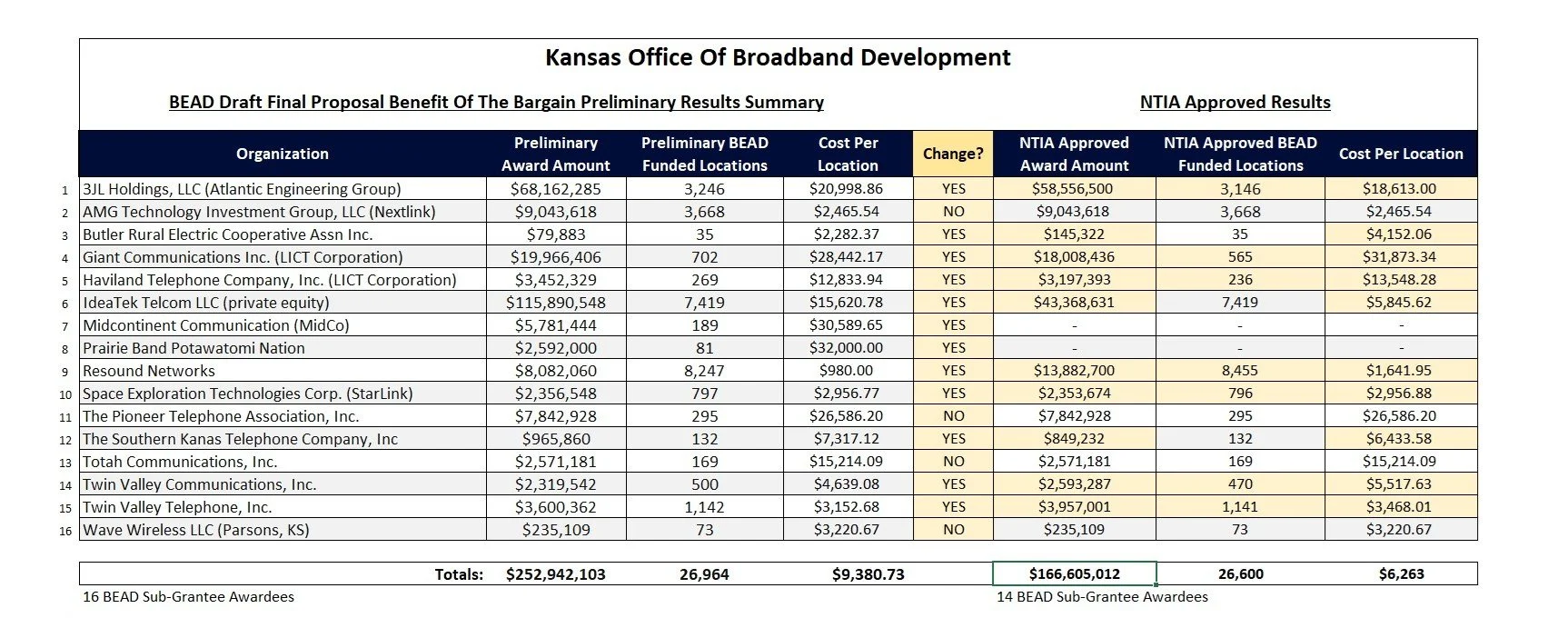
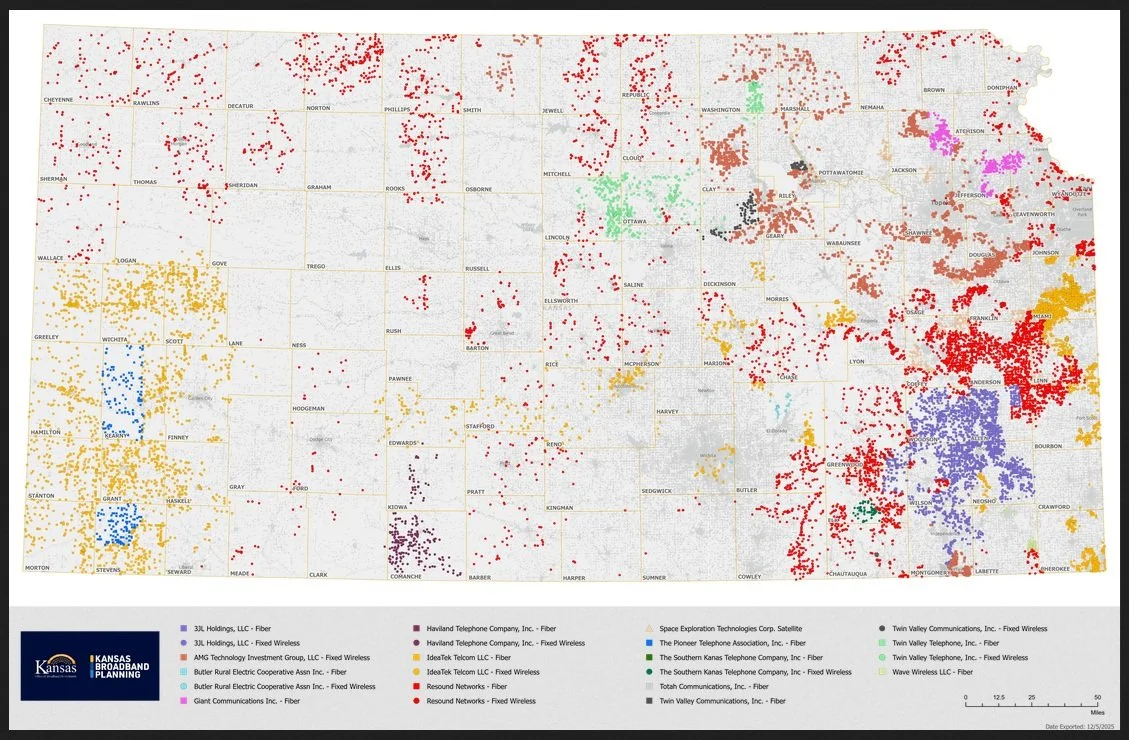
The final proposal approved by NTIA selects 14 awardees to receive a total of $166,605,012 in BEAD grant funding. (KOBD originally selected a total of 16 awardees to receive a total of $252,942,107 in BEAD grant funding.)
The $166,605,012 in total awarded BEAD funding represents a loss of 63% in federal funding for the state of Kansas due to the Benefit of the Bargain Round (Kansas was allocated $451 million).
Total BEAD funding broken down by type of technology is as follows: fiber – 30%; fixed wireless – 67%; and Low Earth Orbit (LEO) satellite service – 3%.
The awards are considered final by NTIA and will now move into the NIST approval process. Thereafter, KOBD will begin the next phase of its BEAD implementation, which includes finalization of BEAD subgrantee contracts, oversight of subgrantee compliance, and continued technical assistance. KOBD expects BEAD subgrantees will commence the groundbreaking of their funded projects during the second half of 2026. Additional specific changes from the original draft final proposal to what was approved by NTIA are shown below.
FCC Resolves Outstanding Enhanced A-CAM Support Recalculations Issues & Releases Updated Interim List Of Eligible Locations
December 8, 2025 – The FCC’s Wireline Competition Bureau (Bureau) has released an Order that resolves several outstanding issues relating to the Enhanced Alternative Connect America Cost Model (E-ACAM or Enhanced A-CAM) support program. Primarily, the Order explains how support recalculations will work for carriers whose total number of obligated locations has changed between the initial E-ACAM authorization and the current updated location list. Also, in the Order, the Bureau responds to several comments from interested parties proposing modifications to E-ACAM funding, and sets forth the timeline when the E-ACAM support recalculations will occur. In a concurrent Public Notice, the Bureau has released an updated interim list of locations that are eligible for E-ACAM support, along with a tentative list of support amounts for E-ACAM carriers which reflects the updated interim list of locations.
AT&T Kansas Files Discontinuance Application – Ending Legacy TDM-Based Voice Services In 89 Wire Centers In Kansas
December 5, 2025 – Southwestern Bell Telephone Company, LLC d/b/a AT&T Kansas has notified the Kansas Corporation Commission (KCC) of a Section 214 Discontinuance Application that was filed with the Federal Communications Commission (FCC). Specifically, AT&T Kansas’s parent company, AT&T Services, Inc., has filed a discontinuance application with the FCC on behalf of its affiliates to discontinue certain legacy TDM-based voice services in portions of certain wire centers located in 18 states.
AT&T Kansas and the other AT&T affiliates seek to discontinue, on or after November 15, 2026, AT&T Residential Local Service and AT&T Business Local Exchange Access Line Service – legacy POTS voice services – provided to a total of approximately 90,000 customers. The AT&T affiliates will offer “AT&T Phone – Advanced” and “AT&T Phone for Business – Advanced” as replacements for the residential and business POTS service that are being discontinued. Both are IP-based voice services which work over any kind of Internet connection, but their primary connectivity is over AT&T’s LTE wireless network.
AT&T states that in the affected service areas, mobile wireless service is widely available (from AT&T’s LTE network and from Verizon); customers have access to competitive voice offerings offered over cable, fiber, fixed wireless, and satellite technologies; and customers can purchase VoIP services that run on top of fixed-wireless or satellite broadband connections.
The wire centers in which AT&T Kansas is seeking a discontinuance are listed on Exhibit 1 to the FCC application and are shown below:
Sections of Kansas: Certain areas currently served by the following wire centers: Andale (ANDLKSHI), Attica (ATTCKSAA), Atwood (ATWDKSST), Belleville (BLVLKSMS), Beloit (BELTKS02), Bird City (BRCYKSRE), Blue Rapids (BLRPKSCA), Burns (BRNSKSPA), Canton (CNTNKSSM), Chase (CHASKSWE), Cheney (CHNYKSKI), Clay Center (CLCTKS06), Coffeyville (CFVLKS10), Cofvl-Dearing (CFVLKSDE), Colby (CLBYKS05), Coldwater (CDWRKSLU), Concordia (CNCRKSBR), Cottonwood (CTFLKSBR), Dodge City (DDCYKS01), Ellsworth (ELWOKSNO), Emporia (EMPRKS08), Eureka (EURKKSEL), Florence (FLRNKSTR), Fowler (FWLRKSMI), Frankfort (FRFTKSLO), Garden Plain (GRDPKSLE), Goodland (GDLDKSAB), Great Bend (GRTBKSST), Halstead (HLSTKSTE), Hanover (HNVRKSED), Harper (HRPRKSMA), Hartford (HRFRKSAA), Herndon (HRNDKS77), Hoxie (HOXIKSTR), JACKSON (ATTCKSCL), Jewell (JEWLKSHA), Kingman (KGMNKSMA), Lacrosse (LACRKSEL), Larned (LRNDKSBR), Liberal (LBRLKS04), Lincoln (LNCLKSLI), Lindsborg (LNBGKSLI), Lyons (LYNSKSEA), Mankato (MNKTKSCO), Marion (MARNKSLA), Marquette (MRQTKSKI), Marysville (MYVIKSEL), Mcpherson (MCSNKSAS), Meade (MEADKSSL), Medicine Lodge (MDLDKS01), Minneapolis (MPLSKS02), Minneola (MNNLKSTU), Mt Hope (MTHPKS04), New Goddard Co (WCHTKSGM), New Sedgwick (WCHTKSCZ), Newton (NWTNKS05), Nickerson (NCSNKSHA), Norcatur (NRCTKSDE), Oakley (OKLYKS03), Oberlin (OBRLKSHA), Ottawa (OTWAKSMA), Paola (PAOLKSPE), Pawnee Rock (PWRKKSYU), Peabody (PBDYKSWA), Phillipsburg (PHBGKS04), Pittsburg (PSBGKSLO), Plains (PLNSKSLO), Plainville (PLVLKSMI), Pratt (PRTTKSNI), Protection (PRTCKSMA), Sabetha (SBTHKSVI), Scandia (SCNDKSFE), Seneca (SENCKSDE), Severy (SVRYKSRE), Stafford (STFRKSBO), Stockton (SKTNKSAS), Sublette (SBLTKSOR), TOPEKA (TPKAKSWA), TOPEKA (TPKAKSRI), Topeka Auburn (TPKAKSAU), Topeka Dover (TPKAKSDO), Topeka Maple Hill (TPKAKSMH), Topeka North (TPKAKSNO), Topeka Richland (TPKAKSCA), Washington (WASHKS03), Wellington (WGTNKSNF), Wichita Colwich (WCHTKSCB), Wichita Whitewater (WCHTKSWW), Williamsburg (WLBGKSMA)
SCTelcom Revises Tariff – Will No Longer Provide A Printed Telephone Directory
December 3, 2025 – South Central Telephone Association, Inc. d/b/a SCTelcom has filed revisions to its General Exchange Tariff with the Kansas Corporation Commission (KCC). SCTelcom’s filing inserts the following revised language into its tariff to explain that it will no longer provide a printed telephone directory:
“The Company does not provide printed telephone directories. The Company will, however, provide upon customer request and without charge, a list of the telephone numbers applicable for the exchange area in which the customer resides. Such list may be obtained in person at Company offices or on the Company’s website. The Company will provide such telephone number lists in any format it deems essential and efficient for customer use.”
Additionally, the tariff filing removes services which are no longer provided by the company. SCTelcom’s states that the tariff changes will have no effect on revenue. The KCC Docket Number for the proceeding is 26-SCNT-0162-TAR.
Lawrence Kansas Considering Sale Of 25,707 Feet Of Empty Fiber Conduit To Google Fiber, Inc. For $10/Linear Foot
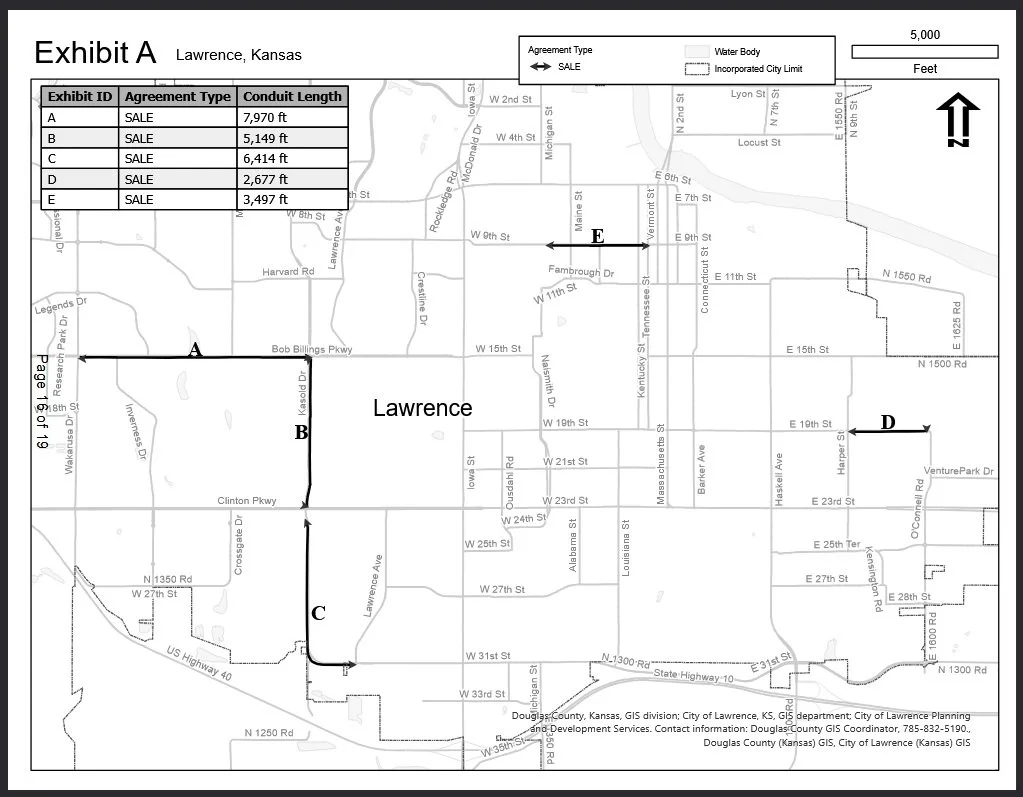
December 1, 2025 – The city of Lawrence, KS is considering entering into an agreement to sell Google Fiber, Inc. 25,707 feet of empty fiber conduit that is owned by the city. Lawrence is considering charging $10 per linear foot, which equates to a purchase price of $257,070. It’s unclear if any other entities occupy part of the conduit and the city is selling the available space, or if the conduit is empty and the city is selling the conduit to Google Fiber for its exclusive use. At its December 2, 2025 meeting, the Lawrence City Commission will consider authorizing the City Manager to execute a Conduit Purchase Agreement with Google Fiber Inc. to purchase the available empty City fiber conduit. The agenda item report for the meeting contains the following executive summary of the transaction:
“This agreement authorizes the City to sell surplus empty fiber conduit to Google Fiber Inc. for the use of Google Fiber’s citywide buildout. Over the years, the City has installed empty conduit through various projects and agreements along Bob Billings Parkway, Kasold Drive, 31st Street, 19th Street, and 9th Street. The City has existing active fiber in these corridors and does not anticipate needing this empty conduit for future expansion. Staff recommends selling the 25,707 feet of empty conduit at $10/linear foot, generating $257,070. The revenue generated could be reinvested into the City’s fiber infrastructure in areas where additional capacity or redundancy is needed to support critical City infrastructure such as traffic signals, traffic cameras, pump stations, fire/police stations, and other City facilities.”
Google Fiber Kansas, LCC, an operating subsidiary of the purchaser of the empty conduit, announced in August 2024 that it is bringing its broadband service to Lawrence, Kansas by the end of 2025. Google Fiber Kansas currently provides high-speed broadband throughout much of the Kansas City metro area. The announcement to deploy broadband service in Lawrence came after the Lawrence City Commission passed an ordinance granting Google Fiber a franchise with the city. Under that franchise agreement, Google Fiber Kansas will pay a franchise fee of 2% of quarterly gross revenues from broadband service for the ability to construct its fiber network in the city’s public rights-of-way.
New Kansas Corporation Commission Telecom Dockets Opened In December 2025
26-SCNT-0162-TAR – South Central Telephone Association's Filing Tariff Revision to Language Related to No Longer Providing a Printed Telephone Directory and Also Removing Services Which are No Longer Provided.
26-RNBT-0165-TAR – Rainbow Telecommunications Association’s General Exchange Tariff Revisions.
26-TMIV-0172-SHO – General Investigation of Tru Mobility, Inc. to Show Cause Why This Commission Should Not Levy Sanctions, Penalties, and Fines or Cancel, Suspend, or Revoke Any Authority the Carrier Hold for Non-Compliance with Kansas Statutes and Commission Orders.
26-BWTC-0176-CCS – CBTS Technology Solutions LLC Request to Cancel Certificate of Convenience.
26-WHST-0179-TAR – Wheat State Technologies’ General Exchange Tariff.
26-BSFT-0182-COC – Brightspeed Fiber Services Certificate of Convenience and Authority to Provide Facilities Based Resold Local Exchange and Exchange Access Services within the State of Kansas.
26-BSFT-0183-COC – Application of Brightspeed Fiber Services LLC for Certificate of Convenience and Authority to Provide Facilities-Based and Resold Interexchange Telecommunications Services Within the State of Kansas.