
News Update – Broadband & Telecom – January 2026
FCC Announces Tentative Agenda For February 18, 2026 Open Meeting
January 28, 2026 – Federal Communications Commission Chairman Brendan Carr has announced the following tentative agenda for the FCC’s open meeting scheduled for Wednesday, February 18, 2026:
Strengthening the Integrity of the Lifeline Program – The Commission will consider a Notice of Proposed Rulemaking seeking comment on reforms to the Lifeline program to ensure that federal dollars go to eligible Americans, enhance program integrity, ensure that service providers comply with the Commission’s rules and regulations, and streamline Lifeline rules. (WC Docket Nos. 11-42, 17-287, 09-197, 21-450, 20-445
Reforming Intercarrier Compensation – The Commission will consider a Notice of Proposed Rulemaking that would seek comment on proposed reforms to intercarrier compensation, interexchange services and CAF ICC support aimed at accelerating network deployment and modernization. (WC Docket Nos. 25-311, 25-208)
Maximizing the Potential of the 900 MHz Band – The Commission will consider a Report and Order that would enable broadband deployment on all ten megahertz of the 900 MHz band (896–901/935–940 MHz band), facilitating additional spectrum access by utilities, critical infrastructure, and other enterprises for private wireless broadband deployments that drive innovation and stimulate the American economy. (WT Docket No. 24-99)
Proposing Application Limit in Upcoming NCE Reserved Band FM Translator Filing Window – The Commission will consider a Public Notice to propose and seek comment on eligibility restrictions and a general limit of ten applications filed by any applicant entity in the upcoming 2026 filing window for new noncommercial educational reserved band FM translator stations. (MB Docket No. 26-20)
The FCC’s February 18, 2026 open meeting is scheduled to commence at 10:30 a.m. ET in the Commission Meeting Room of the Federal Communications Commission, 45 L Street, N.E., Washington, D.C. The meeting is open to the public, but the FCC headquarters building is not open access, and all guests must check in with and be screened by FCC security at the main entrance on L Street. All FCC open meetings are streamed live at www.fcc.gov/live.
FCC Chairman Announces NPRM Aimed At Safeguarding The Lifeline Program
January 27, 2026 – Federal Communications Commission (FCC) Chairman Brendan Carr has announced that during the FCC’s open meeting on February 18, 2026, the FCC will consider a Notice of Proposed Rulemaking (NPRM) to reform the universal service Lifeline program. If approved, the NPRM will seek public comment on proposed rules that are intended to help prevent fraud, waste, and abuse in the Lifeline program, including the following:
Propose that Lifeline is a federal public benefit restricted to U.S. citizens and qualified aliens under the Personal Responsibility and Work Opportunity Reconciliation Act of 1996.
Seek comment on enhanced requirements to ensure that program participants are legal beneficiaries of Lifeline discounts, predictable minimum service standards, ending the voice support phase-down, and preventing duplicative support.
Propose and seek comment on collecting the full nine-digit Social Security Number from applicants and using the Systematic Alien Verification for Entitlements program to support household eligibility verifications.
Propose and seek comment on requiring secondary verification of a consumer’s consent to enroll in Lifeline or transfer to a new eligible telecommunications carrier (ETC).
Seek comment on workable minimum data capacity and speeds for Lifeline supported broadband services and maintaining support for voice-only services.
Propose and seek comment on codifying the existing requirement that an ETC must search its own internal records to ensure that it does not already provide Lifeline-supported service to someone within the applicant’s household.
Seek comment on rule changes to improve program integrity and efficiency, including whether to continue to permit “opt-out” states to use their own verification processes and whether the Commission should reduce annual reporting burdens for ETCs.
Seek comment on changes to promote more principled ETC conduct, including changes to the requirements for non-facilities-based ETCs to participate in the Lifeline program and whether additional enforcement mechanisms are necessary to ensure that only ETCs directly providing Lifeline service receive Lifeline reimbursement.
Propose and seek comment on requiring usage tracking and non-usage de-enrollment for all Lifeline service plans regardless of whether a monthly fee is assessed and collected.
Propose and seek comment on streamlining the Lifeline rules, including deleting Emergency Broadband Benefit Program and Affordable Connectivity Program rules, and minimizing stakeholder confusion.
The upcoming Lifeline NPRM was made public in an FCC press release. Chairman Carr also announced the NPRM in a blog post about the full agenda for the FCC’s February 18th open meeting. Chairman Carr provided the following paragraph explaining the need for the Lifeline program NPRM:
First up, we will take another important step in our work to protect federal USF expenditures from waste, fraud, and abuse. The federal Lifeline program plays a critical role in helping eligible low‑income Americans stay connected. However, the FCC’s Office of Inspector General has found concerning patterns of fraud that merit the Commission’s attention. As a recent Inspector General Advisory shows, millions of Lifeline dollars have been flowing to accounts of deceased individuals. And the FCC itself recently took action to prevent California’s unlawful abuse of the federal Lifeline program. On top of this, the FCC has not updated its rules recently to ensure that federal dollars are only flowing to people that are both here legally and lawfully qualified to receive these federal benefits. So next month, the Commission will vote on proposals aimed at strengthening the integrity of the federal Lifeline program—ensuring USF dollars flow only to living and lawful beneficiaries. These changes are designed to ensure that the Lifeline program is efficient, transparent, and accountable—while continuing to support Americans who rely on it.

SpaceX Wants LEO Satellite Exemptions From Certain Requirements In BEAD Award Contracts
January 27, 2025 – SpaceX has sent a letter to state broadband agencies asking for the removal of certain provisions found in Broadband Equity Access and Deployment (BEAD) program subgrantee contracts. SpaceX’s wholly owned subsidiary Starlink, a Low-Earth Orbit (LEO) satellite broadband provider, was awarded BEAD funding in numerous states. Like other BEAD award winners, Starlink will be required to enter into a subgrant agreement with each state where it was awarded funding. However, SpaceX wants Starlink and other LEO satellite providers to be exempt from certain provisions found in those BEAD award contracts.
In its letter, SpaceX claims that a number of issues remain that, if unaddressed, could render LEO participation in the BEAD program untenable. SpaceX then lays out a set of terms that it intends to function as a contract rider to all subgrant agreements across the country. Key information from the letter and contract rider are summarized below.
Performance Obligations – SpaceX will include the capacity needs of BEAD users into its network planning efforts. These activities are multifaceted and include real time capacity allocation at the network level, launch activities, and sales efforts. As a result, there is no single “document” evidencing the reservation of capacity. Network performance testing shall exclude subscribers who have installed CPE such that its view of the sky is obstructed and subscribers with damaged or malfunctioning CPE.
Payments – SpaceX seeks to clarify that payment schedule releases 50% of the total grant funds upon the time SpaceX certifies it is capable of initiating BEAD-quality service, upon request, to any BSL in a project area within 10 business days. Thereafter, the state would pay SpaceX the remaining 50% of funds in equal quarterly installments over the 10-year period of performance.
Penalties – The Infrastructure Investment and Jobs Act (IIJA), and the BEAD Notice of Funding Opportunity (NOFO) authorizes certain penalties for subgrantee non-compliance: (1) the claw back of previously disbursed funds and (2) the mechanisms of suspension and debarment where appropriate. As such, SpaceX seeks to clarify these two remedies are the exclusive remedies available in the event of grantee default.
Reporting, Records and Audits – The realities of LEO deployment, involving globally utilized, space-based infrastructure simply do not support the structures around documentation of costs applicable to serving specific BSLs or project areas. For SpaceX, this issue is particularly acute given its substantial vertical integration, meaning that invoices from third parties for finished products (launch activities, satellites, CPE, ground network) simply do not exist because these are each manufactured by SpaceX itself.
Labor, Contractors and Procurement Issues – Just as there are no identifiable pieces of SpaceX infrastructure equipment (other than satellite capacity delivered from Space) being funded via BEAD to support BSLs in the state, there are no identifiable employees, contractors, or contracts being funded to support BSLs in the state. As such, all requirements related to labor issues (e.g., prevailing wage and similar obligations), contractors, and procurement are inapplicable to SpaceX.
Insurance – The various insurance requirements contained in subgrant agreements do not make sense for a LEO provider like SpaceX. SpaceX is not conducting any dangerous or material activities in state for which insurable risks might arise. As such, all insurance requirements should be removed from the agreement.
FCC Chairman Announces Intercarrier Compensation NPRM
January 27, 2026 – Federal Communications Commission (FCC) Chairman Brendan Carr has announced that during the FCC’s open meeting on February 18, 2026, the FCC will consider a Notice of Proposed Rulemaking (NPRM) on phasing-out the intercarrier compensation regime. Chairman Carr announced the intercarrier compensation NPRM in a blog post covering the full agenda for the FCC’s February 18th open meeting. Chairman Carr provided the following paragraph on the NPRM:
Finally, we are continuing our work on the transition to all-IP networks by voting on an NPRM that explores the best way to phase carriers out of the intercarrier compensation regime to a full bill-and-keep framework. Over the last year, we have been hard at work creating the right incentives for providers to update their networks to modern, high-speed ones. But it’s just as important that we eliminate some of the potentially perverse incentives embedded in our decades-old rules that keep Americans on old ones. This ICC NPRM aims to do just that, while also recognizing that the Commission must be thoughtful in its approach—mindful of the complex issues, transition timelines, and paramount connectivity goals.
According to the FCC, the NPRM is intended to accelerate the transition of the nation’s telecommunications networks to more efficient all-Internet Protocol (IP) networks by transitioning remaining access charges to bill-and-keep, detariffing those charges, and deregulating and detariffing end-user charges. The move from access charges to bill-and-keep began in 2011 with the release of the FCC’s USF/ICC Transformation Order. The FCC’s summary of the NPRM’s key proposals are included below:
Finalize the Transition of Intercarrier Access Charges to Bill-and-Keep: Propose capping the remaining intrastate originating switched access charges for rate-of-return and competitive local exchange carriers (LECs or carriers) and transitioning these, along with all remaining interstate originating and terminating switched access charges, to a bill-and-keep framework over a twenty-four month period and explore alternatives.
Implementation: Seek comment on how to define the network edge for allocating transport cost responsibilities between carriers, both during the transition and after full IP migration, and seek comment on whether the Commission should forbear from tariffing access charges after the transition to bill-and-keep.
Cost Recovery: To enable carriers to recover their costs directly from end users, seek comment on eliminating ex ante pricing regulation of end-user charges, detariffing them, phasing out CAF ICC support, and on the potential need for any additional funding that may be required to facilitate the IP transition.
Interexchange Marketplace Reforms: Propose and seek comment on deregulating and detariffing domestic interstate and international interexchange services and eliminating outdated reporting requirements.
Industry Input: Invite industry collaboration and input on the most effective and efficient strategies for thoughtfully transitioning carriers to a bill-and-keep framework and all-IP networks.

New Robocall Mitigation Database Filing Rules Now Effective; Robocall Recertification Filings Due March 1, 2026; Filing Window Opens February 1, 2026
January 22, 2026 – The FCC’s Wireline Competition Bureau has issued a Public Notice announcing the approval of and the effective dates for revised Robocall Mitigation Database (RMD) filing requirements and related rules adopted in the FCC’s 2025 Robocall Mitigation Database Report and Order. The revised RMD filing requirements and rules include the following: requiring prompt updates when a change to a provider’s information occurs; establishing a higher base forfeiture amount for providers submitting false or inaccurate information; creating a dedicated reporting portal for deficient filings; issuing substantive guidance and filer education; developing the use of a two-factor authentication log-in solution; and requiring providers to recertify their RMD filings annually.
Pursuant to the new RMD filing requirements and rules, RMD filers must recertify their RMD filings by March 1, 2026. The RMD filing window opens on February 1, 2026. The Bureau’s Public Notice includes a Robocall Mitigation Database Frequently Asked Questions For Filers which includes additional information for completing the RMD annual recertification. Additionally, the Bureau has updated the Robocall Mitigation Database External Filing Instructions, current as of January 2026, which are available online.
HHS Announces 2026 U.S. Federal Poverty Guidelines Used To Determine Financial Eligibility For Lifeline Program
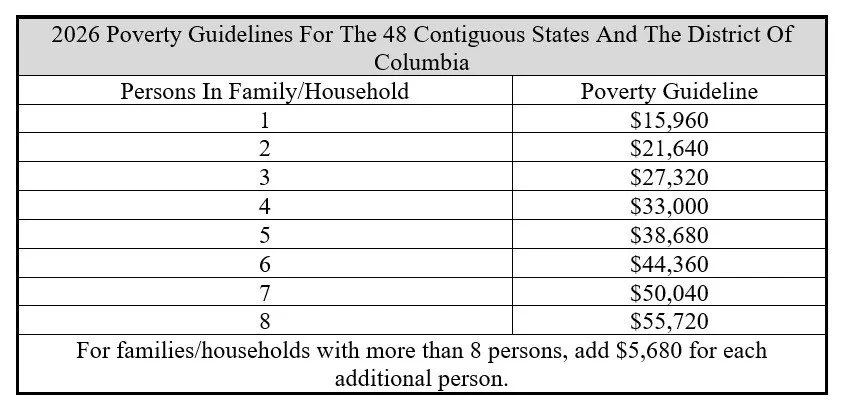
January 15, 2026 – The U.S. Department of Health and Human Services (HHS) has issued the 2026 Federal poverty guidelines which are used to determine financial eligibility for certain programs, including the universal service Lifeline program. The 2026 Federal poverty guidelines have been published in the Federal Register with an effective date of January 13, 2026. A consumer can qualify for benefits from the Lifeline program if their household income is 135% or less than the federal poverty guidelines, or if they participate in a federal support program such as SNAP, Medicaid, or others. There are separate 2026 Federal poverty guidelines for the 48 contiguous states and the District of Columbia, Alaska, and Hawaii.
FCC Announces Tentative Agenda For Open Meeting On January 29, 2026
January 8, 2026 – Federal Communications Commission Chairman Brendan Carr has announced the following tentative agenda for the FCC’s next open meeting scheduled for Thursday, January 29, 2026:
Expanding Unlicensed Operations in the 6 GHz Band – The Commission will consider a Fourth Report and Order that would permit a new class of unlicensed 6 GHz devices—geofenced variable power (GVP) unlicensed devices—that operate outdoors at higher power. The Commission will also consider a Third Further Notice of Proposed Rulemaking that would allow for increased power for certain 6 GHz operations controlled by automated frequency coordination systems and extend low-power indoor operations to cruise ships. (ET Docket No. 18-295)
Establishing Transparency in Foreign Adversary Control – The Commission will consider a Report and Order that would adopt new attestation and disclosure requirements for holders of Commission-granted licenses, leases, authorizations, permits, grants and other approvals, that would enhance public transparency over Foreign Adversary Control over U.S. communications networks operators. (GN Docket No. 25-166)
Promoting Clarity By Codifying and Simplifying Foreign Ownership Rules – The Commission will consider a Report and Order that would adopt clarifications to the Commission’s foreign ownership rules and practices for foreign investment in common carrier wireless and aeronautical radio, and broadcast licensees to reduce unnecessary burdens on industry while continuing to protect the public interest, including national security, law enforcement, foreign policy, and trade policy. (GN Docket No. 25-149)
Modernizing Internet-based Telecommunications Relay Services – The Commission will consider a Notice of Proposed Rulemaking that would seek comment on enhancements for Internet Protocol (IP) Relay and Video Relay Services (VRS), administrative reforms to streamline the TRS program, updating or eliminating obsolete rules, and closing outdated dockets. (CG Docket Nos. 03-123, 10-51, 12-38)
The FCC’s January 29, 2026open meeting is scheduled to commence at 10:30 a.m. ET in the Commission Meeting Room of the Federal Communications Commission, 45 L Street, N.E., Washington, D.C. The meeting is open to the public, but the FCC headquarters building is not open access, and all guests must check in with and be screened by FCC security at the main entrance on L Street. All FCC open meetings are streamed live at www.fcc.gov/live.
House Subcommittee On Communications And Technology To Hold FCC Oversight Hearing On January 14, 2026
January 7, 2026 – The House Subcommittee on Communications and Technology has announced that it will hold a Federal Communications Commission oversight hearing on Wednesday, January 14, 2026. The announcement was made by Congressman Brett Guthrie (R-KY-02), Chairman of the House Committee on Energy and Commerce, and Congressman Richard Hudson (R-NC-09), Chairman of the Subcommittee on Communications and Technology. All three members of the FCC are set to testify. The hearing is scheduled to begin at 10:15 am ET. It will be open to the public and press, and will be streamed live online at the House Energy and Commerce Committee’s website – energycommerce.house.gov.
FCC Extends Effective Date Of Robotext Consent Revocation Rule Until January 31, 2027
January 6, 2026 – The FCC’s Consumer and Governmental Affairs Bureau has extended the effective date of section 64.1200(a)(10) of the FCC’s Telephone Consumer Protection Act rules. The rule requires callers to treat a request to revoke consent made by a called party in response to one type of informational message as applicable to all future robocalls and robotexts from that caller on unrelated matters. The effective date for the rule has been extended until January 31, 2027. Extending the effective date will give the FCC sufficient time to review the record compiled in response to a recent related Further Notice of Proposed Rulemaking, and prevent potentially unnecessary compliance costs on affected parties.
Gigapower, LLC Section 253 Petition Seeks Preemption Of Rock Hill, South Carolina Pole Attachment Exclusivity Requirements
January 5, 2025 – The FCC’s Wireline Competition Bureau is seeking public comment on a Section 253 petition for preemption and declaratory ruling filed by Gigapower, LLC. Comments on the Section 253 petition are due on or before February 4, 2026. Reply comments are due March 6, 2026. In its petition, Gigapower requests that the FCC issue a declaratory ruling preempting the City of Rock Hill, South Carolina (City) from implementing local requirements that effectively prohibit Gigapower from attaching to approximately 1,692 City-owned poles. Gigapower states that the City has granted an existing telecommunications service provider, Comporium, Inc., a superior and exclusive right to attach to all available space on all City-owned poles pursuant to a 1992 joint use agreement. Gigapower further states that the City is requiring Gigapower to rearrange attachments to City-owned poles or to replace poles to obtain access, despite the existence of adequate available space on the poles, and that these requirements will result in excess costs that prevent Gigapower from economically deploying its facilities and, thus, effectively prohibit Gigapower from providing telecommunications services in the City. Gigapower argues the City’s requirements and actions constitute an unlawful barrier to entry in violation of Section 253(a) of the Communications Act. Consequently, Gigapower asserts that Section 253(d) requires the FCC to preempt the City’s unlawful actions that effectively prohibit Gigapower from providing telecommunications services.

Annual HUBB Broadband Deployment Filings Due March 2, 2026
January 1, 2026 – The Universal Service Administrative Company (USAC) has released an announcement reminding broadband providers that deployment data must be submitted to the High Cost Universal Broadband (HUBB) portal by March 2, 2026. Broadband providers that receive universal service support from Connect America Fund (CAF) programs with defined fixed broadband buildout obligations must file and certify their broadband deployment data with USAC’s HUBB portal showing where they built out mass-market, high-speed Internet service in calendar year 2025 or certify that they have no locations to upload. The HUBB portal is accessible through USAC’s E-File system. Additional information on submitting broadband deployment data to the HUBB is available online from USAC.